All species › Even-toed ungulates › Deer › Sika deer
Sika deer | Cervus nippon
Sikahert | Cervus nippon
The sika deer (Cervus nippon) is a medium-sized deer from East Asia, closely related to the red deer. From 1860 it has been released or has escaped from parks in Ireland, Great Britain and at many places in central and western Europe. In the guide area it occurs only as an introduced species; where it lives alongside the red deer, the two species interbreed.

Tracks
The slot resembles that of the red deer but is smaller. The droppings are black and shiny, smaller than those of the red deer. In the rut stags score tree trunks with their antler tines, leaving deep vertical grooves in the bark; they also fray young trees, dig rutting scrapes and wallow in mud. Sound is the clearest sign: in the rut a series of high, whistling screams, usually three or four in a row, audible from far away. The sika makes more than ten different sounds, from soft whistles to loud screams.
Identification
A medium-sized deer with a head-body length of 95 to 180 cm, a shoulder height of 50 to 110 cm, a tail of 7.5 to 13 cm and a weight of 30 to 160 kg; the Japanese animals introduced to Europe fall in the lower part of those ranges, with hinds of 30 to 40 kg and stags of 40 to 70 kg. The summer coat is chestnut with white spots, which adults keep; the winter coat is dark grey-brown with faint or no spots, and stags then grow a mane. The rump patch is white with a black border and is flared when alarmed; the short tail is white. The hind leg has a pale gland above the hock. Pale eyebrow marks give the face a frowning expression. The antlers stand upright and usually have no more than eight points.
Similar species
The red deer is larger, reddish-brown without spots, with a yellowish to pale brown rump patch and, in old stags, antlers with more points. The fallow deer is also spotted but has a longer black tail above a white rump patch with a horseshoe-shaped black border, and palmate antlers in the buck. Hybrids of sika and red deer are often impossible to recognise in the field and show features of both species. The roe deer is smaller and has no visible tail.
Habitat
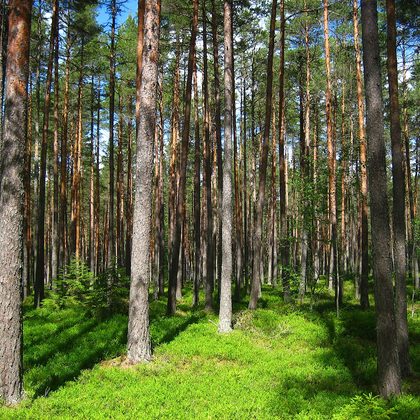
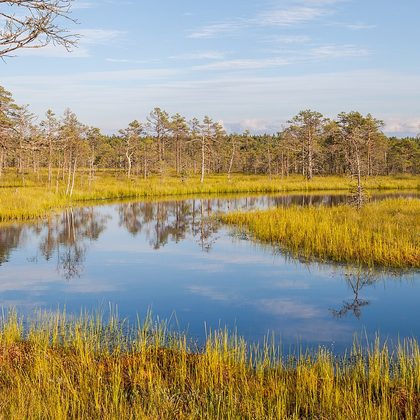
Conifer plantations and mixed woodland with dense undergrowth, broadleaved woodland, and adjoining heath, bog and clearings. In Ireland and Scotland the sika lives mainly in young conifer plantations, on heath and in peatland.
Where the animal is most at home, classified with EUNIS — the European standard for habitats.



Distribution
The natural range covers Japan, eastern China, Taiwan, Vietnam, Korea and the Russian Far East. In Ireland the sika was brought to the park at Powerscourt (Wicklow) in 1860; after escapes there are now up to 50,000 animals. In Great Britain the species is widespread above all in Scotland and in England lives in Dorset and the New Forest, among other places, where a pair from the Beaulieu park was released in the early twentieth century. On the European mainland the sika has been introduced over the past 150 years to Germany, Austria, Poland, the Czech Republic, France, Switzerland, Denmark and Hungary, among others; the Czech Republic holds one of the largest free-living populations on the continent.
- Established introduction
- dark = core range, pale = thinly spread
Way of life
The sika is active mainly at dusk and at night. It eats grass, herbs, heather and the leaves, twigs and bark of broadleaved and coniferous trees. Outside the rut hinds with calves live in small groups and stags apart. The rut falls mainly from early September to November and can continue into winter. Gestation lasts about seven months; a single calf of 4.5 to 7 kg is born and suckles for up to ten months. Sika are sexually mature at sixteen to eighteen months.
Where and when to look
In October listen at dusk for the whistling rutting call. In Ireland the Wicklow Mountains around Glendalough, and in England the Arne nature reserve in Dorset, are suitable; there sika graze on the heath and in clearings among the pines at sunrise and sunset. In winter, when the spots fade, the white rump patch with its black border and the pale gland on the hind leg are the best features.
Conservation status
Least Concern (LC, 2015), for the species as a whole; some Asian subspecies are threatened. In Europe the sika is an introduced species. The main concern is hybridisation with the red deer: in Scotland this is regarded as a serious threat to the genetic integrity of the red deer, and on the mainland mixing of the two species has also been shown in many areas. A general management strategy for the mainland is lacking, while the number of free-living sika is increasing. The species also causes browsing and bark-stripping damage in forestry.
Scientific name
Cervus nippon | Temminck, 1836
Temminck described the species in 1836 and placed it straight away in the genus where it still stands. Cervus is the Latin word for 'deer, stag'. nippon is Nihon or Nippon, the Japanese name of Japan; it stands as an indeclinable noun in apposition to the genus name. The specimen the first description was based on came from Japan.