All species › Rodents › Squirrels and marmots › Speckled Ground Squirrel
Speckled Ground Squirrel | Spermophilus suslicus
Gevlekte soeslik | Ardilla Terrestre Moteada
The Speckled Ground Squirrel (Spermophilus suslicus) is a ground squirrel with distinct white spots over the whole back. Since the western populations were split off as a separate species (S. odessanus) in 2024, this species comprises the steppe east of the Dnieper. Since 2023 it has been listed on the Red List as Critically Endangered, after the loss of most of the population in thirty years.
Tracks
The main sign is the colony. Burrow entrances of 5 to 8 cm, round to slightly oval and entering the ground obliquely, lie by the dozen in one field; in front of each fresh burrow is a fan of excavated subsoil that stands out pale on the black earth of the Ukrainian and south Russian steppe. A colony can therefore be recognised from a distance as a field with dozens of pale patches. Around the entrances the grass is shorter and differently coloured than outside, and narrow worn paths run between the burrows from hole to feeding site. In winter the burrows are plugged with soil from within and are not visible; in March they are open, with fresh soil around them. Droppings are small, dark and elongated and lie scattered, not in a latrine. On field margins lie bitten-off ears of grain that have been dragged towards the burrows. The clearest sign is the short, sharp alarm whistle repeated across the whole colony, after which the animals stay underground for some time.
Identification
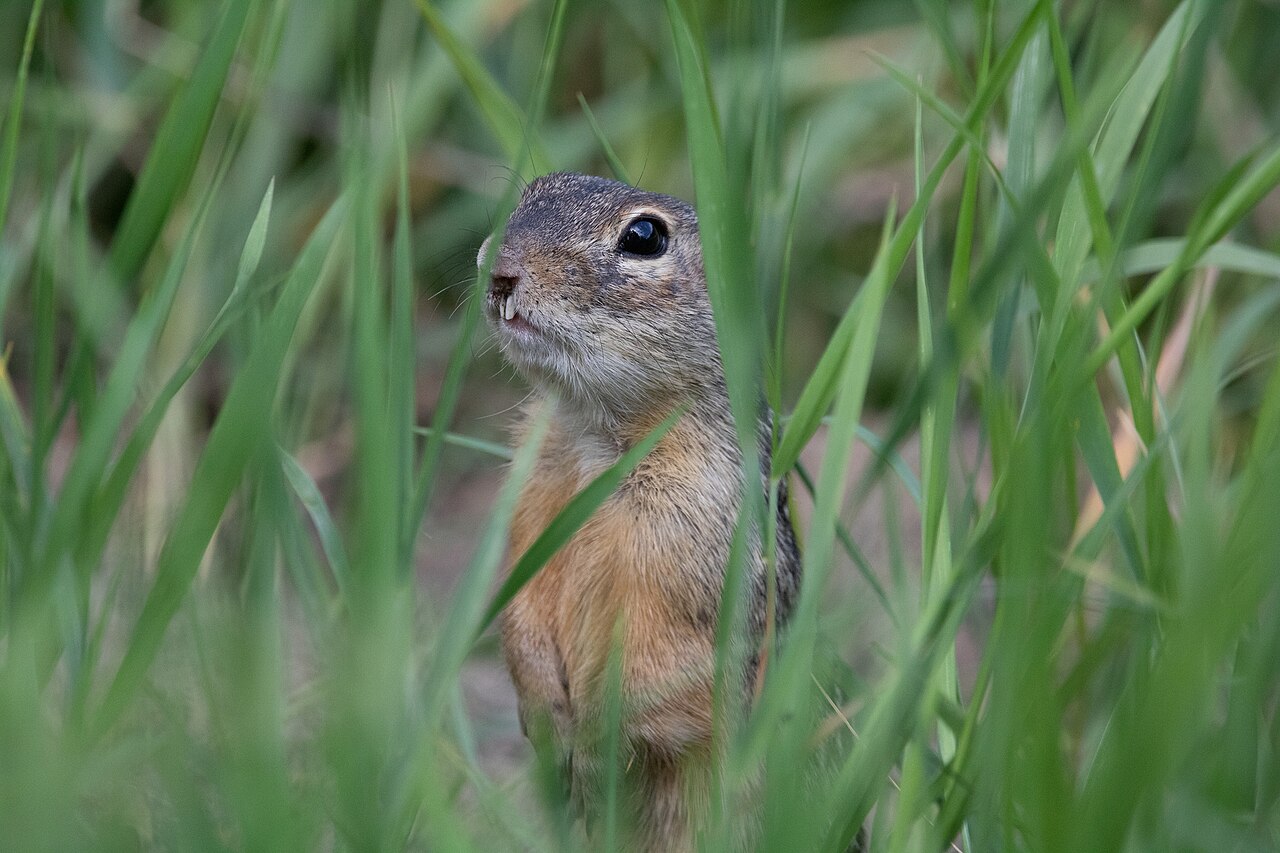
Head-body 19 to 22 cm, tail 3.6 to 5.7 cm, weight 180 to 220 g: a small, thickset ground squirrel with a tail of at most about a quarter of the head-body length. On the greyish-brown to dark chestnut back are sharply defined cream to pure white spots of 2 to 5 mm, evenly distributed from nape to rump. The head is warmer brown, with a distinct pale eye-ring and a chestnut cheek patch below the eye; chin and throat are white, the belly yellowish white. The ears are small and rounded, the tail short and thin with a dark tip. Like all sousliks it sits upright at the burrow entrance, neck stretched and fore paws against the chest. The spots are clearest in summer coat; during the moult in mid-summer they become blurred.
Similar species
There is one species with which the Speckled Ground Squirrel can be confused in the field, and it cannot be distinguished from it: Spermophilus odessanus, the western sister species, with the same white spots and the same measurements. The boundary is the Dnieper: east of it, in eastern Ukraine and European Russia as far as the Volga, every spotted animal is this species; west of it, the animal is S. odessanus. The difference lies in the chromosome number (34 against 36), not in the coat. Other ground squirrels are easily distinguished. The European Souslik, whose range in the nineteenth century reached close to that of this species, has no true spots but a blurred black mottling, and today lives west of the Dnieper. In the drier steppe south and east of the range lives S. musicus, plain sandy without spots, and beyond the Volga the Little Ground Squirrel. It nowhere occurs together with the Turkish and Caucasian mountain species. Outside the genus: the Bobak Marmot lives in the same steppe but weighs five kilograms, the Common Hamster is nocturnal and has a black belly, and the Siberian Chipmunk has stripes instead of spots.
Habitat
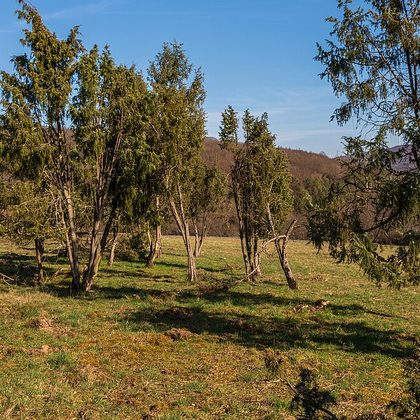
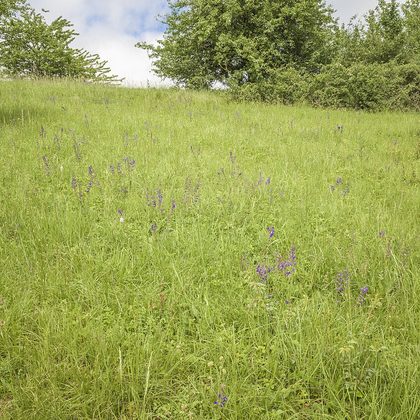
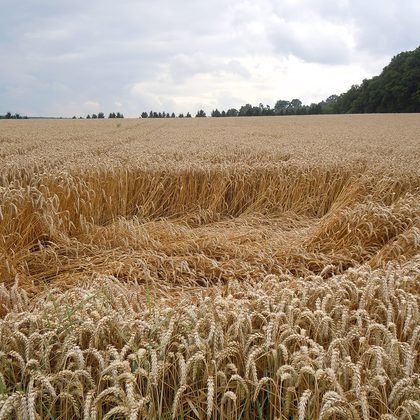
Short-grazed dry steppe, steppe pasture and open patches in forest-steppe, on chernozem and loess. In the farmed landscape: grazed slopes, dykes, road and railway embankments, field margins, fallow land and old cemeteries. The requirements are the same as for other sousliks: deep, dry, well-drained soil and low vegetation. Where grazing stops, the grass grows dense and the colony disappears within a few years. From sea level to about 500 m; wet hollows, heavy clay and ground that floods in spring are avoided.
Where the animal is most at home, classified with EUNIS — the European standard for habitats.

Distribution
Since the split of S. odessanus the range comprises Ukraine east of the Dnieper and European Russia, from the forest-steppe near Kursk and Voronezh, where Güldenstädt collected the type in 1770, south across the Don and east to the Volga. In the nineteenth century this area consisted of continuous steppe; it is now almost entirely arable land, and the species lives in the remaining steppe fragments. The species does not occur in western or central Europe. Where the literature mentions the Speckled Ground Squirrel for Belarus and Poland, the animal concerned is S. odessanus.
- Native
- dark = core range, pale = thinly spread
Way of life
Diurnal, with a peak in the morning and in the late afternoon. The species is colonial but not social: the animals live close together, but each adult has its own burrow system and a small territory of its own, and the species is less group-oriented than most ground squirrels. Food consists of grasses, herbs, seeds, bulbs and tubers, in summer also cereal grain from adjacent fields, as well as grasshoppers and beetles and exceptionally a young mouse or a clutch of eggs. Hibernation lasts from August or September to February or March, half a year or more, so that the period above ground covers less than five months. The burrow is plugged from within. Mating takes place shortly after emergence; after a gestation of about 27 days an average of six young are born, which come above ground after a month and are almost full-grown in their first summer. They breed after one hibernation. Predators are fox, polecat, steppe polecat, stoat and large falcons and eagles of the steppe; in the wild the species seldom lives beyond three years.
Where and when to look
Search from late March to mid-June, in the morning, on a grazed slope or an old steppe bank in eastern Ukraine or southern Russia. The chance of a sighting is small and colonies are hard to find: first search satellite images or scan with binoculars for fields with dozens of pale patches, then walk them. Sit down and wait at least ten minutes after the first alarm whistle. For photographs of the spot pattern May is the best month, before the moult blurs the spots. The sister species S. odessanus in south-eastern Poland is easier to observe and looks the same.
Conservation status
Critically Endangered (CR, 2023). The IUCN describes a decline of ninety per cent or more in thirty years, for a steppe rodent long regarded as common. The causes are the same as for other sousliks but occurred here simultaneously: ploughing of the last steppe fields, the collapse of extensive livestock farming after 1991, which allowed the grass to grow tall, chemical control in the Soviet period, which greatly reduced the dense populations, and drought. What remains are small, isolated colonies no longer connected to one another, because young animals rarely move more than a few hundred metres. Because of the war in Ukraine, counts and management are not possible in much of the range. Recovery requires, as with the European Souslik, grazing of the remaining fields; under present circumstances this measure is particularly difficult to implement here.
Scientific name
Spermophilus suslicus | (von Güldenstädt, 1770)
Von Güldenstädt described the species in 1770 as Mus suslica; because it was later moved to another genus, the author and year stand in brackets. Spermophilus is Greek, from sperma, 'seed', and philos, 'loving': the seed-lover, after the food the animal carries to its burrow in its cheek pouches. suslicus is the Russian suslik, 'ground squirrel', the country name Güldenstädt noted down on the steppe. The specimen the first description was based on came from Russia, Voronezh.