All species › Rodents › Mice and rats › Tristram's Jird
Tristram's Jird | Meriones tristrami
Turkse zandmuis | Meriones tristrami
Tristram's Jird (Meriones tristrami) is the northernmost jird of the guide area; its range extends from Anatolia to the Caucasus and the Jordan valley. The species is not a desert animal: its range ends where rainfall drops below a hundred millimetres a year. It lives in dry steppe, cereal land and at village edges. In Turkey it is the commonest rodent of the open plateau.
Tracks
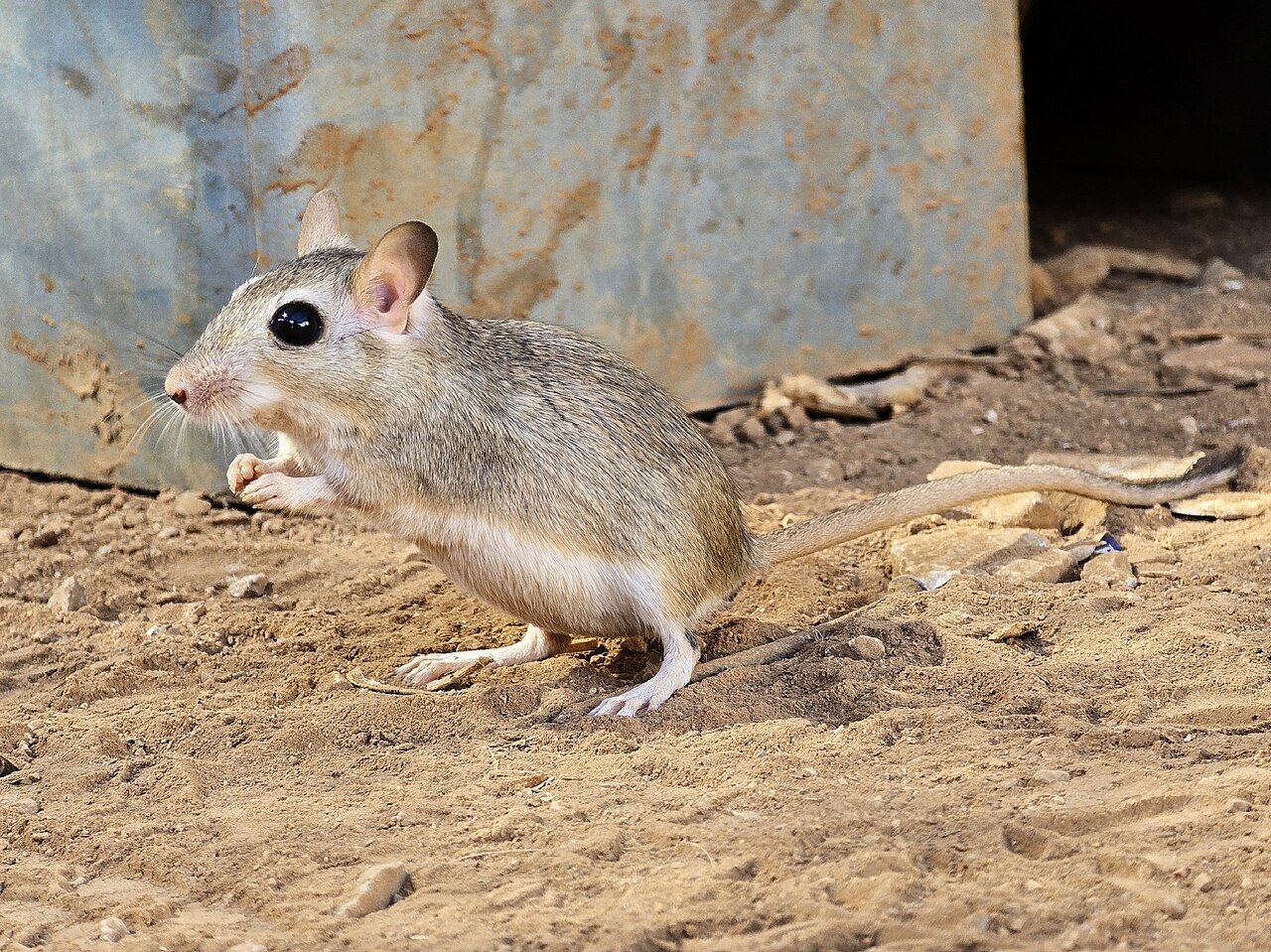
The burrow is the main sign, and it changes with the season, which is unusual in a jird. In Turkey the winter burrows are shallow, with one or two entrances and a widened nest chamber thirty to forty centimetres deep, whereas the summer burrows have four or five entrances and reach seventy centimetres deep. Entrances lie preferably in the flank of a hillock or field bank, where the soil is soft and free-draining; rocky ground is avoided. Fresh heaps of earth lie in front of the openings and smooth, worn paths run between them. The nest is about twenty centimetres across and consists of plant material and strikingly often also of shredded paper or other refuse from around villages; a nest containing scraps of newspaper is almost certainly of this species. In some places the species lays up a large winter store, with reports of up to five kilograms per nest; other studies did not find this, so it is not a constant feature. Above ground, clipped stems and leaf fragments lie at the entrances, black spindle-shaped droppings three to five millimetres long in small heaps, and in dusty field margins clear prints with four toes in front and five behind. In pellets of Barn Owl and Long-eared Owl the species is one of the commonest prey items in Anatolia and the Levant.
In its habitat
Head close-up
Identification
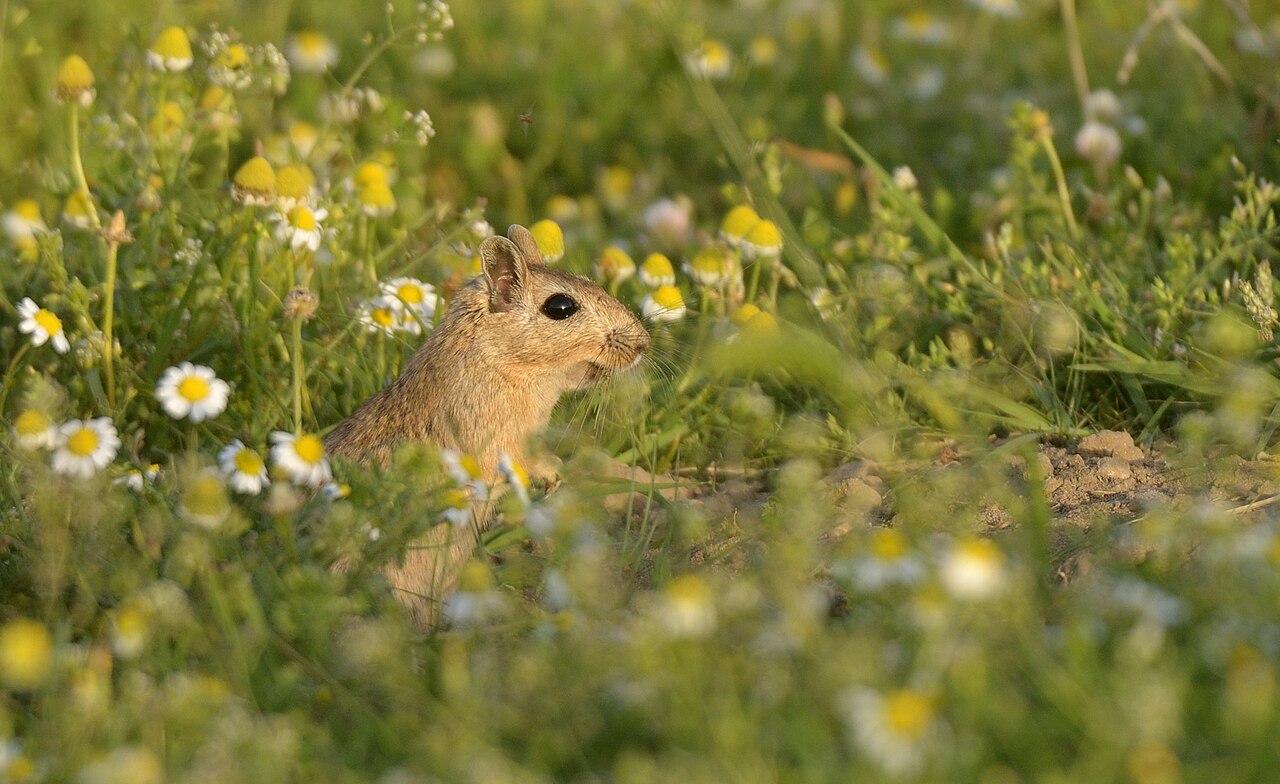
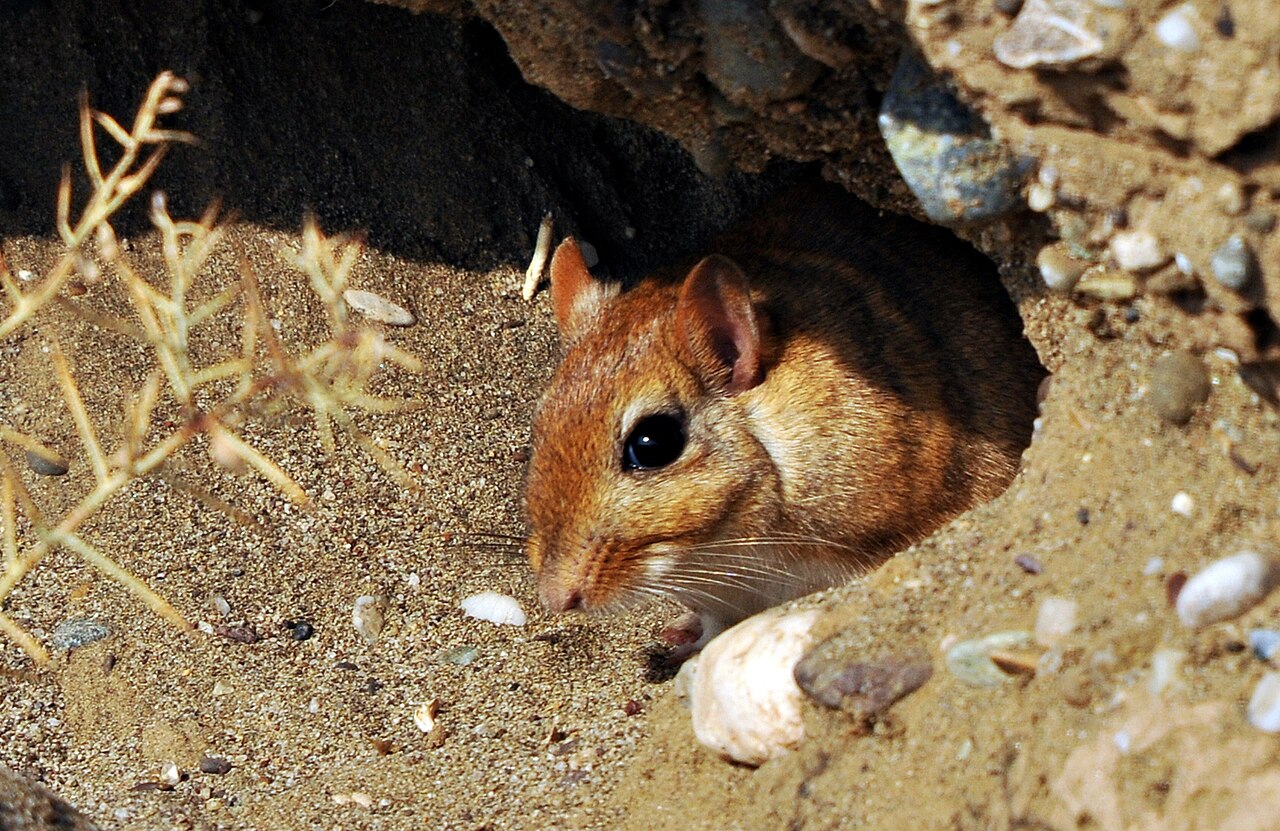
A medium-sized to large jird: head-body 106 to 171 millimetres, weight 42 to 130 grams; males are clearly larger than females. The back varies from pale greyish fawn to dull reddish brown, the animals of south-eastern Turkey being warm rufous; the belly is white. The best character is the tail: it is relatively short, 77 to 125 per cent of head-body length, and ends in a poorly developed brush of darker hairs that is hardly visible at a distance. The soles of the hind feet are haired except for the front part. The ears are large for a jird (17 to 23 mm), the hind foot measures 29 to 40 millimetres. The auditory bullae are not greatly enlarged, about a third of skull length; this distinguishes the species from the true desert species and is immediately visible on a skull from a pellet.
Similar species
Within its range this is almost the only jird; confusion is more likely with species from other families. The Libyan Jird (Meriones libycus) and Persian Jird (Meriones persicus) border the range in eastern Anatolia and northern Iraq; both have a longer tail with a well-developed dark tuft, and the Persian Jird lives on rocky slopes, which this species avoids. A large Wood Mouse (Apodemus) has larger ears and eyes, a naked, scaly tail without a tuft and moves by leaping; this species walks. A Brown Rat is heavier, darker and has a naked tail. A hamster has a blunt, very short tail, a stocky body and black markings on the belly. M. tristrami was long regarded as a form of the North African Shaw's Jird and has been generally recognised as a separate species only since the 1970s and 1980s; the ranges meet nowhere, so this is irrelevant in the field.
Habitat
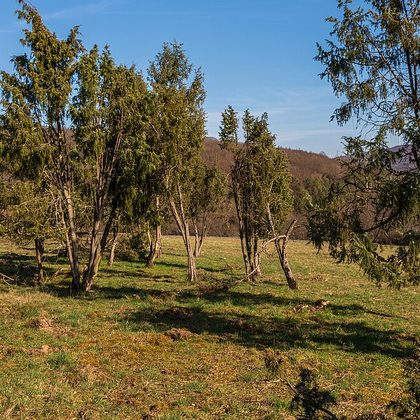
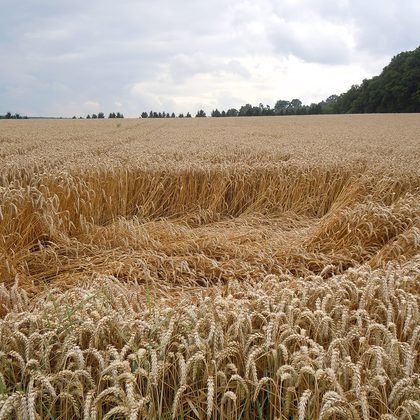
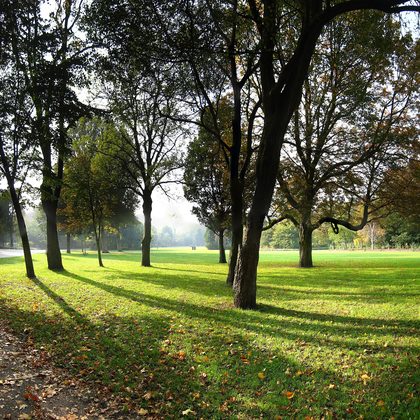
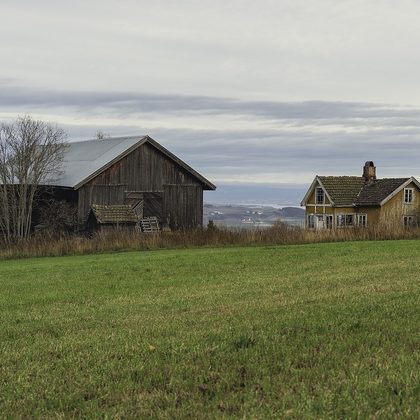
Lowland steppe with more than a hundred millimetres of rainfall a year; this is the limit of the range. Within that limit the species is not selective: dry grassland, cereal fields and fallow strips, garrigue and phrygana, vegetable plots and orchards, and yards and earth banks at village edges. It depends on soft, free-draining soil to dig in; rocky slopes are avoided. It is a lowland species, but also occurs at higher altitudes: there are records up to 1350 metres in Turkey, 1550 metres in Lebanon, 1600 metres in Israel and 2000 metres in Azerbaijan.
Where the animal is most at home, classified with EUNIS — the European standard for habitats.


Distribution
Anatolia, Syria, Lebanon, Israel and Palestine, western Jordan, northern Iraq, southern Georgia, Armenia, Azerbaijan and north-western Iran. The species is monotypic, although considerable geographic variation in build and chromosomes has been found within Turkey; this variation justifies regionally described forms, but a split of the species is not supported while research remains unfinished.
- Native
- dark = core range, pale = thinly spread
Way of life
Nocturnal and crepuscular and entirely terrestrial. Breeding continues throughout the year, with a clear peak from March to September; gestation is 25 to 29 days and a litter contains one to eight young, on average slightly fewer than four, with smaller litters in the south of the range. The young are born naked and blind and are weaned after three weeks. Food consists of seeds, grain, leaves and stems. Density fluctuates strongly between seasons and years, from one and a half to two animals per hectare to forty-five, a more than twentyfold difference; as a result the species is hardly recorded in Turkey in some years and recorded everywhere in others. There is no hibernation: the animals are active all year and in winter merely occupy a different type of burrow.
Where and when to look
In south-eastern Anatolia the species is easiest to find in spring: walk in May along field margins and banks of the plains around Diyarbakır or Şanlıurfa and look for holes with fresh earth in the flank of a hillock; in the last evening light the animals sit upright beside the entrance. In Israel and Lebanon the same method works in cereal fields and on fallow strips in the hills. Use a red light and choose a windless evening. Because density fluctuates strongly, it is worth revisiting an area that seemed empty one year in the following year. Pellets under Barn Owl roosts in Anatolia also give a good picture of the species present.
Conservation status
Least Concern (2021) and fairly common throughout its range. The species benefits from extensive arable farming and village edges; as long as there is cereal land with soft soil, it is not threatened. Where it occurs locally at high densities it is regarded as damaging to crops and stores and is controlled, but a threat to the species has not been established anywhere. The main uncertainty is taxonomic: geographic variation within Turkey is considerable, and until the revision is complete it is unknown whether this is one widespread species or a series of forms each requiring its own assessment.
Scientific name
Meriones tristrami | O. Thomas, 1892
O. Thomas described the species in 1892 and placed it straight away in the genus where it still stands. Meriones is the name of Meriones, the Cretan hero of the Iliad; the name itself belongs with Greek mēros, 'thigh'. Why Illiger gave it to a jird he does not say. tristrami honours the English clergyman and naturalist Henry Baker Tristram (1822–1906), author of The Fauna and Flora of Palestine. The specimen the first description was based on came from Israel.