All species › Even-toed ungulates › Oceanic dolphins › White-beaked dolphin
White-beaked dolphin | Lagenorhynchus albirostris
Witsnuitdolfijn | Delfín de pico blanco
The White-beaked Dolphin is a robust cold-water dolphin found only in the northern North Atlantic, from the Gulf of Maine and Greenland to the Barents Sea and the North Sea. Adults grow to just over three metres. In the central and northern North Sea it is the most abundant dolphin; in Scotland it is present all year, with most sightings between June and October.

Tracks
At sea the species is recognised by the combination of a tall, curved dorsal fin and the pale back behind the fin, briefly visible at each breath. The blow is not visible. White-beaked Dolphins surface with a vigorous, often splashing motion, and readily ride the bow wave, especially of large, fast vessels. They leap, somersault and slap the water with the tail. Most groups number fewer than ten animals; off north-west Scotland schools of up to fifty are regularly seen. Northern Gannets and gulls often hang over feeding groups. On the beach only stranded animals are found, which in the Netherlands, Belgium and the United Kingdom are examined by stranding networks.
Identification
A heavily built dolphin with a short, thick beak of five to eight centimetres, usually pale grey to white; in some animals the beak is dark, so the name does not always fit. The back is black to dark grey, the belly white. On the flank there is a pale grey to white patch in front of the dorsal fin and a second, larger pale area behind the fin that always extends over the back, forming a pale saddle behind the fin. The pattern varies between individuals. The dorsal fin is set mid-back and is tall and sickle-shaped. Adults reach 3.1 metres; males average twenty centimetres longer than females.
Similar species
The Atlantic White-sided Dolphin (Leucopleurus acutus), which occurs in the north and west of the guide area, is slimmer, with a dark beak, a sharply defined white patch below and behind the dorsal fin and behind it an ochre-yellow band on the tail stock; it lacks the pale saddle over the back. The Bottlenose Dolphin also has a short beak and a tall fin, but is plain grey without pale patches on flank and back. The Common Dolphin is smaller and slimmer, with a long dark beak and an hourglass pattern with a yellow front half. At a distance, when only back and fin break the surface, the pale saddle behind the fin separates the White-beaked Dolphin from the other species; without it, a distant group often cannot be identified to species.
Habitat
The cool waters of the continental shelf and its edge, mostly at depths of less than two hundred metres. The species feeds close to the bottom on gadoids such as cod, whiting, haddock and hake, and also on sprat, mackerel, herring, scad, gobies and cephalopods; in British waters cod, whiting and hake make up most of the diet. It avoids warm water and is absent from the southern part of the guide area.
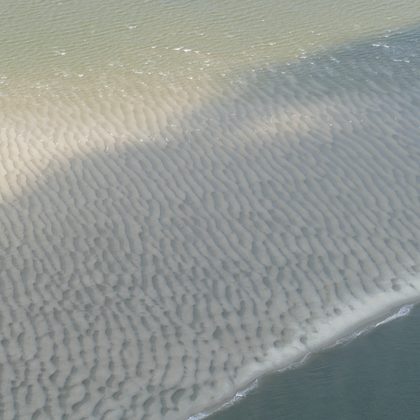
Where the animal is most at home, classified with EUNIS — the European standard for habitats.

Distribution
Only in the northern North Atlantic. In the east from Iceland and the Faroes along the Norwegian west coast into the Barents Sea, and around the British Isles: off Shetland and Orkney, in north-west Scotland and the Hebrides, along the Scottish and north-east English North Sea coast and off the west coast of Ireland. In the central and northern North Sea it is the most abundant dolphin. In the southern North Sea, the Channel and the Irish Sea it is scarce, and it is absent south of the Bay of Biscay. In northern Britain the species is present all year; most sightings fall between June and October, peaking in August.
- Native
- dark = core range, pale = thinly spread
Way of life
Active by day and night. The animals live in groups of changing composition; most number fewer than ten. Females mature at six to ten years, males at eight to twelve. Gestation is about eleven months, and calves are born mainly between June and September; a newborn calf is 1.1 to 1.2 metres long and weighs about forty kilos.
Where and when to look
Search in calm seas, force three or less, because the species surfaces low and the pale flank disappears among the whitecaps. Good places are the coasts of Northumberland and Yorkshire, the east coast of Scotland, Orkney, Shetland and the Hebrides, between June and October; in Iceland boats sail from Húsavík and from harbours on Eyjafjörður on which White-beaked Dolphins regularly ride the bow wave. From the ferries across the northern North Sea and to Shetland you can watch for them from the deck. Look for flocks of Northern Gannets over the sea: a group of dolphins is often hunting there too.
Conservation status
Least Concern (LC, 2018). The species is legally protected in European, British and Irish waters, is listed on Annex IV of the Habitats Directive and is covered by ASCOBANS. Threats are bycatch in trawl and purse-seine nets, disturbance by underwater noise, and pollution. In the Faroe Islands White-beaked Dolphins are also taken in the drive hunts for pilot whales. Because the species is bound to cold water, warming of the North Sea is expected to shift its range northwards.
Scientific name
Lagenorhynchus albirostris | J. E. Gray, 1846
J. E. Gray described the species in 1846 and placed it straight away in the genus where it still stands. Lagenorhynchus is formed from Greek lagynos, 'flask, bottle', and rhynchos, 'snout': the bottle-snout, after the short, thick beak. albirostris is formed from Latin albus, 'white', and rostrum, 'snout, beak': white-beaked. The specimen the first description was based on came from England, Great Yarmouth (Norfolk).