All species › Rodents › Mice and rats › Wood mouse
Wood mouse | Apodemus sylvaticus
Bosmuis | Ratón De Campo
The Wood Mouse is one of the most numerous mammals of western and southern Europe, but is rarely seen. It is nocturnal, moves by leaping and occurs in almost all woods, hedges, gardens and sheds. It cannot always be separated with certainty in the field from the related Yellow-necked Mouse.
Tracks
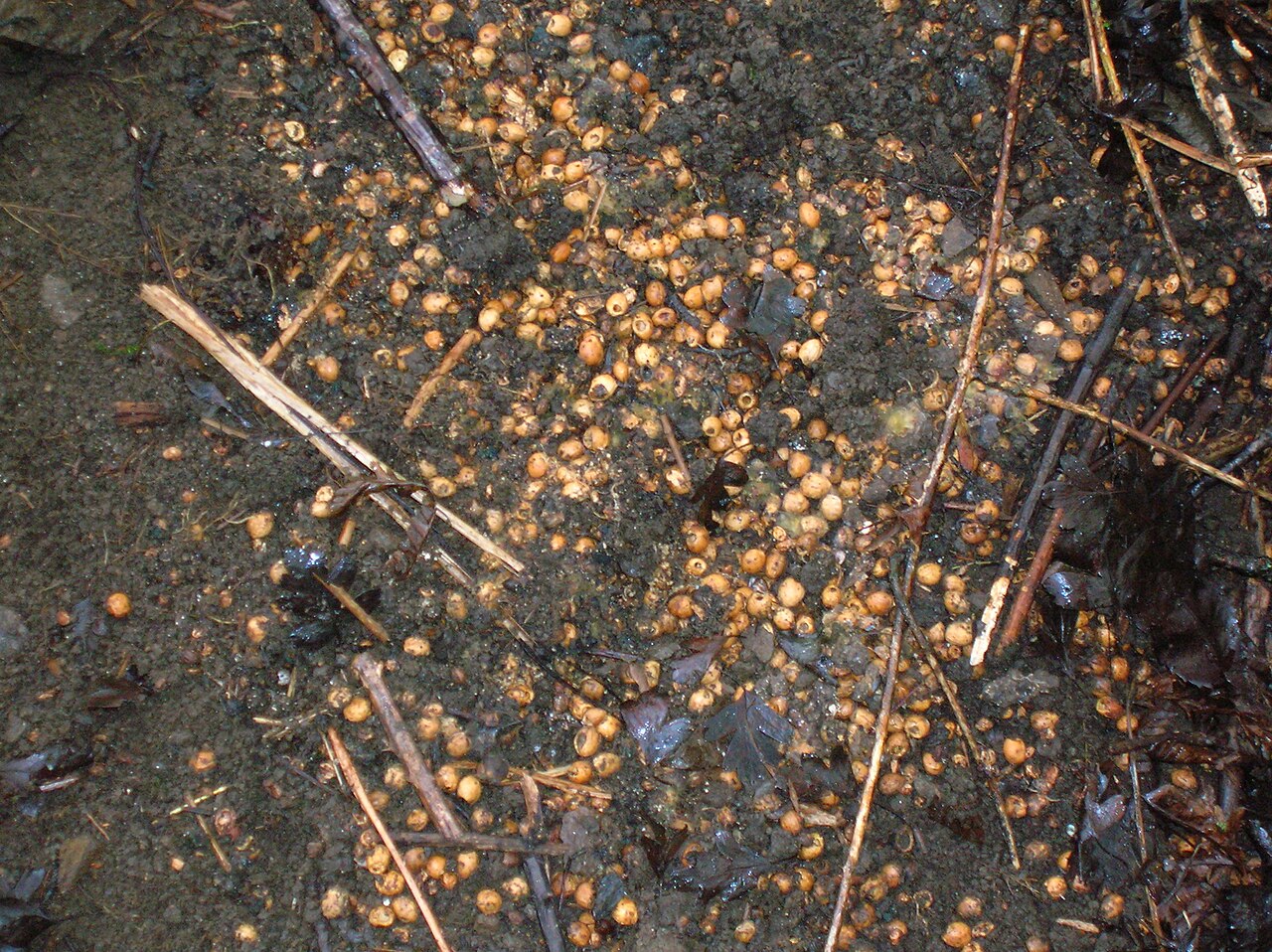
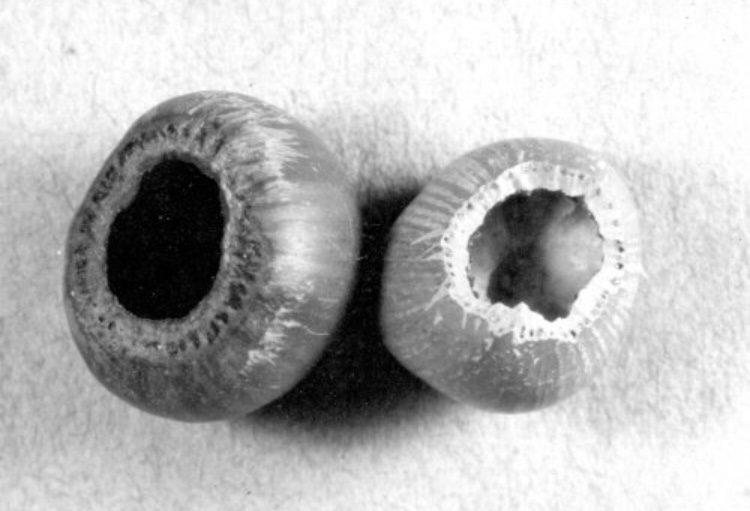
The feeding signs can be identified well with a hand lens. The best known is the opened hazelnut: the Wood Mouse gnaws a round hole five to eight millimetres across in the shell from the outside, leaves parallel tooth grooves on the inner rim of the hole and also makes rough tooth marks on the shell surface around it. This character separates it from three other species: a Bank Vole leaves neat parallel grooves on the inner rim but no marks on the surface outside the hole, a squirrel splits the nut into two halves or makes a large ragged hole in it, and a woodpecker chisels an irregular opening while the nut is wedged in a crack. Nut shells collected under a hazel in a hedge give an indication of the rodent species present in that area. The Wood Mouse also opens cherry and sloe stones with the same round hole, eats rose hips out from the inside and leaves conifer cones as a smooth, thin core, without the stubble and without the tuft of scales at the tip that a squirrel leaves. Caches are found in varied places: in old nest boxes, in an abandoned bumblebee nest, under a fallen log, in a molehill and regularly in a coat pocket in a shed. The droppings are dark, spindle-shaped grains three to five millimetres long, glossy when fresh, scattered rather than in heaps. In snow or fine dust the bounding trail is visible: four prints in a group with the five-toed hind feet in front of the four-toed fore feet, bounds of twenty to fifty centimetres, and between the groups the thin drag line of the tail. The runs go beneath the leaf litter and among tree roots and are seldom visible as tunnels; burrow entrances about two to three centimetres across, round, bare and without a spoil heap, can be found.
In its habitat
Head close-up
Identification
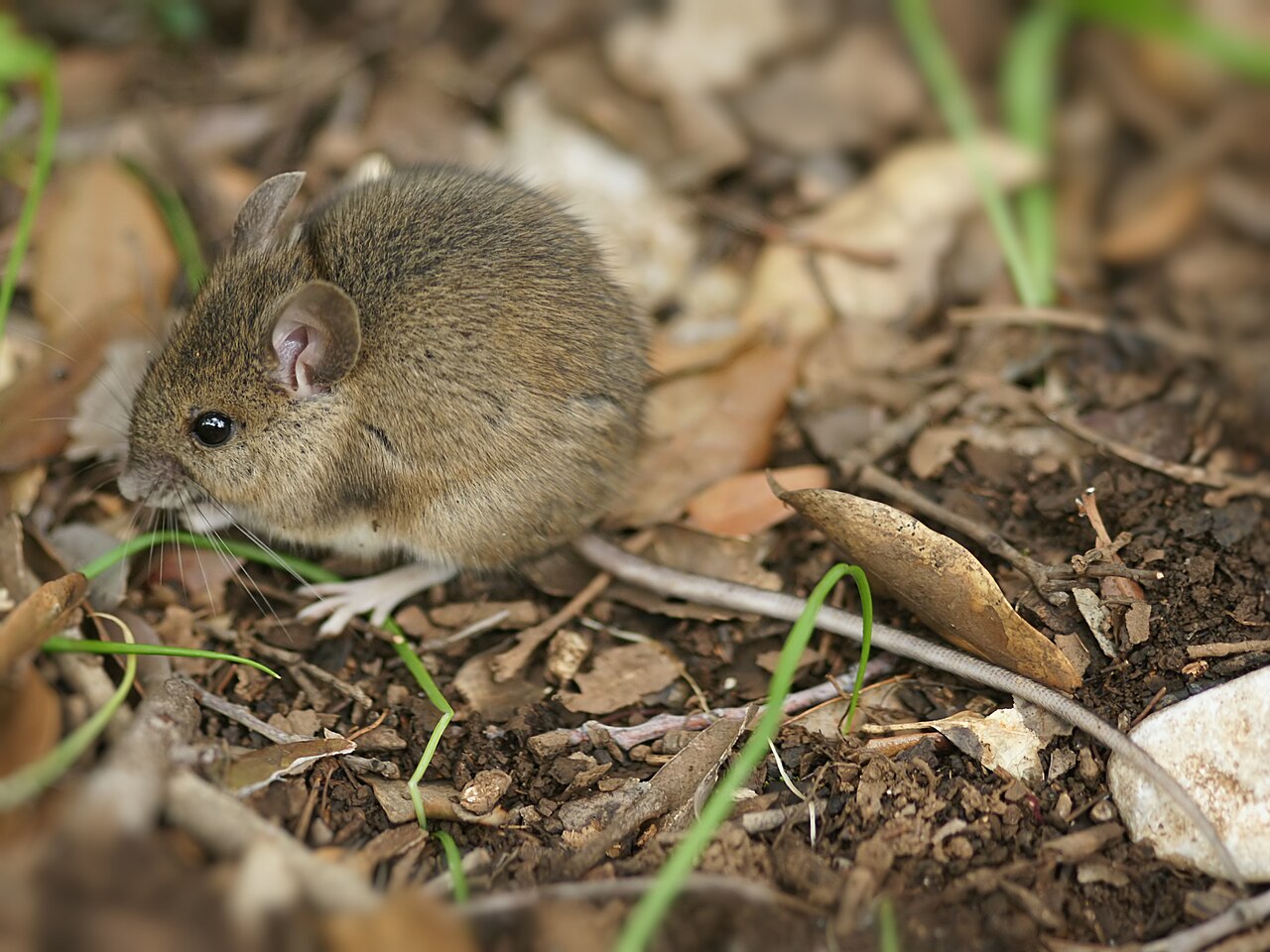
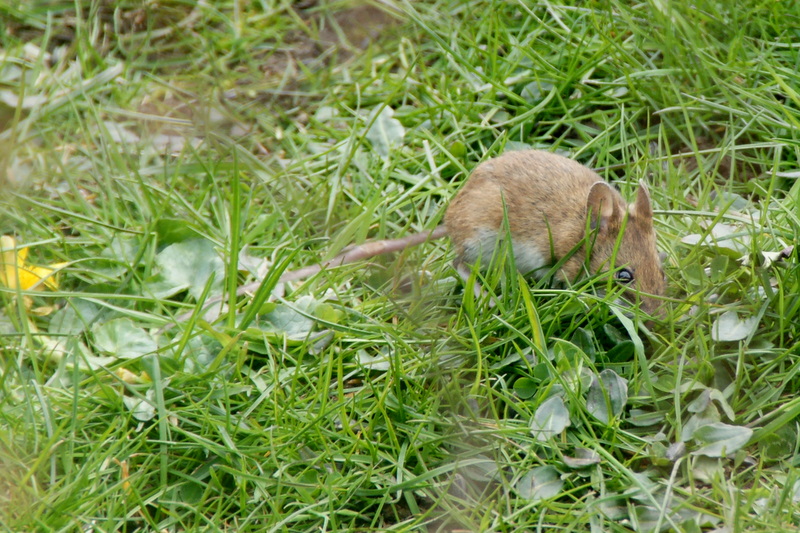
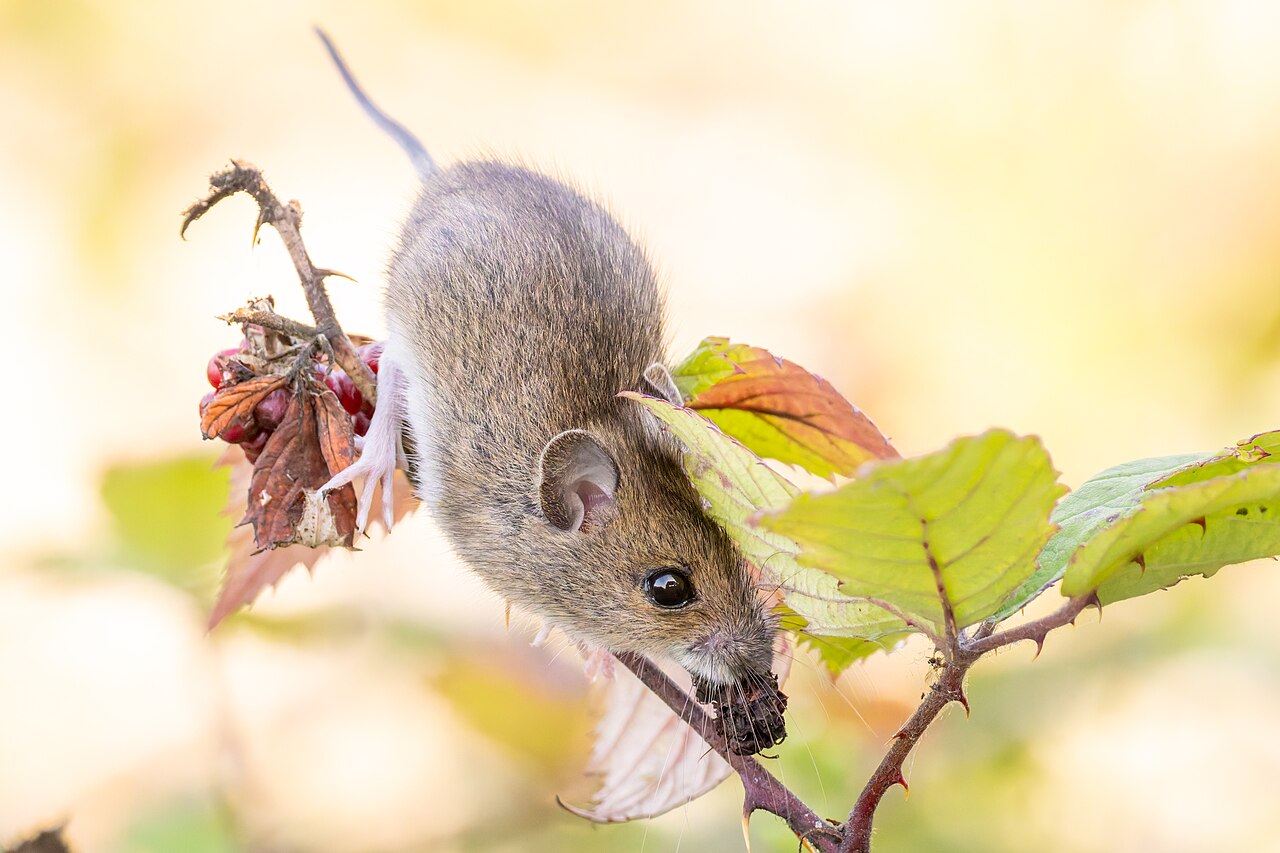
A slender, long-tailed mouse with head-body 8 to 11 cm, a tail of 7 to 11 cm, about as long as head and body, and a weight of about 23 to 25 g. The upperparts are warm yellowish to reddish brown, the flanks ochre, the belly sharply demarcated pure white to greyish white; there is often a small yellow spot or short yellow streak on the chest. The eyes are large, black and protruding and the ears are large and thin, long enough to fold forward over the eye; together the large eyes and ears are the quickest identification character. The hind legs are long; the species moves mainly by leaping, with leaps of up to half a metre. The tail is thin, scaly and sparsely haired, dark above and pale below; the tip breaks off if the tail is seized and does not regrow.
Similar species
The Yellow-necked Mouse often cannot be separated from the Wood Mouse in the field with certainty. The Yellow-necked Mouse is on average larger and redder and has a complete yellow band across the chest, where the Wood Mouse has at most a spot or short streak that does not reach the sides. However, young Yellow-necked Mice sometimes have an incomplete band and old Wood Mice a strikingly large spot, and the measurements overlap widely. In the hand, hind-foot length and chest marking together usually decide; on a photograph or in a torch beam they often do not, and identification to the genus Apodemus is then the correct choice. On the Iberian Peninsula this problem arises only in the northern half, because the Yellow-necked Mouse is a species of mountains and humid forest there. The House Mouse can be separated in the field: greyer and duller, with smaller eyes and ears, no sharp line between back and belly, a tail equally dark all round and a strong mousy smell. The Harvest Mouse is half the size, orange-brown and has a prehensile tail. The voles, such as Bank Vole and Common Vole, have a blunt muzzle, small eyes, ears hidden in the fur and a tail much shorter than the body.
Habitat
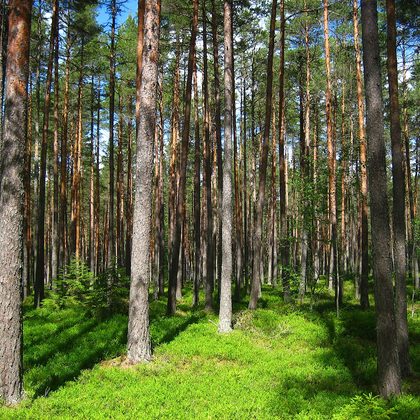
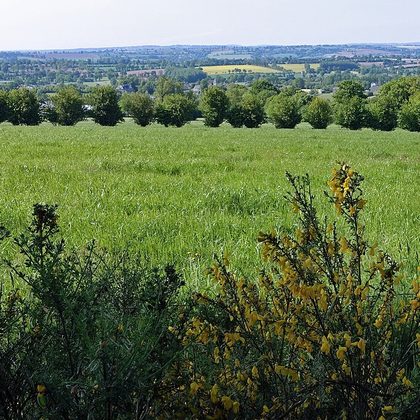
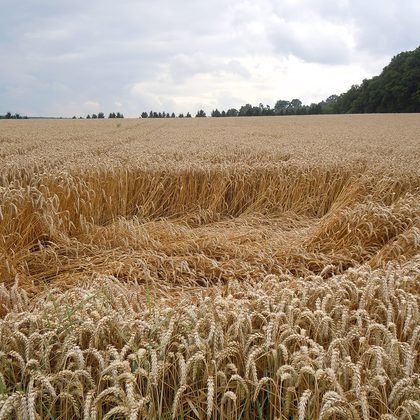
Almost all habitats with cover: broadleaved, mixed and coniferous woodland, hedges, shelterbelts, wood edges and rough ground, young plantations, dune scrub, arable margins and stubble, gardens, allotments, cemeteries, sheds and lofts, and in southern Europe maquis, garrigue, olive groves and vineyards. The species occurs both in old beech forest and on bare ploughed fields in winter, and on most sites is the first species to return after disturbance. Open, permanently wet grassland and bog are avoided.
Where the animal is most at home, classified with EUNIS — the European standard for habitats.




Distribution
From Ireland and the Iberian Peninsula to Ukraine and from northern Scandinavia to North Africa, and on almost all Mediterranean islands. The species occurs throughout Britain and Ireland, including most smaller islands from the Hebrides and Orkney to the Isles of Scilly, throughout the Netherlands and Belgium, including the Wadden Islands, and on the entire Iberian Peninsula from sea level high into the mountains, and on the Balearic Islands. On the Iberian Peninsula and the Balearics four subspecies are recognised: one in the northern half of the peninsula, one in the southern half and on Mallorca and Menorca, and separate forms on Ibiza and Formentera. In these regions the Wood Mouse is regarded as the most numerous small mammal; the British population is estimated at tens of millions of animals, and an average wood holds more Wood Mice than all other mammal species combined. Numbers fluctuate strongly from year to year with the seed crop of beech and oak: a mast year is followed by a winter in which Wood Mice continue to breed and by a peak the following spring. The species is frequently found in the pellets of Barn Owl, Tawny Owl and Long-eared Owl and is therefore better studied than most other small mammals.
- Native
- dark = core range, pale = thinly spread
Way of life
Strictly nocturnal, with most activity in the first hours after sunset and again before sunrise; by day it is seen only by chance, for example when it flees from a log pile. It is active in winter and does not hibernate: it loses weight, in frost several animals share one nest, and it lives on the stores laid down in autumn. The diet consists of seeds, nuts, acorns, beech mast, buds, seedlings, berries, fungi and a considerable proportion of insects, snails and worms. Stores are laid down in cavities and, as in the squirrel, scattered in the soil. The nest lies underground among roots, under a stump or in a tree hole, and consists of finely shredded leaves and grass. From March to October, and in mast years throughout the winter, four to seven young are born after a gestation of 21 to 26 days, with up to four or five litters a year. The young are sexually mature at less than three months, so that a spring litter can itself breed in the same year. Hardly any Wood Mouse lives until a second summer: average life expectancy in the wild is about one year. The Wood Mouse is a main prey of Tawny, Long-eared and Barn Owls, Weasel, Stoat, Fox and Pine Marten; the numbers of these predators therefore depend partly on the seed crop of the previous year.
Where and when to look
The simplest method is waiting: sit on a still evening with a red torch by a log pile, a compost heap or a garden feeding station; a Wood Mouse often appears within half an hour. By day you can collect opened nut shells under a hazel in a hedge; with a hand lens the rim of the hole shows which species opened the nut. In fresh snow the bounding trail with its tail line runs from hole to hole, so that the burrow system of a plot can be mapped in a short time. A third method is dissecting owl pellets, in which the species is frequent. Do not trap animals without a licence; live-trapping of small mammals is regulated, and Wood Mice die quickly in a badly set trap.
Conservation status
Least Concern (2021). The Wood Mouse benefits from woodland expansion, scrub, untidy gardens and human food stores, and populations are so large that local declines caused by a hard winter, a failed mast year or intensive control recover within one season. On some Mediterranean islands the species has been introduced and affects native vegetation and ground-nesting birds there; on the European mainland it is native. The Wood Mouse is an important prey species for owls, mustelids and the fox; how those species fare in a given year depends strongly on the number of Wood Mice, which in turn depends on the quantity of acorns and beech nuts that fell the previous year.
Scientific name
Apodemus sylvaticus | (Linnaeus, 1758)
Linnaeus described the species in 1758 as Mus sylvaticus; because it was later moved to another genus, the author and year stand in brackets. Apodemus is Greek, from apodēmos, 'away from home'. sylvaticus is Latin for 'of the woods', from silva, 'wood, forest'. The specimen the first description was based on came from Sweden, Uppsala.