All species › Lamiales › Rainbow plant family › Byblis filifolia
Byblis filifolia
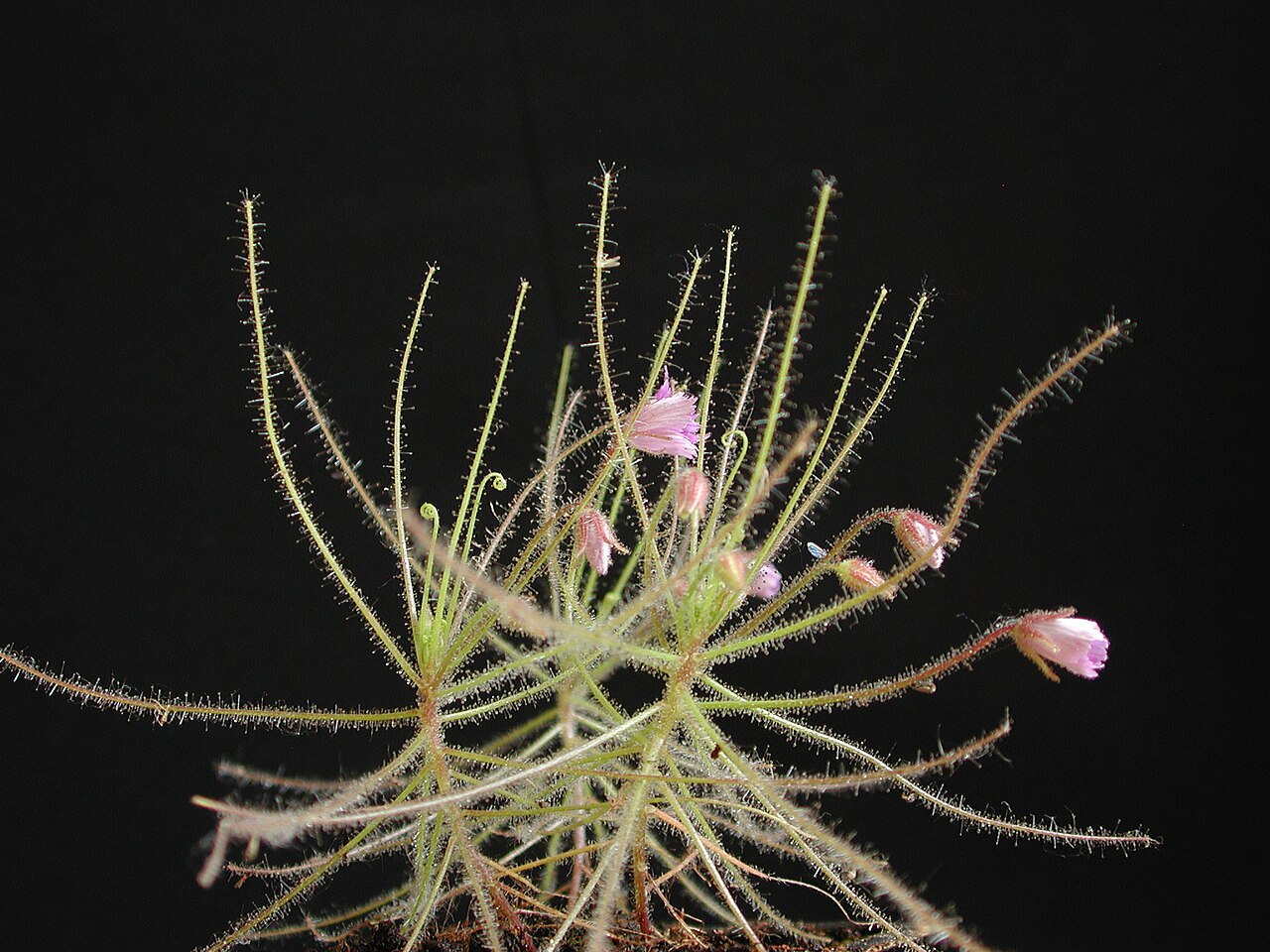
This is the species you can hardly miss in north-western Australia. Where Byblis liniflora stays a hand's breadth high, Byblis filifolia grows to half a metre and turns woody at the base, carrying dozens of needle-shaped leaves that point in every direction, each one loaded with sticky droplets. Backlit in the early morning a plant stands in the savanna like a lit broom. It is accordingly the commonest and most photographed Byblis of the Kimberley, and at the same time the hardest in the genus to delimit: a fair part of what goes under other names out there may simply be filifolia.
Identification
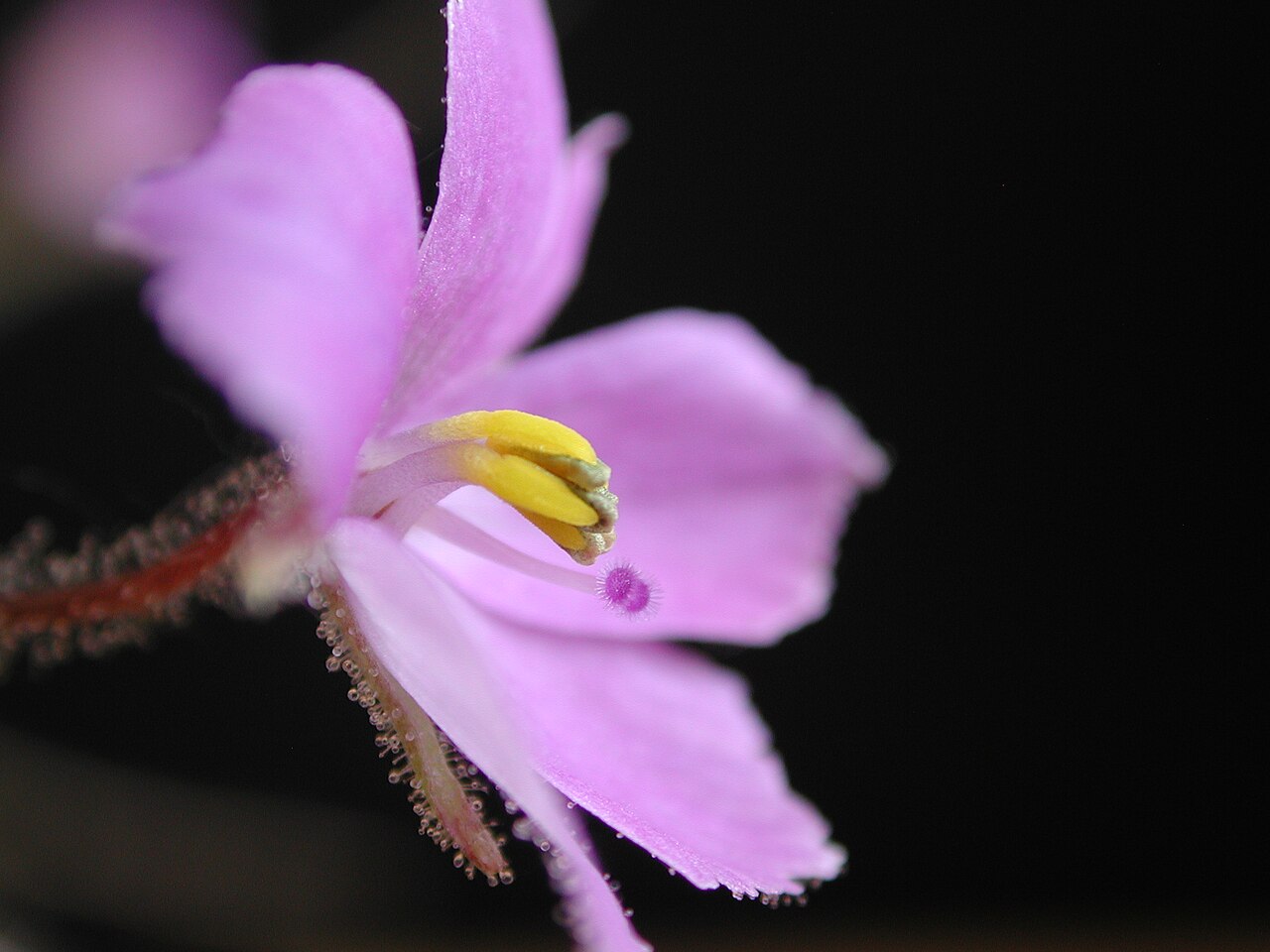
An erect plant, or one leaning on surrounding herbs, 20 to 60 cm tall, with a main axis that becomes woody towards the base and branches higher up. The leaves are thread-shaped and round in cross-section, 3 to 15 cm long but mostly 4 to 8 cm, densely set with stalked sticky glands and, between them, far smaller sessile glands. Flowers are borne on long stalks from the leaf axils. The sepals are 4.5 to 6.5 mm long and carry short stalked glands 0.3 to 0.5 mm long — the character by which the key separates this species from B. rorida. The petals are 10 to 15 mm long, mauve to purple above and white, yellow or striped red and yellow beneath, irregularly toothed at the tip. The five stamens curve to one side, and the anthers are 2.5 to 3.5 mm long, therefore longer than the 1 to 3 mm filaments. In Western Australia it flowers from March to June, from the end of the monsoon into the dry season.
Similar species
The whole northern half of the genus is a tangle. Byblis liniflora is far smaller, stays under 15 cm, and has anthers shorter than the filaments — with a hand lens that is the quickest distinction. Byblis rorida occurs in the same country and also has anthers longer than the filaments, but bears conspicuously long glandular setae of 0.7 to 1.5 mm on the sepals against 0.3 to 0.5 mm here. Byblis guehoi of the Dampier Peninsula is barely separable in the field and differs mainly in seed and chromosome number. Byblis aquatica sprawls in standing water and cannot be confused. Confusion with a Drosera is impossible once you look closely: there the glandular hairs sit on a flattened blade and move, here they surround a needle-like leaf and do not.
The trap and how it works
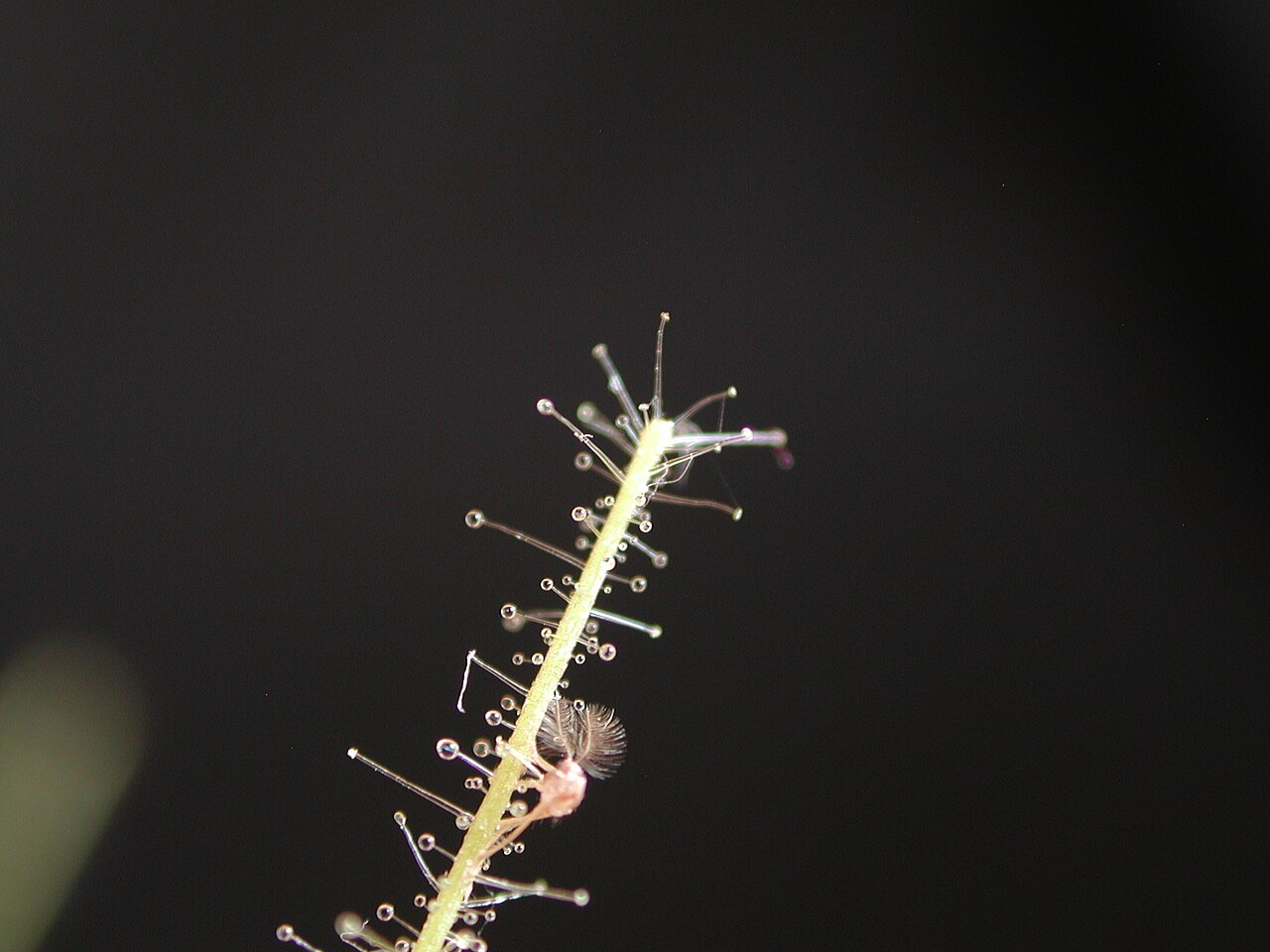
A passive flypaper trap. The leaf does not move and the glands do not move; no stimulus is processed at all. Each long stalked gland carries a clear droplet that yields on contact and sticks, so that an insect struggling to get free only touches more of them. Digestion is the work of the much smaller sessile glands on the leaf surface, which release enzymes only once prey is lying on them and then absorb the liberated nitrogen and phosphorus. That division of labour between two gland types is exactly what separates Byblis from Drosera. Because this species grows large and produces so much leaf surface, plants are often black with catch by the end of the season — mostly midges, small flies and winged ants. Predatory bugs live on the sticky leaves, walking them unharmed and stealing the prey.
Habitat and ecology
Sandy soils in open savanna woodland, and beyond that the sandy margins of rivers and creeks and places where groundwater seeps out in the wet season. The plant needs full light and will not tolerate a closed grass sward, so it stands out especially on recently burnt savanna, on bare sand flats and along roads and tracks. The substrate is usually a deep, poor sand flushed with water during the monsoon and bone dry for months afterwards. In the fixed codes that means a combination: a sand plain (D1) that functions as a seepage swamp for part of the year (W3) and that often lies along a creek or river margin (W7).
Distribution and elevation
The dry north-west of Australia: from around Port Hedland in the Pilbara through the Great Sandy Desert, Dampierland and the whole of the Kimberley to the Tanami, and across the border into the Northern Territory, where it reaches the coastal country near Darwin. It is therefore endemic to Australia, but spread across an enormous area. It is a lowland plant throughout; no reliably documented altitudinal limit exists for the species, so the elevation field is left empty here.
- Recorded (quarter-degree cells)
Forms and variation
There is a great deal of wild variation, and that is precisely the taxonomic problem of the species. Flower colour runs from deep mauve to almost pure white, and some populations have the backs of the petals handsomely striped in red and yellow. Plant size also varies strongly with the wetness of the site: on poor, quickly drying ground plants stay under 20 cm, on wet seepages they reach the full 60 cm. Field workers who have travelled the whole range suggest that B. filifolia, B. rorida, B. guehoi and possibly B. pilbarana together form a single highly variable species; that is a hypothesis for now, not an accepted arrangement. No varieties and no natural hybrids are recognised.
Where and when to see it
April to June is the best window: plants are full grown and flowering and the Kimberley's sand tracks are passable again. Search with the sun low behind you, when the glandular droplets light up and the plants are visible from tens of metres. The best places are the edges of drying swamps, sandy creek banks, road verges and stretches of savanna that have burnt recently. With every find, note whether the anthers are longer or shorter than the filaments and how long the glandular setae on the sepals are — without those two data points a record within this group is worth little.
Conservation status
The Red List assesses the species as Least Concern, and the Western Australian Herbarium lists it as not threatened. The range spans thousands of kilometres, the plant occurs in many protected areas, and it positively thrives on disturbed and freshly burnt ground. What matters locally is a change in fire regime: where tall grass and shrubs close in, it disappears from that spot, and where fire comes too often and too hot, the seed bank runs down.
Scientific name
Byblis filifolia | Planchon, 1848
Described by Jules Émile Planchon in 1848. The precise type locality could not be established with certainty; the species occurs in northern Australia and is one of the most widely cultivated members of the Byblis liniflora complex. The species name filifolia combines the Latin filum ("thread") and folium ("leaf") and refers to the plant's thin, thread-like leaves.
World Checklist of Vascular Plants (WCVP), via Plants of the World Online (POWO), Royal Botanic Gardens, Kew.