All species › Lamiales › Rainbow plant family › Byblis liniflora
Byblis liniflora
This plant is less a place than a season. Byblis liniflora is an annual of the Australian monsoon: it germinates as the first rains soak the sandy flats, flowers within a few weeks, and is gone again before the country has fully dried. Finding it means watching the weather first and the map second. Once you are in the right place at the right week it is easy enough: in full sun it gives itself away from several metres off by its glitter, because every leaf carries thousands of stalked glands, each holding a droplet that catches the light.
Identification
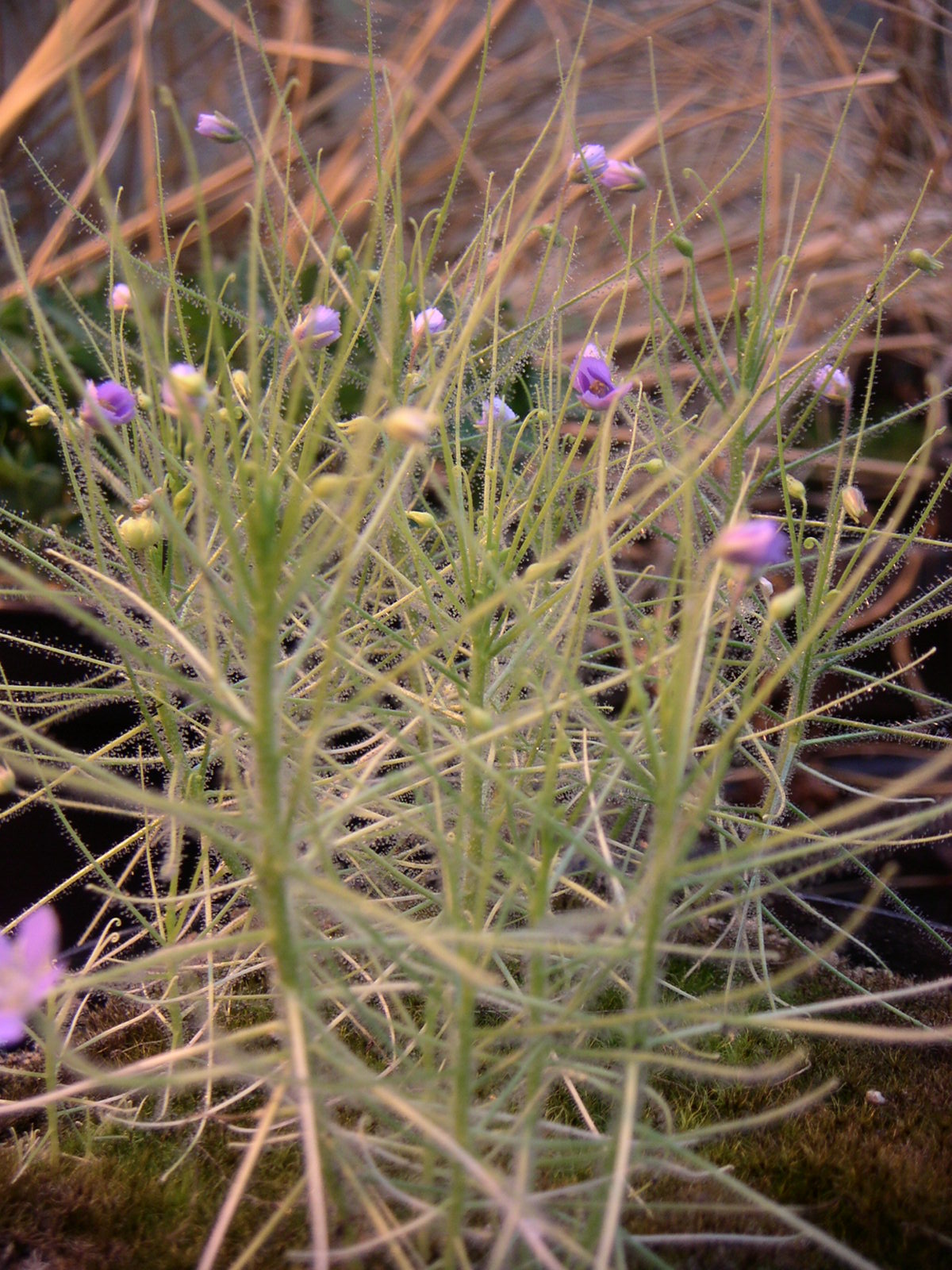
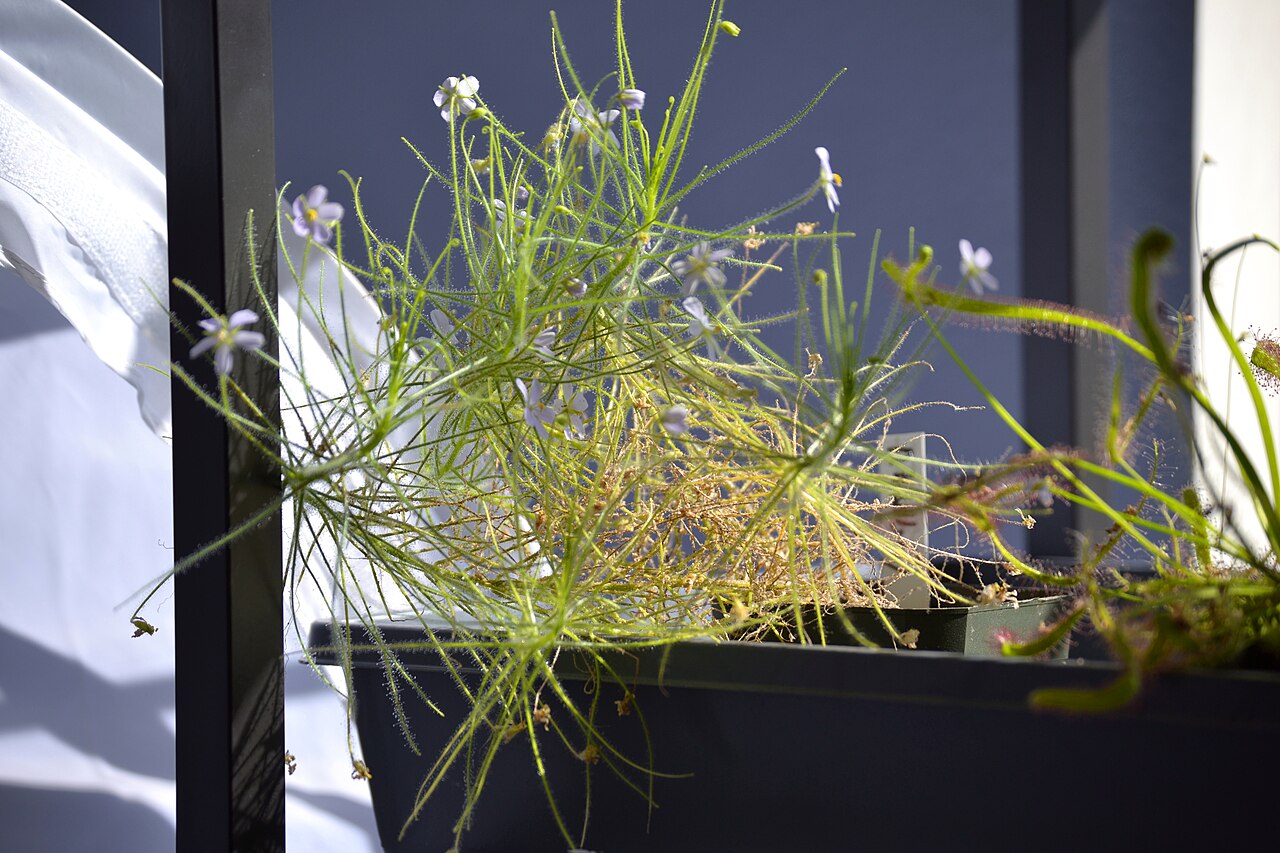
An erect, basally branched herb 5 to 15 cm tall, with no rosette: the leaves are scattered along the stem and point in every direction. They are thread-fine and round in cross-section, tapering gradually to the tip, and along their whole length they carry two kinds of gland intermixed — long stalked glands each tipped with a clear sticky droplet, and between them far smaller sessile glands that only go to work once something has been caught. Flowers are solitary on long stalks arising from the leaf axils, pink to lilac-purple, with five petals finely toothed at the tip. The five stamens are all curved towards one side of the flower. In this species the anthers are shorter than the filaments, and with a hand lens that is the most dependable field character. In Western Australia it flowers from March to August, that is from the end of the wet season well into the dry.
Similar species
Within the genus confusion is the rule rather than the exception. Byblis filifolia and Byblis rorida grow in the same country and look much the same from a distance; both are larger and sturdier, and in both the anthers are as long as or longer than the filaments. Byblis rorida is additionally clothed in short non-glandular hairs on the stem, which B. liniflora lacks. Byblis aquatica lives in permanently wet hollows and has lax, partly floating stems. Confusion with a Drosera is unlikely once you have the plant close to your eye: in Drosera the glandular hairs sit on a flattened blade and move, here they surround a needle-like leaf and do not.
The trap and how it works
A passive flypaper trap, in the simplest form the group has. The leaf does not move, the glands do not move, and no stimulus is processed at all: a midge or small fly that blunders into the droplets sticks fast and, in struggling, only contacts more of them. Digestion is the work of the far smaller sessile glands set on the leaf surface between the stalks; these release enzymes once prey is lying on them, and then take up the liberated nitrogen and phosphorus themselves. Splitting the two functions between two gland types is exactly what separates Byblis from Drosera, where a single tentacle does both and bends as well. The catch consists mostly of small flying insects. Bugs of the genus Setocoris live on the plants, walking the sticky leaves unharmed and stealing the prey.
Habitat and ecology
Seasonally wet sand in open, nearly treeless savanna and along the margins of temporary swamps. The substrate is sand, clayey sand or a thin skin of soil over sandstone pavement across which water seeps in the wet season; the plant tolerates neither shade nor competition from tall grass. That is why it turns up so often on disturbed ground: road verges, foot tracks, patches of savanna recently burnt. None of the fixed substrate codes fits it exactly — it is a sand plain (D1) that behaves like a seepage swamp (W3) for part of the year and is bone dry for the rest.
Distribution and elevation
Northern Australia — the Kimberley in Western Australia, the Top End of the Northern Territory and parts of northern Queensland — and beyond it southern New Guinea, in both Papua New Guinea and the Indonesian portion. It is therefore not endemic, and it is the only species of the genus to leave the Australian landmass; the Arafura Sea was dry land during the glacial periods, and the New Guinean occurrences are what remains of that connection. It is a lowland plant throughout, but no reliably documented altitudinal limit exists for the species, so the elevation field is left empty here.
- Recorded (quarter-degree cells)
Forms and variation
There is little variation to report, and there is a taxonomic reason for that. Until 1998 Byblis liniflora was a broad concept covering much of the northern material. The revision by Lowrie and Conran pulled B. aquatica and B. rorida out of it as separate species, and B. guehoi was segregated later. What remains is a narrowly circumscribed species with almost no formal variation left in it: flower colour shifts a little between pale pink and lilac-purple, and plant size depends mostly on how wet the germination site was. No wild varieties or colour forms are recognised, and no natural hybrids are known — crosses within the genus are rare and the northern species flower partly at different times.
Where and when to see it
The first half of the dry season, roughly April to June, is the best window: plants are full grown and flowering, and the ground is passable. Search in early morning with the sun low behind you, when the glandular droplets light up and reveal a plant that is easy to walk straight past when viewed from above. The good places are open, freshly exposed sandy soils: the edge of a drying swamp, a ditch along an unsealed road, a stretch of savanna that has recently burnt. Read the year as well as the season — after a weak monsoon a site that was carpeted last year may stay empty altogether.
Conservation status
The Red List assesses the species as Least Concern. The reasoning is straightforward: the range is enormous, the plant occurs in dozens of protected areas, it favours disturbed ground, and a soil seed bank buffers the bad years. What does matter locally is a change in fire regime and the thickening of the savanna: wherever tall grass or shrubs take the light, the plant disappears from that spot.
Scientific name
Byblis liniflora | Salisbury, 1808
Richard Anthony Salisbury described the species in 1808, establishing the genus Byblis for it. The type locality lies in northern Australia. The genus name Byblis refers to the figure from Greek mythology who, after being rejected by her brother Caunus, dissolved into an endless stream of tears — an allusion to the glistening sticky droplets on the leaves. The species epithet liniflora is Latin for 'with flowers like flax', referring to the resemblance of the blue flowers to those of the flax plant.
World Checklist of Vascular Plants (WCVP), via Plants of the World Online (POWO), Royal Botanic Gardens, Kew.