All species › Lamiales › Rainbow plant family › Byblis gigantea
Byblis gigantea | Rainbow plant
A subshrub that looks in the sun as though it had been dusted with glass: every leaf carries thousands of glue droplets, and against the light they break it into colours — hence the name rainbow plant. It grows on the sandplain around Perth, exactly where the ground is most wanted, and of all the species in this guide it is the one in the worst position.

Identification
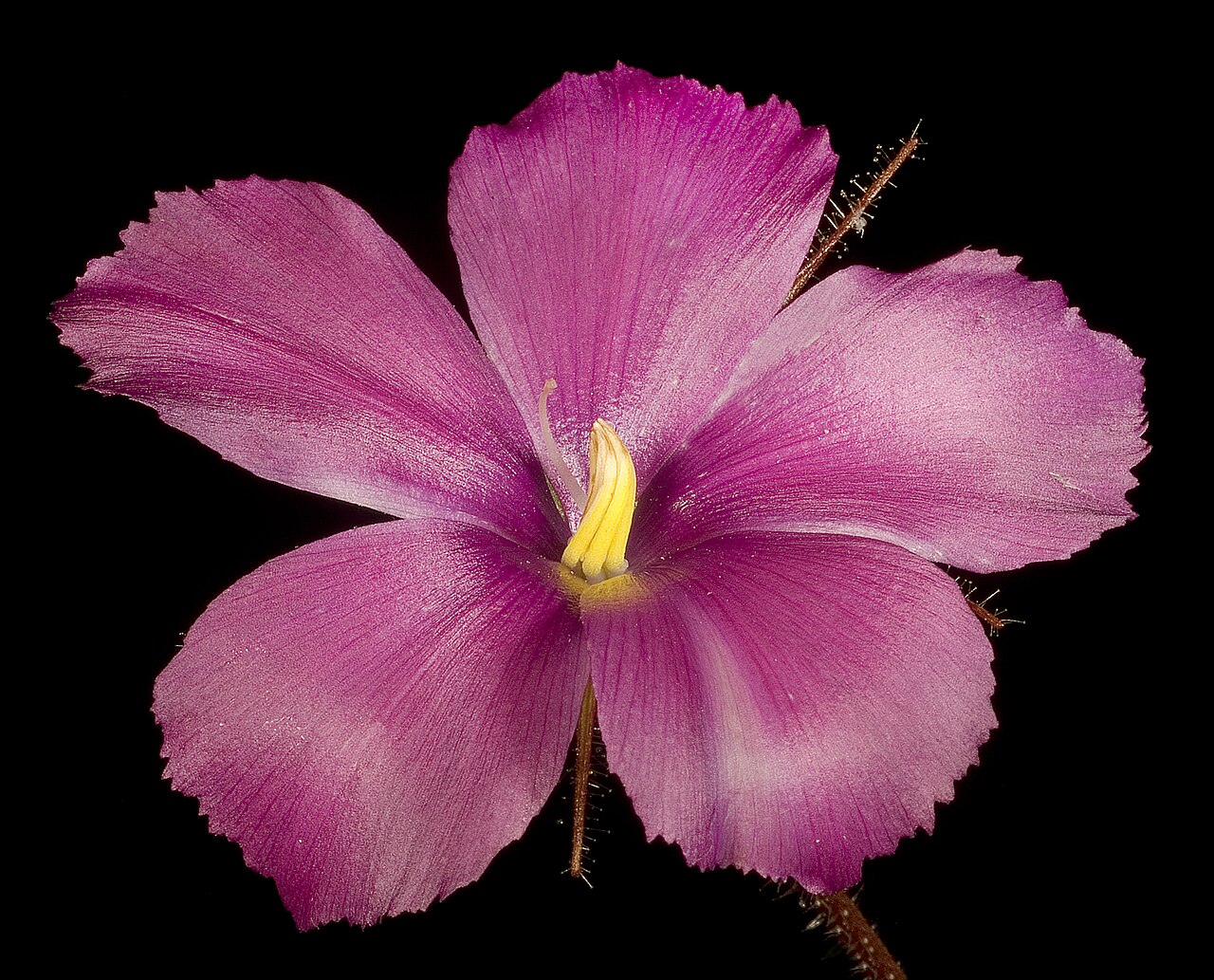
An erect subshrub to 45 cm high, with a woody, tuber-like base from which several stems arise. The leaves are thread-like and round in section, pointing obliquely upwards and tapering to a point; along their whole length stand stalked glands with a droplet, and small sessile glands between them. The flowers are borne singly on long stalks from the leaf axils: five pink to purple, rarely white petals in an open dish, with five stamens whose anthers are bent to one side. The whole plant glitters; old plants carry a dense bunch of stems.
Similar species
The genus itself is unmistakable in Western Australia; the species within it are not. Byblis gigantea is the large perennial species of the south-west; the annual species of the tropical north stay smaller, die away completely in the dry season and lie outside this country. The plants of the sandplains north of the core area have since 1998 largely been referred to B. lamellata, which has ribbed leaves; where exactly the boundary between the two runs is still unsettled. Sundews share the same wet flats, but carry their glandular hairs on a flat blade rather than on a round thread.
The trap and how it works
A passive flypaper trap, as in Drosophyllum and unlike the butterworts: nothing moves. The stalked glands hold the prey, the sessile glands secrete the digestive fluid, and the leaf stays straight. What it catches is small and flies: midges, flies, small beetles. A bug of the genus Setocoris lives on the sticky leaves as well, moving over them unharmed and sucking out the trapped insects — a stowaway that lives off the plant's trap. The flower has a mechanism of its own too: the pollen only leaves the anthers when a bee buzzes against them at the right pitch.
Habitat and ecology
Sandy peat on flats that stand under water in winter and lie bone dry in summer, in open scrub and heath on poor sandy ground. Above ground the plant dies back in summer and passes the season in its woody, tuber-like base. After a fire it resprouts and flowers profusely: fire belongs to its life cycle, as it does everywhere in this landscape.
Distribution and elevation
Endemic to the south-west of Western Australia. It grows on the sandplain around Perth and on the adjoining edge of the Jarrah Forest country; the source followed here also names the sandplains further north, where the boundary against the related species is disputed. This guide goes no further than that: for a species in this state, a precise locality is a set of directions for anyone who digs plants up.
- Recorded (one-degree cells)
Forms and variation
No varieties are recognised within the species; the variation lies in flower colour, which runs from pale pink to deep purple and is rarely white. The real story is the delimitation of the species itself: what was once all called B. gigantea has since been divided between two species, and which populations belong to which is not everywhere settled. No natural hybrids have been described.
Where and when to see it
September to December, at the end of the wet season: it flowers then and the stems are at their tallest. Go to a reserve on the sandplain around Perth that is managed with fire, and look in the winter-wet hollows. Search into the sun: the droplets light up and the plant carries for tens of metres, while with the sun behind you it disappears into the vegetation entirely. Touch nothing and dig nothing up — here every plant counts.
Conservation status
Critically Endangered on the Red List, and formally declared threatened flora in Western Australia. The reason is simple: its range is the sandplain on which Perth was built. What is left lies scattered between suburbs, roads and farmland, and those remnants dry out as groundwater is pumped and water is drained away. An altered fire regime comes on top of that: burning too often exhausts the rootstock, not burning at all lets the scrub close over. Recovery and management rest with the state; digging plants is prohibited.
Scientific name
Byblis gigantea | Lindley, 1840
Described by John Lindley, in his work “A Sketch of the Vegetation of the Swan River Colony”; the work is often dated to 1840 (the year also used in this guide), though some sources place its appearance already in 1839. The type material was collected in 1839 by the Scottish plant collector James Drummond near the Swan River in Western Australia. The species name gigantea is Latin for "gigantic" and refers to this species' considerably larger dimensions compared to the closely related Byblis liniflora.
World Checklist of Vascular Plants (WCVP), via Plants of the World Online (POWO), Royal Botanic Gardens, Kew.