All species › Oxalidales › Albany pitcher plant family › Cephalotus follicularis
Cephalotus follicularis | Albany pitcher plant
Australische bekerplant | Jarrito enano
A plant that fills a family on its own, and in this guide the only member of its order as well: the pitfall trap of Cephalotus arose quite separately from all the others, far from the American trumpet pitchers and the Asian pitcher plants. It grows in a narrow strip along the south coast of Western Australia, low to the ground, and carries two entirely different kinds of leaf at once in a single rosette.
Identification
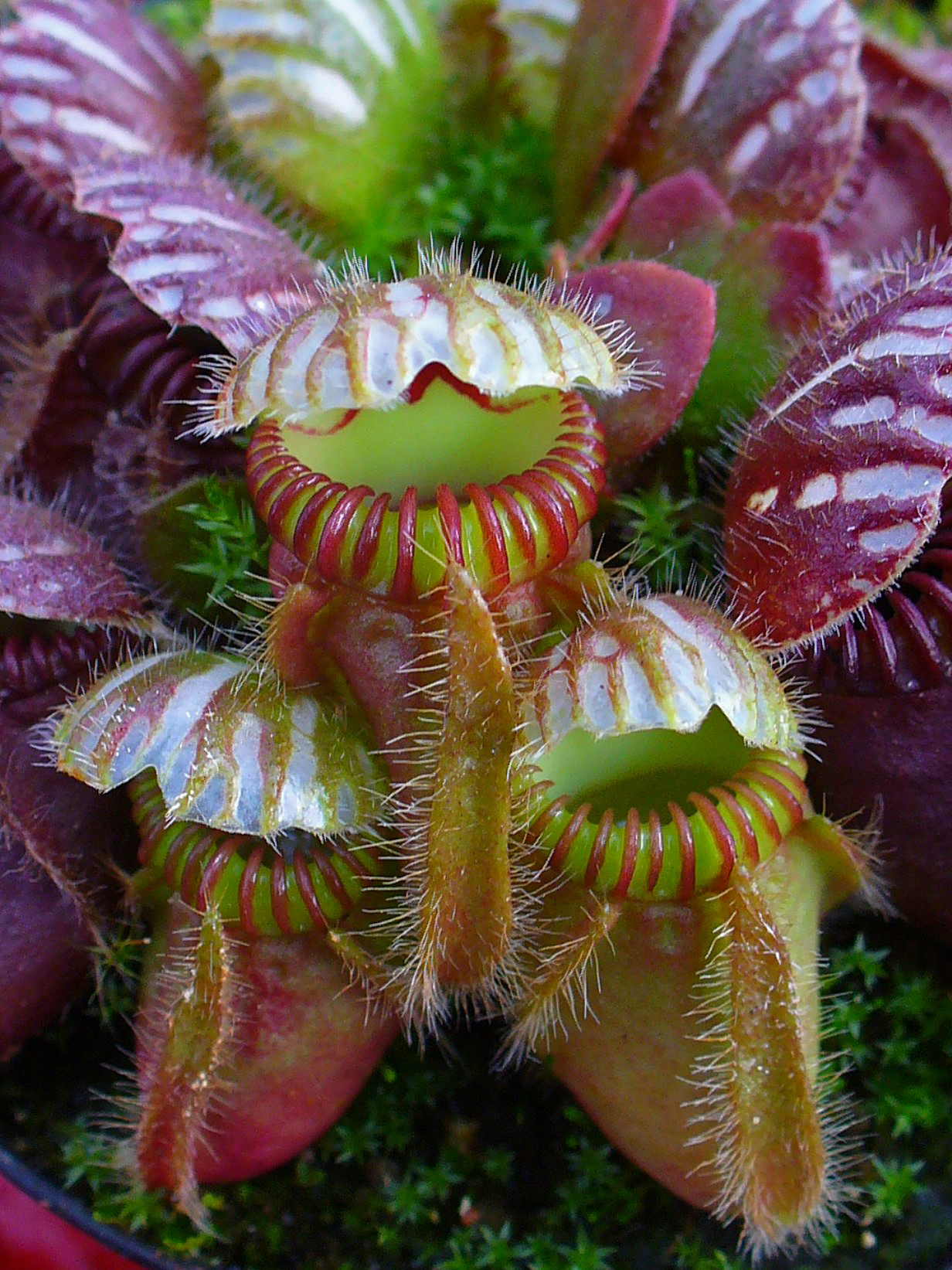
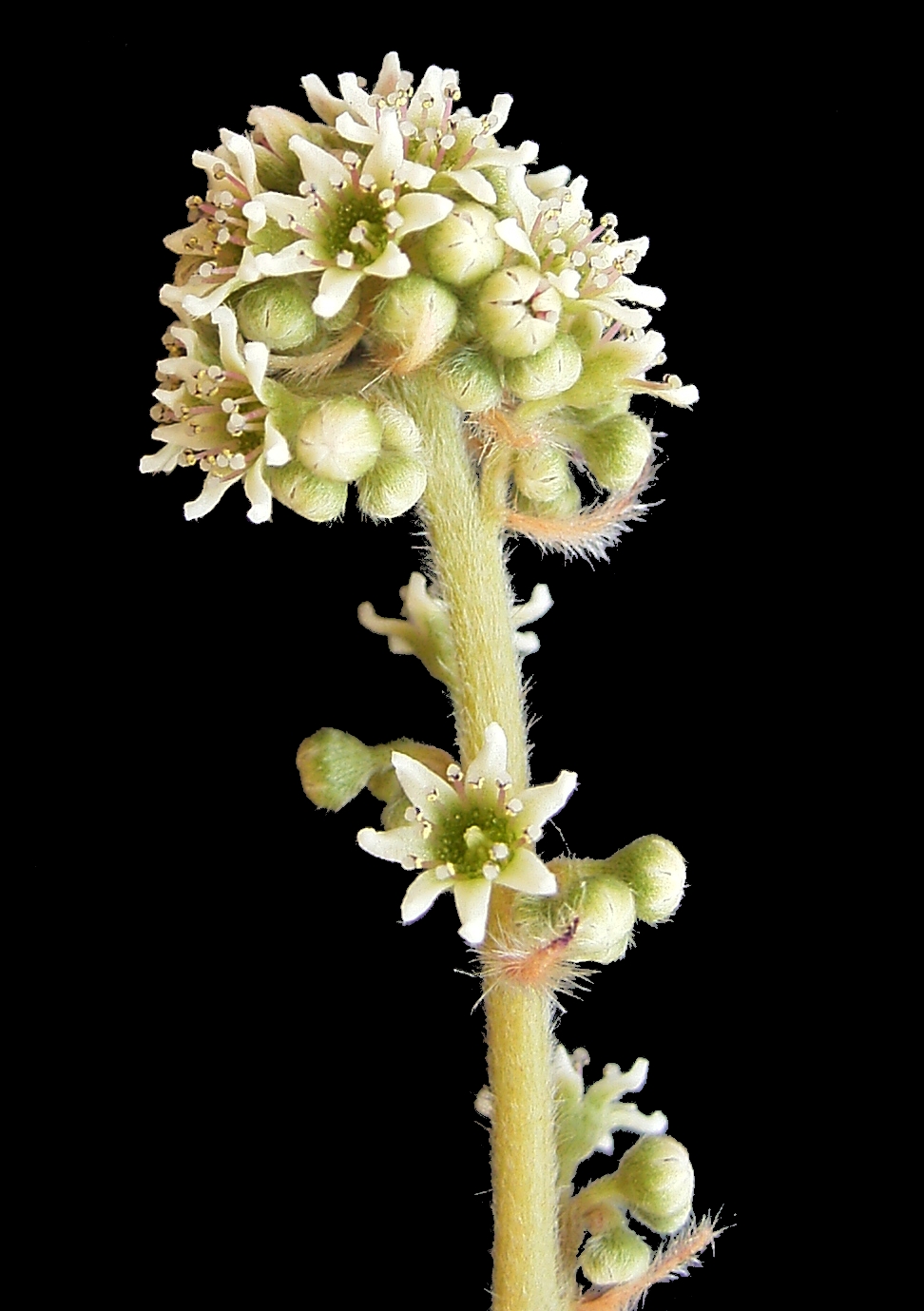
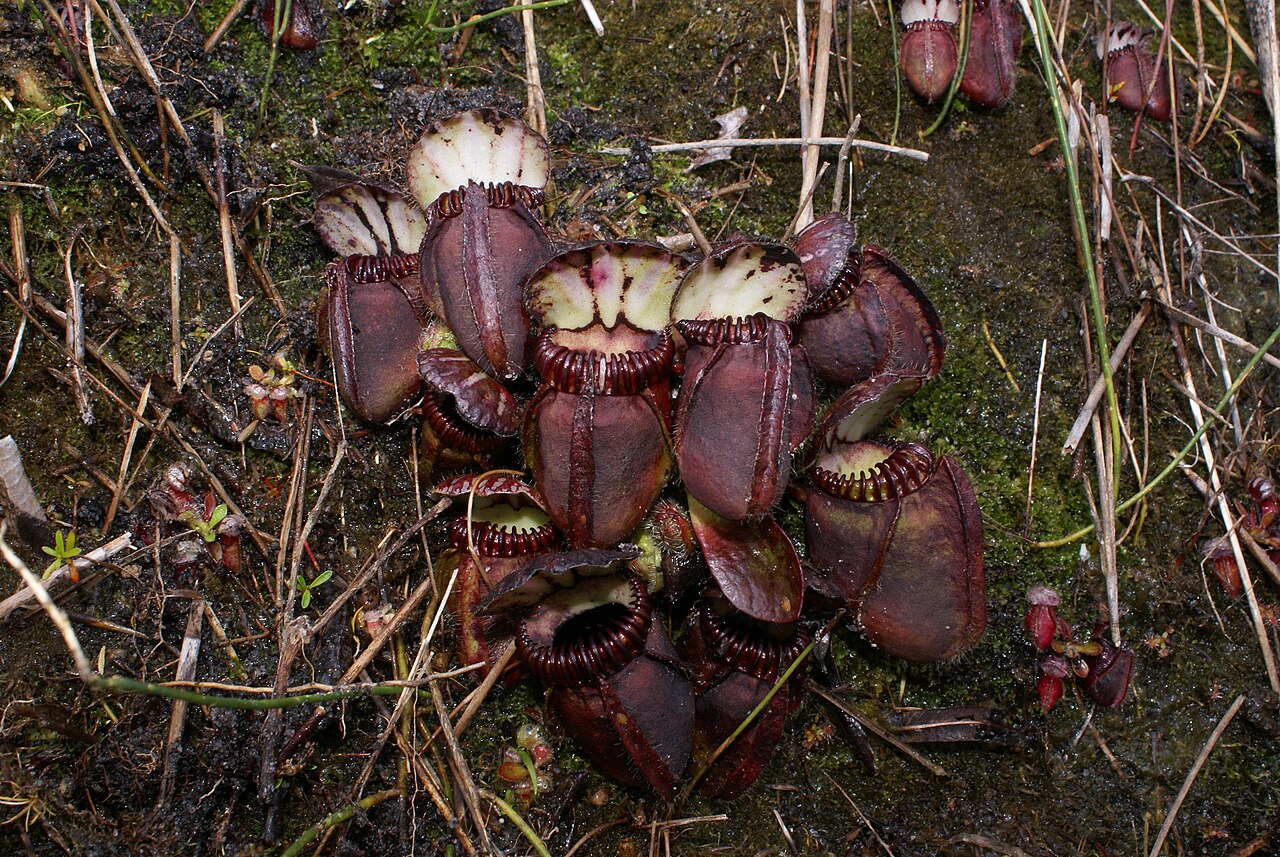
A low rosette with two leaf forms mixed together. The ordinary leaves are flat, leathery and elliptic, and catch nothing. Among them lie the pitchers: squat, egg-shaped, the mouth tilted upwards, the outside carrying three lengthwise ribs densely set with hairs. The rim is a thick ribbed collar whose ribs end on the inside in sharp points. Above it stands a lid that roofs the pitcher and carries translucent windows, like skylights. In full sun pitcher and lid flush deep red to wine-coloured; in shade everything stays green. The plant itself stays low — no more than 20 cm — but in summer a bare scape up to 60 cm rises above it, bearing a raceme of very small white to cream flowers.
Similar species
In the field confusion is impossible: there is no second pitcher-bearing plant in Australia. The pitcher plants of South-East Asia (Nepenthes) hang from a tendril and belong to a quite different family; the American trumpet pitchers are upright tubes. Anyone meeting the plant outside the pitcher season sees only a rosette of smooth flat leaves and could take it for anything — then look among the litter for old weathered pitchers, which persist for a long time. Sundews share the same little swamps: they carry glandular hairs with a droplet on a flat blade, and no hollow vessel.
The trap and how it works
The pitcher is a leaf folded shut into a jug, lying among the moss on the ground with its mouth on the ants' route. The three hairy ribs run up to the rim like ladders, and nectar along the rim and on the lid does the rest. The collar around the mouth is smooth and its ribs end in inward-pointing spikes: an insect gets over them, but not back. Below stands fluid with digestive enzymes, against a smooth waxy wall. The lid keeps the rain out and carries translucent windows — an insect flying towards the light hits the roof and drops. Nothing moves: this trap lives by its architecture, not by speed. The catch is accordingly made up mostly of ants and other ground-walking prey.
Habitat and ecology
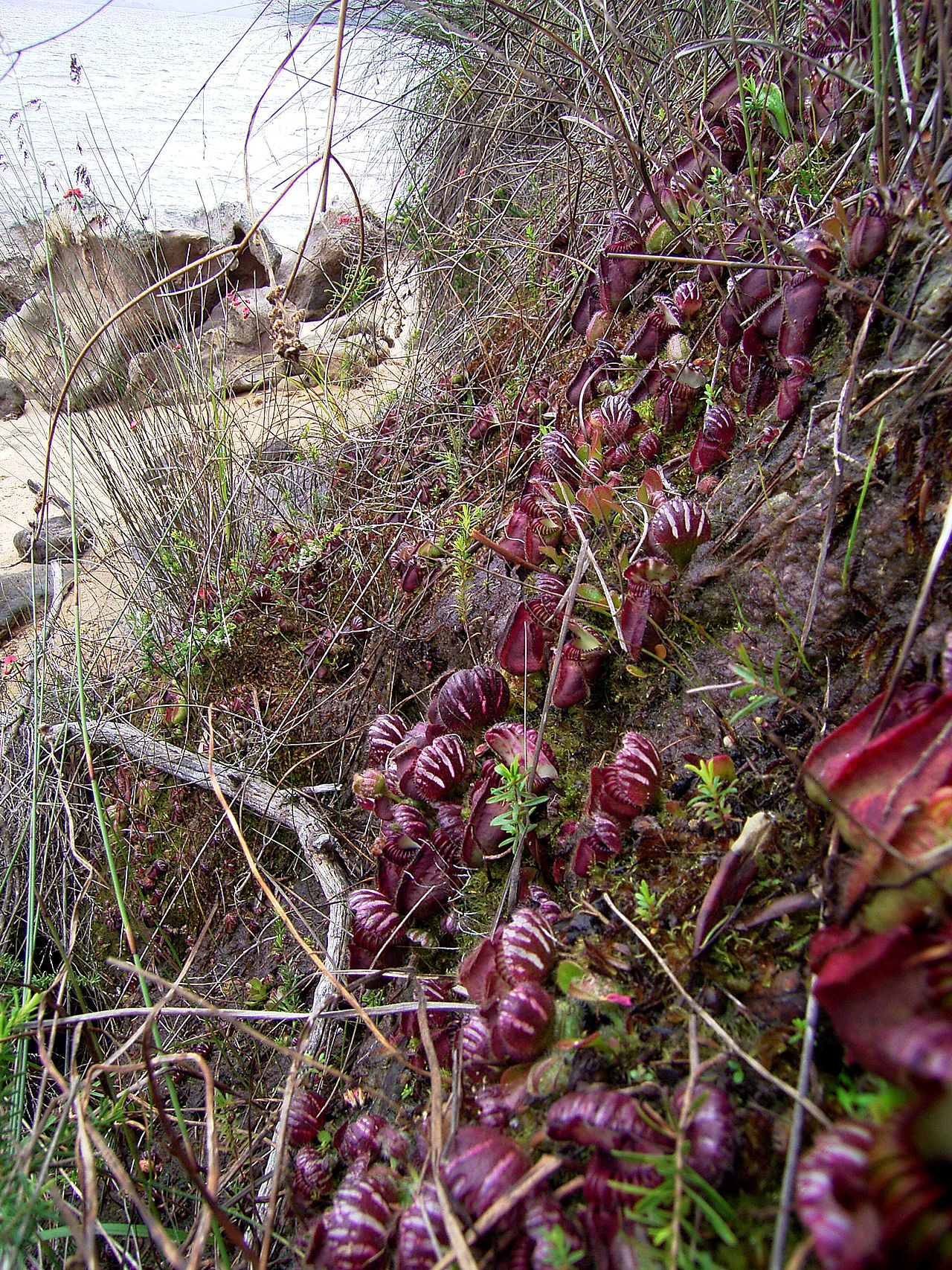
Wet peaty sand: small swamps, seepage patches and the banks of creeks and streams in the south-west of Western Australia, often in the half-shade of scrub but just as readily in full sun among sedges. The soil is acid, poor and moist all year; through the mediterranean summer of the south coast, seepage keeps the spot wet while the surroundings dry out. Fire belongs to this landscape and the plant takes it: it resprouts afterwards from the rootstock.
Distribution and elevation
The south-west of Western Australia only, in a narrow strip along the south coast. The source followed here names the Warren district, the southern Jarrah Forest and the Esperance Plains; beyond that coastal country the species is native nowhere. It is one of the smallest ranges in this guide, and at the same time the entire range of a family: the Cephalotaceae consist of this one species. The source gives no altitudes; everywhere it is lowland close to the coast.
- Recorded (quarter-degree cells)
Forms and variation
In the wild variation is limited to the colour and size of the pitchers: plants in full sun are squat and deep red, plants in shade larger and green, and that already differs from spot to spot within one swamp. No varieties or subspecies are recognised, and natural hybrids cannot exist — there is no second species to cross with. What circulates in collections under names in quotation marks was selected in cultivation and has no place in this guide.
Where and when to see it
December to April, the Australian summer: it flowers then, and the pitchers are full grown and at their deepest colour. Search close to the ground, because the pitchers lie among moss, sedge and litter and are all but invisible from standing height; the flowering stem gives the plant away sooner than the pitcher does. The wet seepage margins along creeks in the south-coast reserves between Walpole, Denmark and Albany are the best-known ground. Do not tip out pitchers to see what is inside: that fluid is the plant's stomach.
Conservation status
Vulnerable on the Red List; the Western Australian herbarium does not count it among the state's threatened flora, and it is not in the CITES appendices. Its range is small and its sites are fragile: drainage, roadworks, trampling of the seepage margins and the digging of plants for collections are the threats, with altered fire regimes alongside them. Because the species is propagated in quantity by tissue culture, the trade no longer needs a wild plant.
Scientific name
Cephalotus follicularis | Labillardière, 1806
Jacques Labillardière described the species in 1806 in Novae Hollandiae Plantarum Specimen, based on material collected by Jean Baptiste Leschenault de la Tour. The type locality lies in south-western Western Australia, in the coastal strip between Augusta and Cape Riche where the species occurs naturally. The genus name Cephalotus comes from the Greek kephalé ('head') and ous/ōtos ('ear'), referring to the shape of the anthers. The species epithet follicularis is Latin for 'sack-shaped', referring to the pouch-like pitcher traps.
World Checklist of Vascular Plants (WCVP), via Plants of the World Online (POWO), Royal Botanic Gardens, Kew.