All species › Caryophyllales › Sundew family › Drosera rotundifolia
Drosera rotundifolia | Round-leaved sundew
Ronde zonnedauw
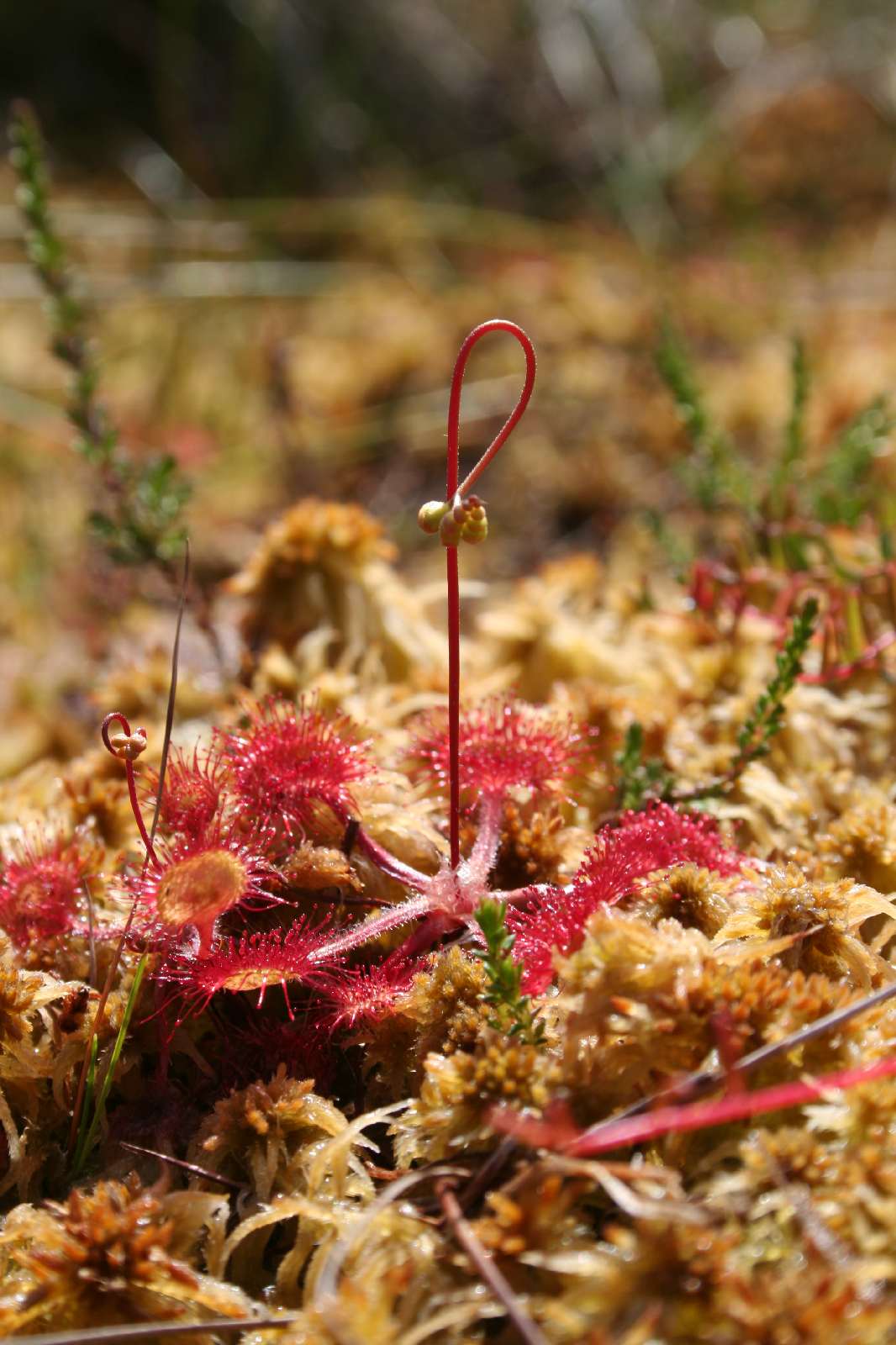
The sundew of the northern European bog, and the yardstick against which you measure all the others. It is rarely bigger than a beer mat and vanishes completely into the sphagnum — until the sun drops and the moss turns out to be full of little red stars hung with glittering droplets. Of all the plants in this guide it has by far the largest range: it runs almost the whole way round the northern temperate zone.
Natural hybrids
Identification
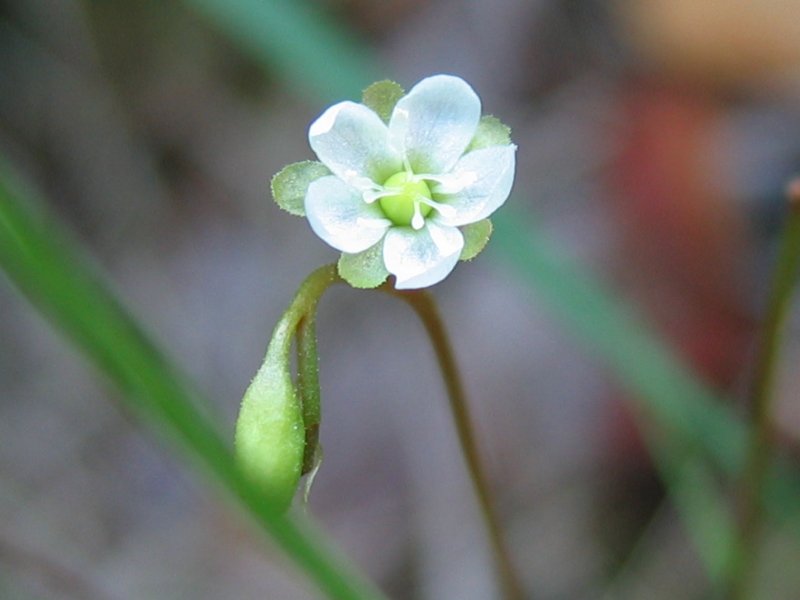
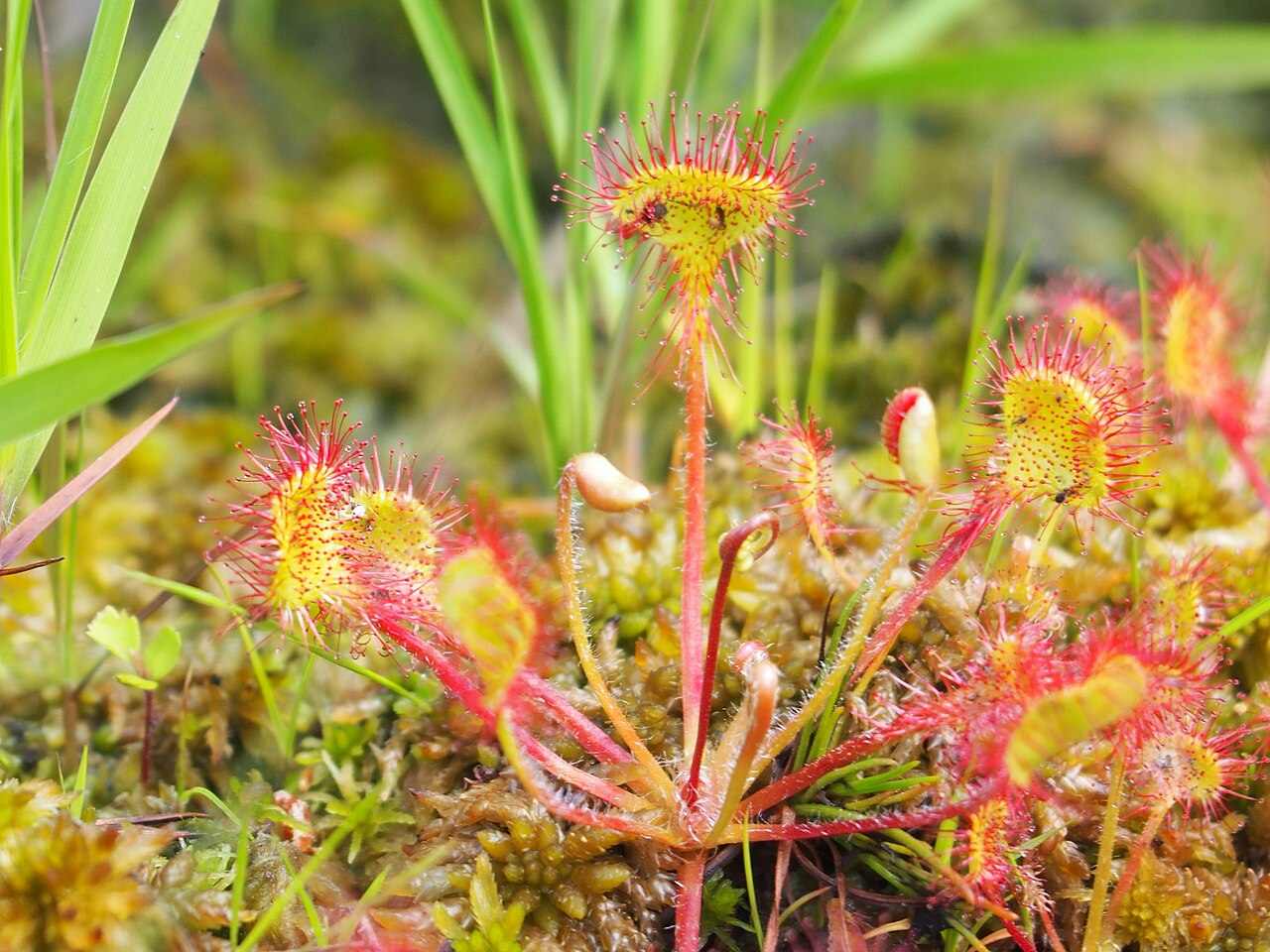
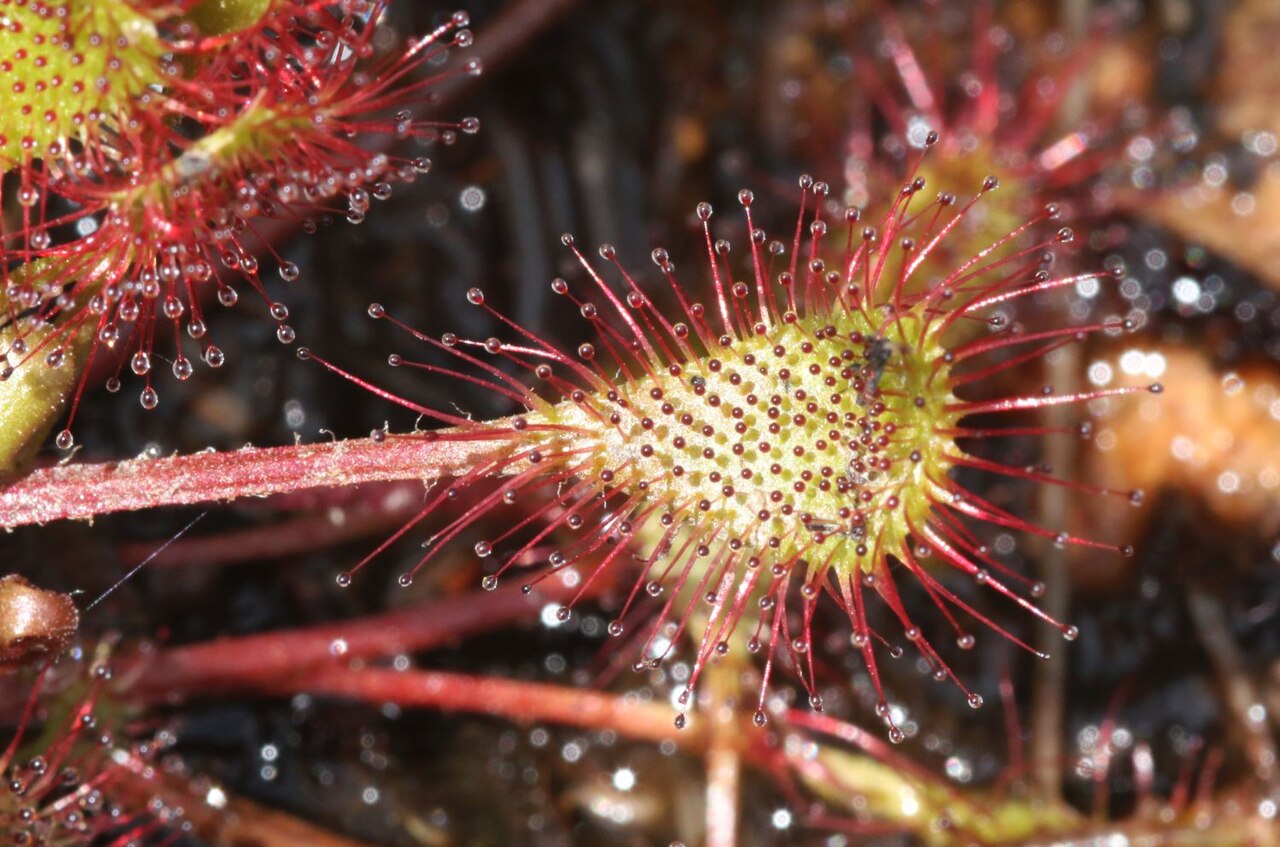
A flat rosette of leaves lying against the moss. The lamina is 4 to 10 mm long and 4.5 to 18 mm wide — as broad as long or broader, and that is the character everything turns on — and narrows abruptly into a usually hairy petiole 1 to 3.5 cm long. The upper face of the lamina carries tentacles 4 to 5 mm long, each with a clear drop of glue; they lengthen towards the margin and turn deep red in full sun. One to three bare scapes 7 to 25 cm tall rise from the middle of the rosette, well above the leaves, bearing 6 to 10 flowers along one side of a tip that slowly uncoils. The petals are white and 4.5 to 5 mm long; the flowers open for only a few hours on a sunny morning and pollinate themselves. In winter the plant withdraws into a bud of tightly rolled leaflets at ground level.
Similar species
Two other sundews grow on the same European peat, and they separate on the shape of the lamina. In Drosera anglica the lamina is three to six times longer than wide and the leaf is held obliquely upright; in D. intermedia it is two to three times longer than wide and the scape leaves the rosette from the side, curving downwards first. Only in this species is the lamina as broad as long or broader, and only here do the leaves lie flat. Where two species grow together the hybrids D. × obovata and D. × belezeana turn up; both are sterile and intermediate in leaf shape. In the south-east of the United States its range reaches into the states of the Venus flytrap (Dionaea muscipula): that plant has a leaf with a hinge, a sundew has glandular hairs with a droplet and no hinge.
The trap and how it works
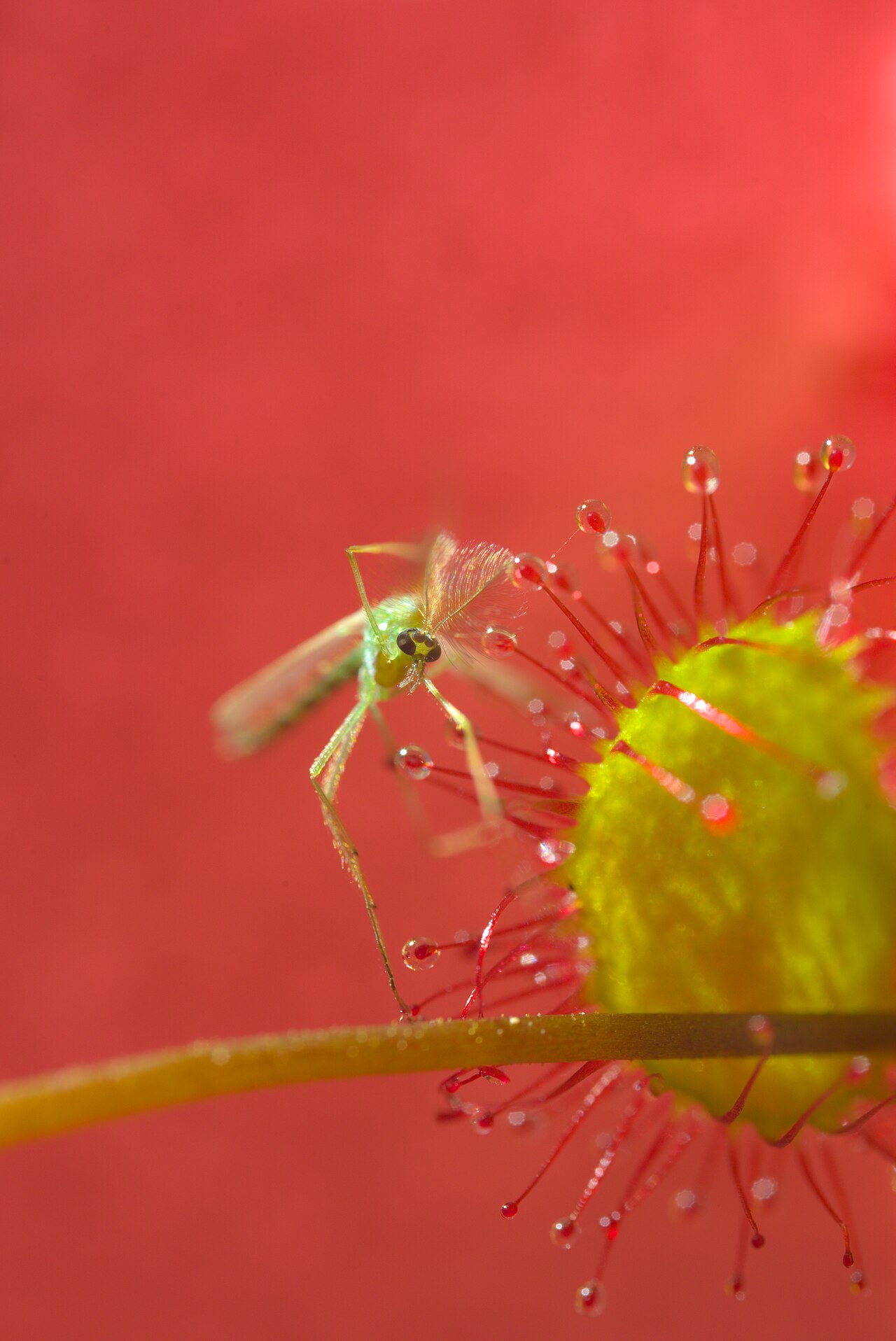
An active flypaper trap. Every tentacle carries, on a stalk, a drop of viscous mucilage that looks like dew and does not dry; small flies drifting over the peat settle on it and do not get off again. The stimulus of a struggling insect first moves the tentacle it touched and then its neighbours: over minutes to hours they bend towards the centre of the leaf and lay the prey on the short glands there, which release the digestive fluid. With a large catch the lamina itself curls over a little, but it never goes further than a shallow bowl — and there it differs from D. capensis, whose whole leaf rolls more than half a turn around its prey. Digestion takes days; the tentacles then straighten and an empty husk is left for the first wind to take. On peat, nitrogen is the limiting factor, and the catch supplies most of the plant's share of it.
Habitat and ecology
Living raised bog: the plant roots in the sphagnum itself and climbs a little higher every year as the moss grows. Also wet heath, pool margins, quaking fen and old peat cuttings that have been rewetted. Always on acid, permanently wet, extremely nutrient-poor ground in full sun; the moment purple moor-grass or birch overtops it, it is gone. It shares that ground with cranberry, bog rosemary and white beak-sedge, and on European bogs with Pinguicula vulgaris. From sea level to the subalpine zone.
Distribution and elevation
Almost the whole way round the northern temperate zone: the distribution data list well over a hundred regions. In Europe from Iceland, Svalbard and Scandinavia to the mountains of Spain, Portugal, Italy, Greece and Turkey, with an outlier into the Near East; through the Caucasus and the whole of Siberia to Kamchatka, Sakhalin, the Kurils, Japan and Korea, and with distant outposts in the mountains of New Guinea and the Philippines. In North America from Alaska, Greenland and Newfoundland south to California, Oregon, the Appalachians and the coastal plain of the Carolinas. Beyond that natural range it is naturalised in southern South America.
- Recorded (quarter-degree cells)
Forms and variation
Little to report, which for a range of this size is remarkable. No varieties are recognised. What varies is colour — from nearly all green in shade to deep red in full sun — and the length of the petiole, which simply grows with the depth of the moss; both already differ from plant to plant within one hollow. The real variation lies in the hybrids with the two other European species, D. × obovata and D. × belezeana. They are sterile, intermediate in leaf shape, and always stand between their parents.
Where and when to see it
June to August, on a sunny morning: that is when the droplets glitter and you see rosettes you would have walked over an hour earlier. Look in the bogs of the Low Countries and their neighbours — Bargerveen, Fochteloërveen, Dwingelderveld, the Hautes Fagnes — along the edges of wet sphagnum hollows and old peat cuttings, where it often stands in hundreds. Get down on your knees and look into the sun; from above with the sun behind you it is all but invisible. Stay on the path or the boardwalk: sphagnum does not recover from a footprint for years, and the plant is in it.
Conservation status
Least Concern on the world list, and rightly so: the range is enormous and in Fennoscandia and Siberia the plant is common. In western Europe the picture is different. The bogs went and the plant went with them; in the Netherlands and Belgium it holds on in the remnants that have been rewetted. Drainage and land conversion are the direct cause, nitrogen deposition the indirect one, because purple moor-grass overgrows the sphagnum and crowds the rosettes out. Switzerland lists it nationally as Near Threatened and several cantons protect it outright; it appears on regional red lists elsewhere too. Collecting plays no real part here — it is the peat that is scarce, not the plant.
Scientific name
Drosera rotundifolia | Linnaeus, 1753
Linnaeus described the species in 1753 in Species Plantarum. No precise type locality was given; the species occurs naturally in bogs across large parts of Europe, Asia and North America. The genus name Drosera comes from the Greek droseros ('dewy'), referring to the glistening sticky droplets on the glandular hairs. The species epithet rotundifolia is Latin for 'round-leaved', referring to the shape of the leaf blade.
World Checklist of Vascular Plants (WCVP), via Plants of the World Online (POWO), Royal Botanic Gardens, Kew.