All species › Caryophyllales › Sundew family › Drosera capensis
Drosera capensis | Cape sundew
Kaapse zonnedauw
The sundew with the long strap-shaped leaf, in the wild a plant of the permanently wet places in the fynbos of the Western Cape. It is grown almost everywhere in the world, and for exactly that reason it has ended up loose in the open in several places outside Africa, where it does conspicuously well. Anyone looking for it in South Africa needs the ground where water seeps through the soil all year round.
Identification
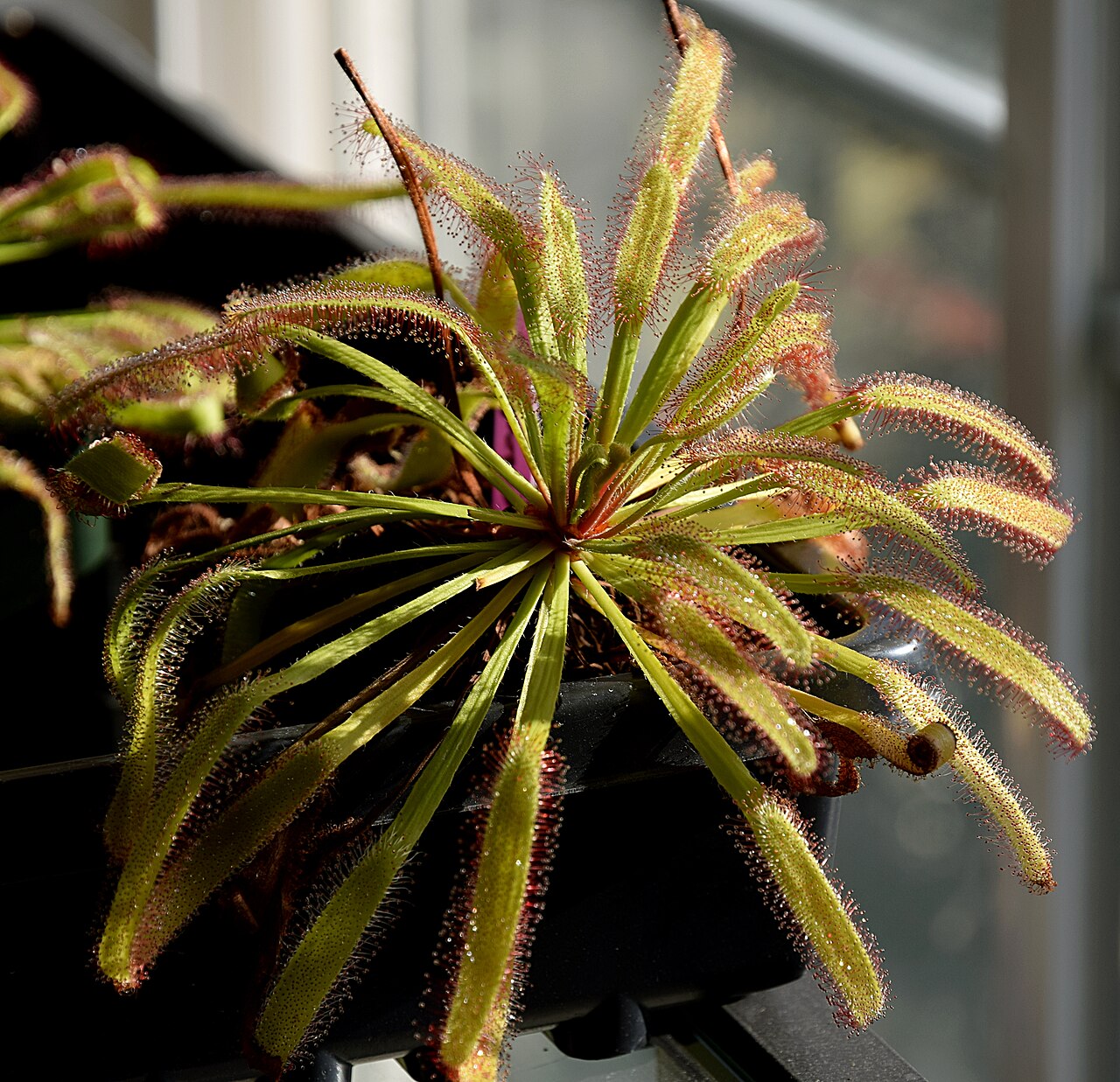
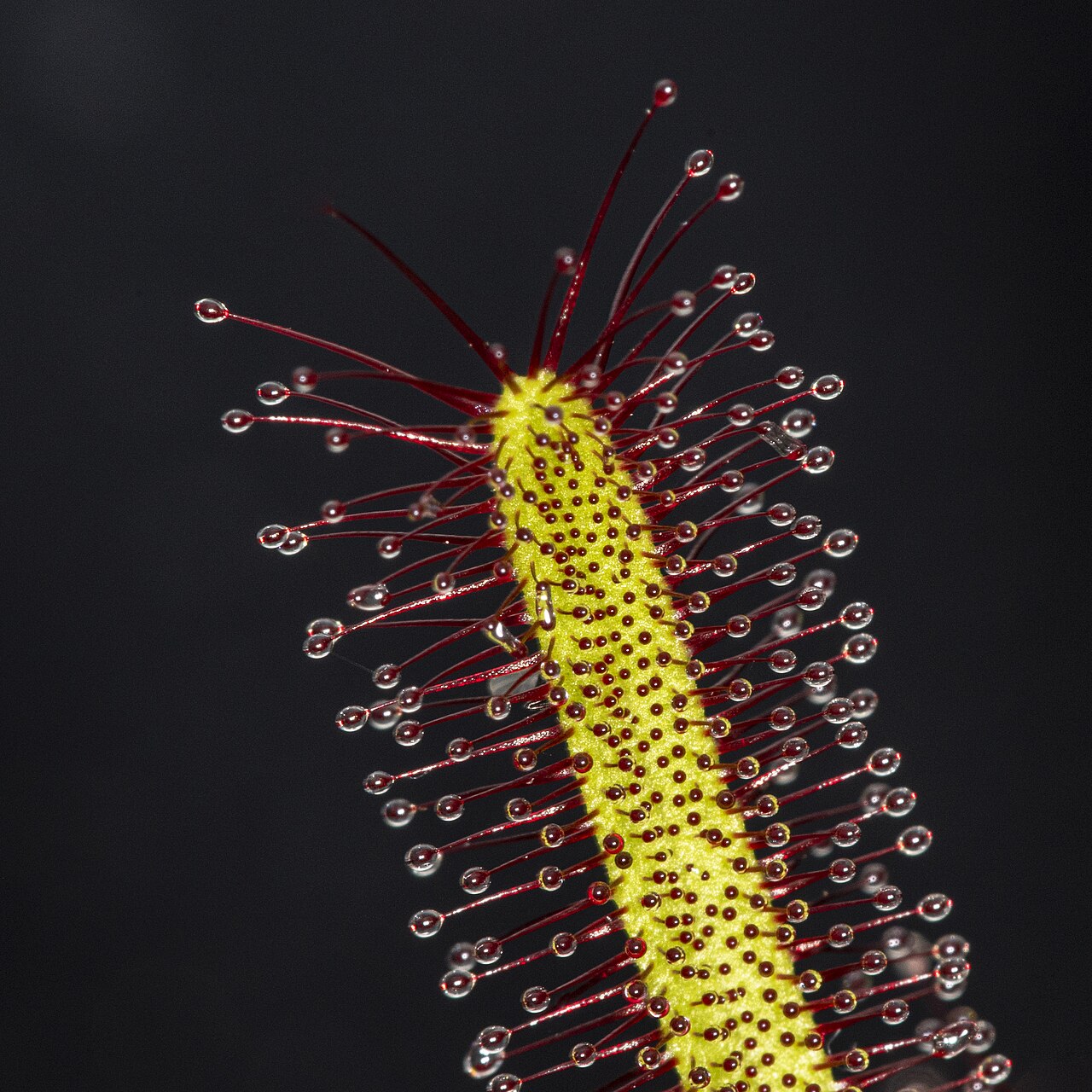
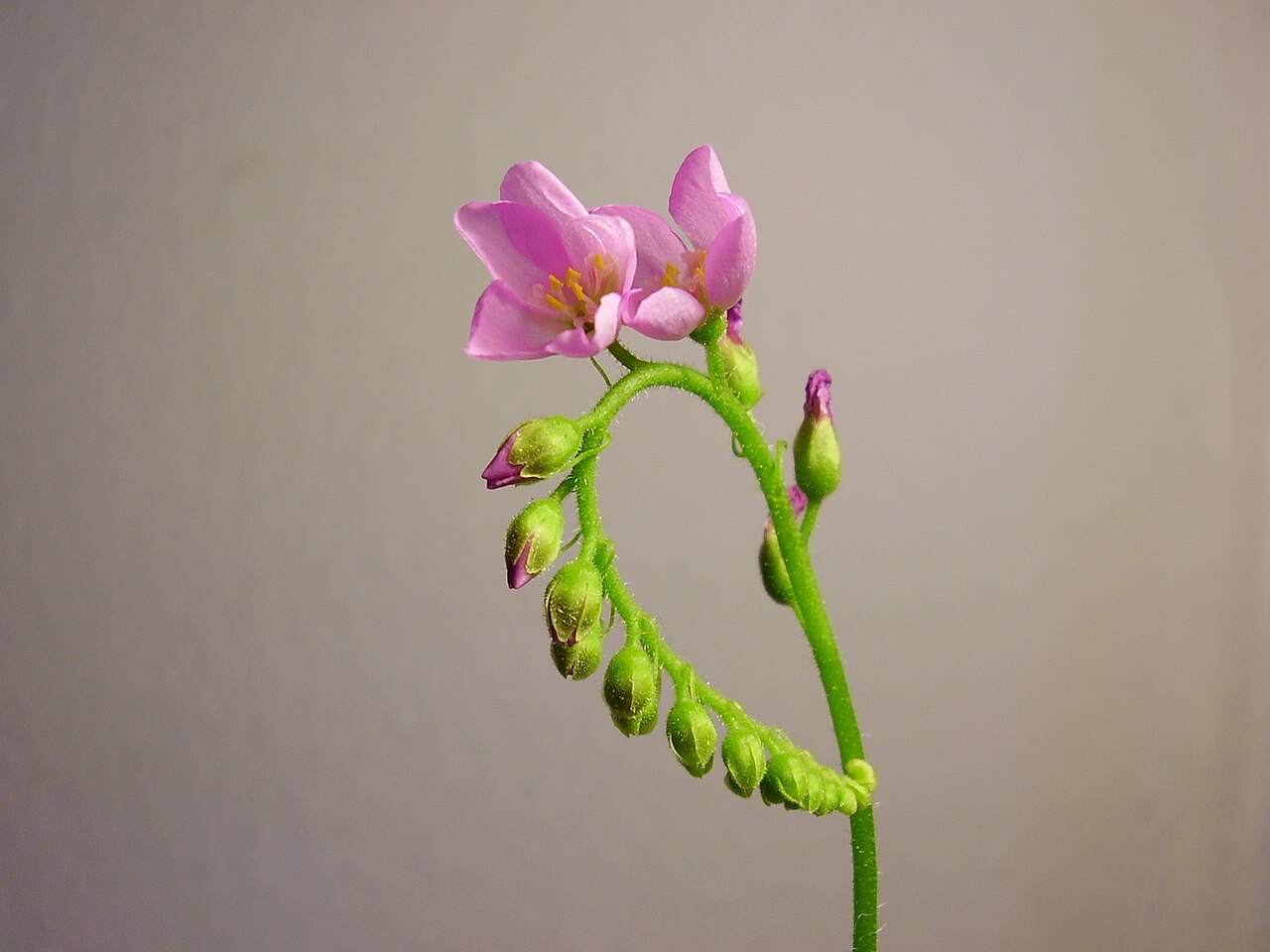
A rosette rising from a short woody stem with a creeping rhizome; over the years the stem lifts, carrying the rosette above its own dead leaves like a small palm. The plant is usually about 15 cm high. The leaves radiate from the stem; petiole and lamina are roughly equal in length, and the lamina is narrow and strap-shaped, far longer than wide. Its margin carries a dense fringe of stalked glandular hairs with a droplet; towards the centre they are fewer and shorter. The lower surface is smooth and hairless. A single scape carries 15 to 30 simple pink to mauve flowers that open in succession; flowering falls in the southern high summer, December and January. The seeds are minute and black.
Similar species
Other rosetted sundews grow in the fynbos, but their leaves are spathulate or wedge-shaped and at most a few times longer than wide — Drosera aliciae and D. cuneifolia among them. The long strap on an equally long petiole is the character here. D. regia, from the same region, is told by being far larger and by having no distinct petiole: there the leaf runs in one piece from the base. D. binata has a forked leaf and grows on the other side of the world. Compare it too with the Venus flytrap (Dionaea muscipula) from the same family: that one shuts on a hinge in a tenth of a second, while this leaf takes hours to roll itself around its prey.
The trap and how it works
An active flypaper trap, and of the five sundews in this guide the one that goes furthest. The glandular hairs tell prey from a raindrop: water gets no response. Once an insect is stuck, the surrounding tentacles lean slowly over it. Then the leaf itself moves: the narrow lamina can bend through more than half a turn and rolls around the prey, pressing it against glands on every side. How fast that happens depends on where on the leaf the prey landed — near the tip it is quicker than near the base. After digestion the leaf straightens again, often with the empty husk still on it. Of its neighbours here, D. rotundifolia does the same thing far more modestly, while D. glanduligera moves a hundred times faster by an entirely different mechanism.
Habitat and ecology
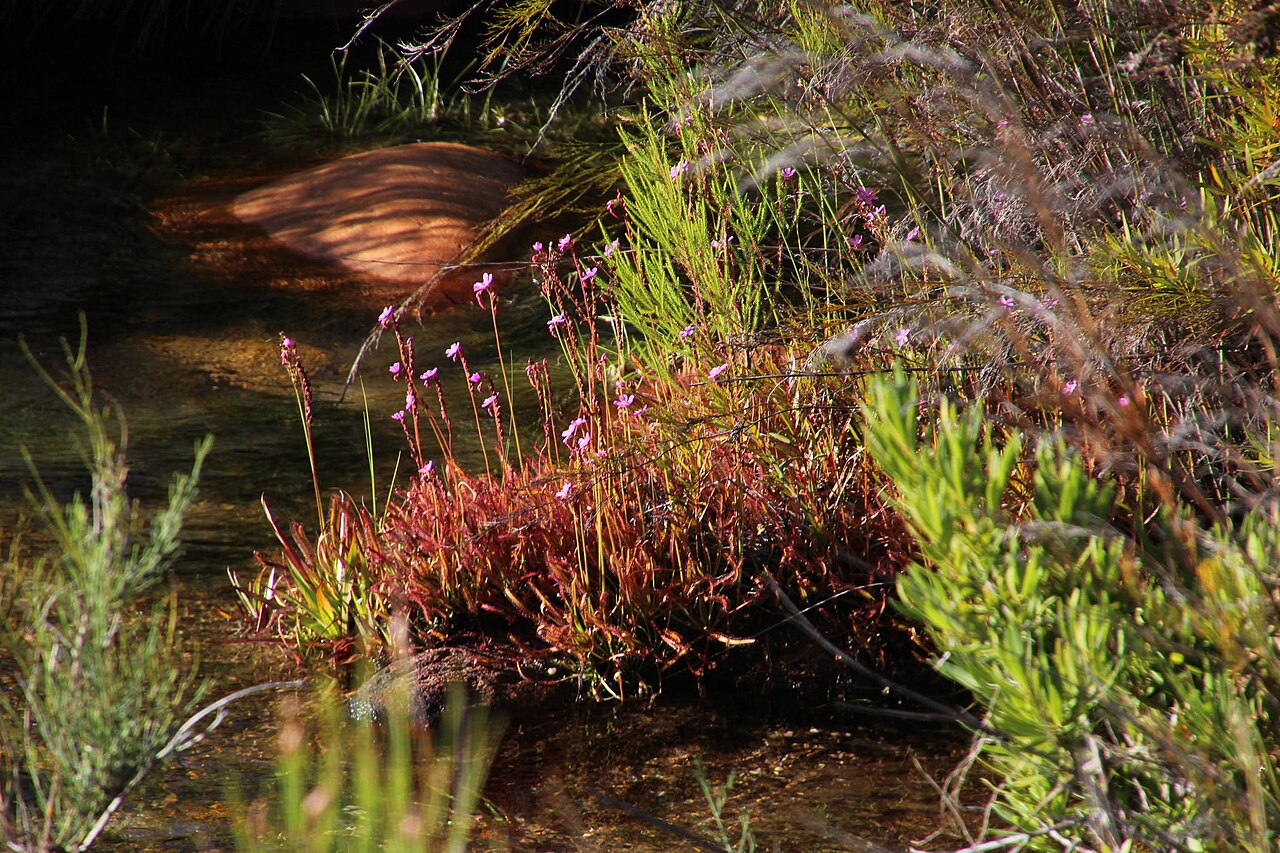
Permanently wet ground in fynbos: seepages that give off water the year round, marshy hollows, stream banks and damp patches among the shrubs. The soil is acid and poor, usually sand derived from sandstone, and stays wet through the dry Cape summer. Full sun. As with almost everything in fynbos the site depends on fire: after a burn the seepage lies open and the rosettes stand in full light, and then the shrub layer closes again.
Distribution and elevation
Native only to the Cape Provinces of South Africa, with its centre in the south-western Cape. Beyond that it has escaped in several places and maintains itself unaided: in California and in New South Wales in Australia, and at a handful of other sites. Those colonies are not natural spread but the work of growers and enthusiasts, deliberate or accidental; on some of them it forms dense continuous mats that leave little room for the region's own wetland plants.
- Recorded (quarter-degree cells)
Forms and variation
Two forms are known in the wild besides the ordinary one: a white-flowered form, whose petals lack the pink, and a broad-leaved form, whose lamina is distinctly wider than the usual strap. Both occur within the native range among normal plants and are not products of cultivation. Beyond that it is mainly the degree of red colouring that varies, and that depends heavily on how much sun the plant gets. The many names in the trade for red, dwarf or extra-broad plants are cultivars and have no place in this guide.
Where and when to see it
December and January, when the scapes rise above the shrubs with a row of pink flowers open; on a stalk like that you see the plant from a distance, while the rosette itself disappears among the restios. Walk the ground where water visibly seeps all year — the line of permanently wet sand or dark peat running through dry fynbos — and look down there. A site that burned a few years ago gives the best chance, because the shrub layer is still low. Where it has escaped, the reverse applies: take nothing away and let no seed ride out on your boots.
Conservation status
Not evaluated worldwide: the Red List has never assessed the species, so there is no category. What is known points the same way: in South Africa it counts as not threatened, it occurs across a large part of the Cape, and many of its sites lie inside protected land. With this species the problem is on the other side. Outside South Africa it has naturalised and locally forms dense mats that crowd out native wetland plants; in those areas it is treated as a troublesome alien and sometimes actively controlled. Wild collecting plays no part: hardly any carnivorous plant is easier to raise from seed.
Scientific name
Drosera capensis | Linnaeus, 1753
Linnaeus described the species in 1753 in Species Plantarum, giving as its origin the overly broad 'Aethiopia' — the common, rather loose Linnaean designation for sub-Saharan Africa. The type locality lies in the Cape Province of South Africa, where the species is still most common today. The species epithet capensis means 'of the Cape', referring to the Cape of Good Hope in South Africa.
World Checklist of Vascular Plants (WCVP), via Plants of the World Online (POWO), Royal Botanic Gardens, Kew.