All species › Caryophyllales › Sundew family › Drosera regia
Drosera regia | King sundew
Koningszonnedauw
The largest sundew in the world, and at the same time one of the rarest. Its leaves reach seventy centimetres: not a rosette you walk past, but a sheaf of straps fanning out from a woody rhizome. It comes from one small piece of mountain in the Western Cape and from nowhere else. In the family tree of the genus it stands apart, a branch of its own beside all the other sundews put together.
Identification
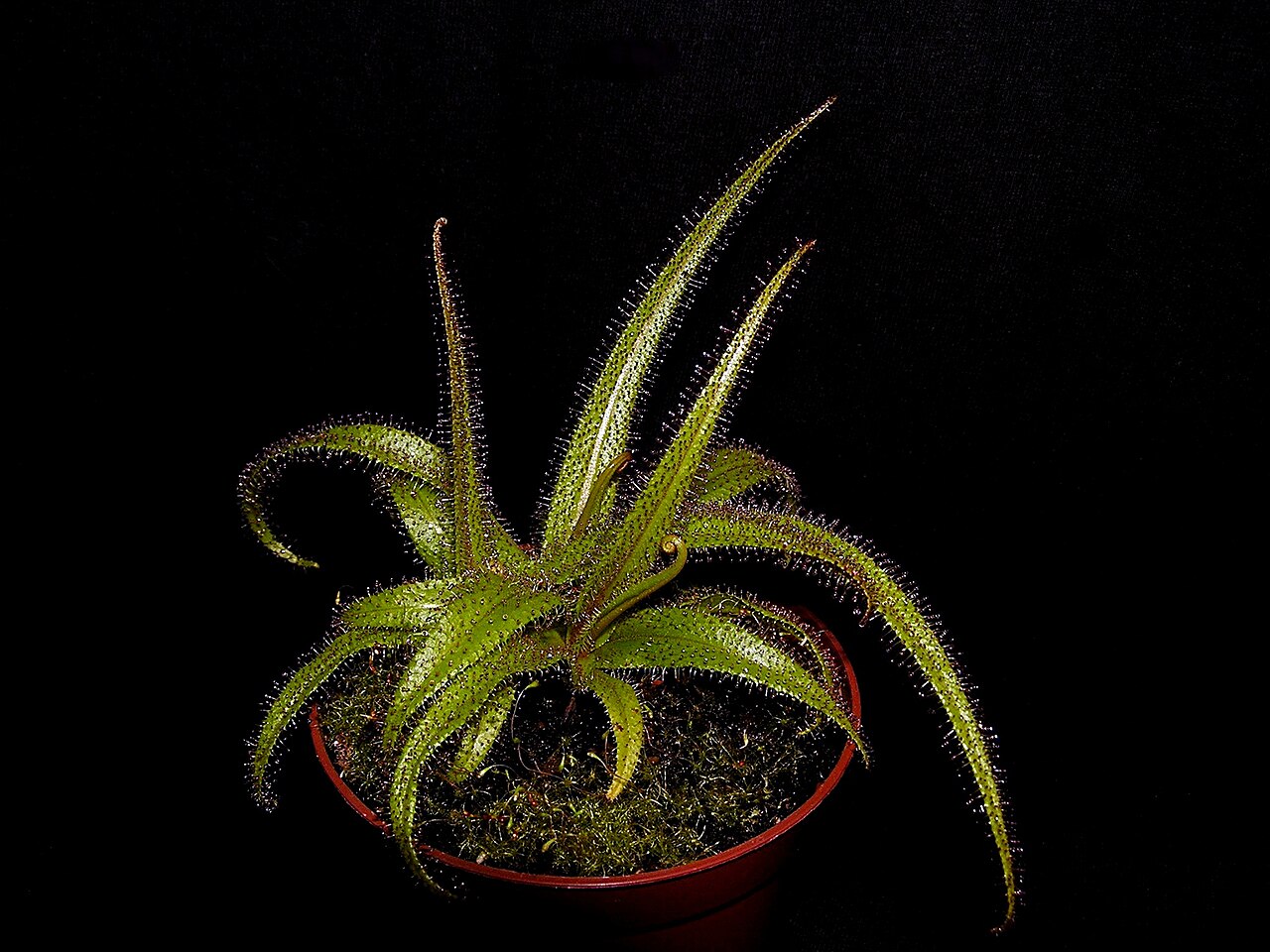
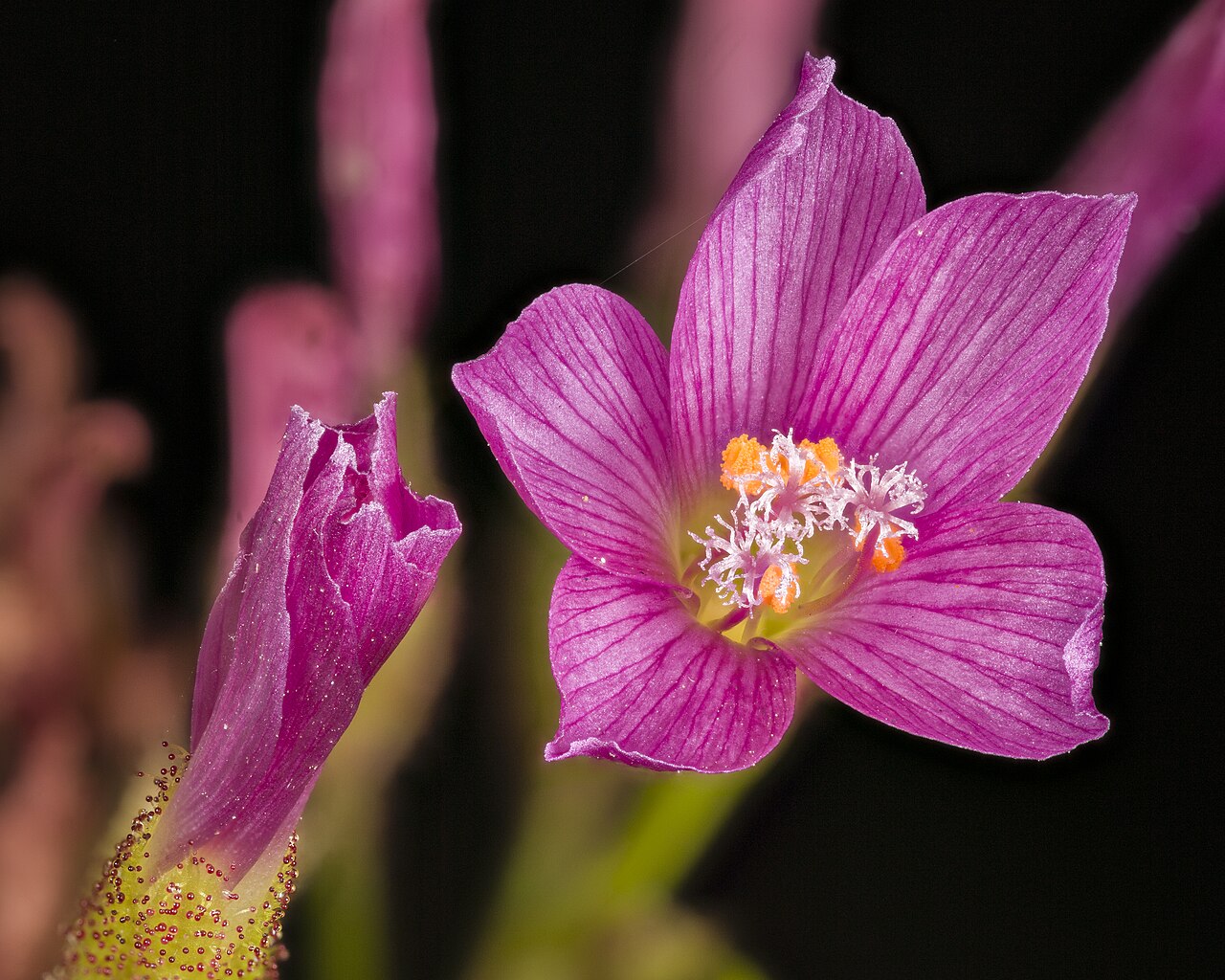
A substantial herb with a horizontal woody rhizome bearing a crown of long linear leaves that stand up and out. A leaf reaches 70 cm long and about 2 cm wide and runs out into a thread-like point; there is no separate petiole and there are no stipules — the leaf runs in one piece from the base and carries stalked glandular hairs with a droplet over almost its whole upper face. Older leaves sag and curl at the tip. The scape reaches 40 cm and carries 5 to 20, sometimes 30 unscented pink flowers with petals 2 to 3 cm long — exceptionally large for a sundew. Flowering falls in January and February, the middle of the southern summer.
Similar species
With a full-grown plant confusion is all but impossible: no other sundew has leaves of this length. A young plant can suggest Drosera capensis, which grows in the same part of the Cape, but in D. capensis there is a clear petiole about as long as the lamina, and here that is absent altogether. D. binata, the only other sundew in this guide with a long narrow leaf, has that leaf forked. If you go by the flower alone, go by size: petals 2 to 3 cm long belong to no other sundew.
The trap and how it works
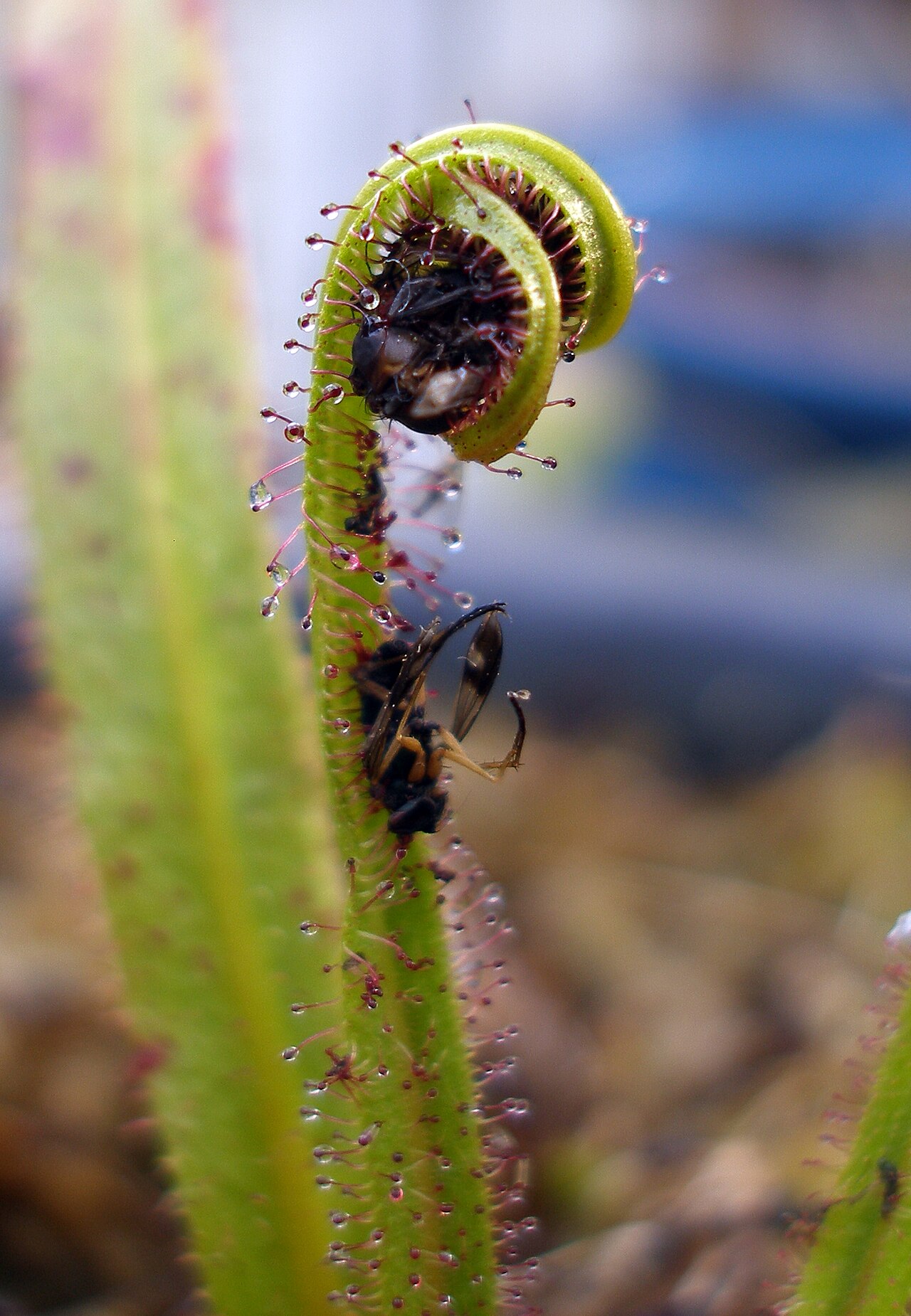
An active flypaper trap on a large scale. The whole upper face of the long leaf carries tentacles with a viscous droplet, and an insect that lands on it sinks in. The tentacles it touched bend towards the leaf and draw the prey down towards the base; with a large catch the leaf tip curls over too, so that the leaf wraps around the prey like a long band. That is slower and less complete than in D. capensis, whose narrow leaf really rolls up, but the reach is far greater: because the leaves stand high above the ground this species also takes flying insects that a ground-hugging rosette sundew never meets. Digestion takes days, after which the leaf straightens again. Unlike most of its relatives, the scape does not uncoil like a fern crozier as it grows.
Habitat and ecology
Damp, boggy ground high in the mountains, in fynbos on sandstone. The soil is acid, peaty-sandy and kept wet the year round by seepage; the plant stands in full sun among restios and low shrubs. As everywhere in fynbos, fire is part of the system: after a burn the site lies open and the rhizome shoots again. It grows between roughly 500 and 900 m.
Distribution and elevation
Only in the Cape Provinces of South Africa, and within them confined to one small mountain massif in the Western Cape. The national assessment of 2011 puts the whole area within which the species occurs at about 60 square kilometres — smaller than a mid-sized municipality. There is no second locality elsewhere in the country and no population anywhere outside South Africa that holds on unaided. Beyond 'the Cape Provinces' this guide deliberately does not go.
- Recorded (one-degree cells)
Forms and variation
No varieties or colour forms are recognised and no natural hybrids are known — in a species confined to a handful of hectares there is little room to vary. The plant also stands alone taxonomically: within the genus it forms a branch of its own beside all other sundews, which explains why it falls outside the usual range in almost every character. What you see differing in the field is age and site, not form.
Where and when to see it
This guide gives no locality and no coordinates, and that is deliberate: the entire range fits into a few tens of square kilometres, and the national assessment names the removal of plants from the well-known sites in so many words as the risk the species runs. Anyone who wants to see it should do so through the management of the reserve it lies in and with a guide who knows the ground; this is rough mountain country and the sites are on wet, steep slopes. Recognise it from a distance by the long straps standing above the low shrubs. Dig nothing up and take no cutting — seed-raised plants are legally available everywhere, wild plants are irreplaceable.
Conservation status
Not evaluated worldwide: the Red List has never assessed the species, so there is no international category, and for a plant with a range this small that is a gap. Nationally it has been looked at. The Red List of South African Plants placed it in 2011 in the category 'Rare': a highly localised habitat specialist with an extent of occurrence of about 60 square kilometres, whose habitat is well protected and which for that reason was not treated as threatened. The older literature reports it from only two stands, one of them estimated some fifteen years ago at around fifty mature plants; the assessors take the view that more plants stand in places that in this terrain simply cannot be reached. The only threat named is collecting at the well-known sites.
Scientific name
Drosera regia | Stephens, 1926
Drosera regia was described in 1926 by the South African botanist Edith Layard Stephens, published in Transactions of the Royal Society of South Africa, volume 13(4): 309–312. The type material comes from a single valley near the Bain's Kloof pass in the Western Cape province, South Africa, about 120 km north of Cape Town, growing in sandy and peaty soils in low-lying grassland (at elevations of roughly 500–900 m). Stephens was alerted to the site by a Mr J. Rennie, who had found the plants at Easter 1923 growing beside a stream; a second population was later found about 6.5 km away near Slanghoek Peak (1926). The epithet regia is Latin for "royal," and according to Stephens herself refers to the plant's striking, stately appearance — hence its common name "King Sundew." A role for the botanist Ted Oliver, sometimes mentioned in relation to this species, could not be confirmed as part of the original description or discovery in the sources consulted.
World Checklist of Vascular Plants (WCVP), via Plants of the World Online (POWO), Royal Botanic Gardens, Kew.