All species › Caryophyllales › Sundew family › Drosera binata
Drosera binata | Forked sundew
The only sundew with a forked leaf, and that alone is the whole identification. Where every other species in this guide has a round, spathulate or strap-shaped blade, here the leaf splits in two like a tuning fork — and in many plants those two split again. It grows in Australia, New Zealand and on the Chatham Islands, which makes it the only one of these five to span two countries.


Identification
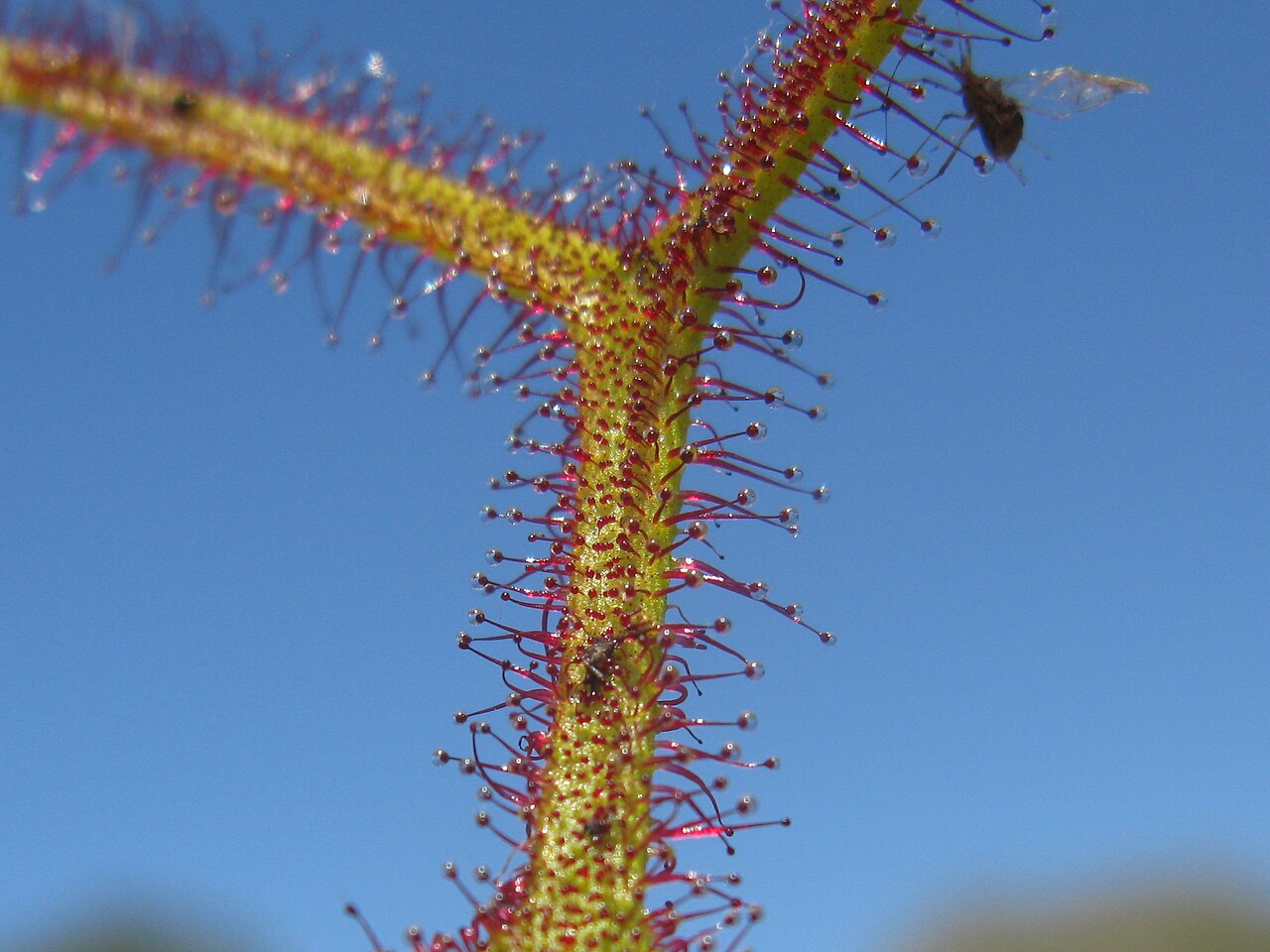
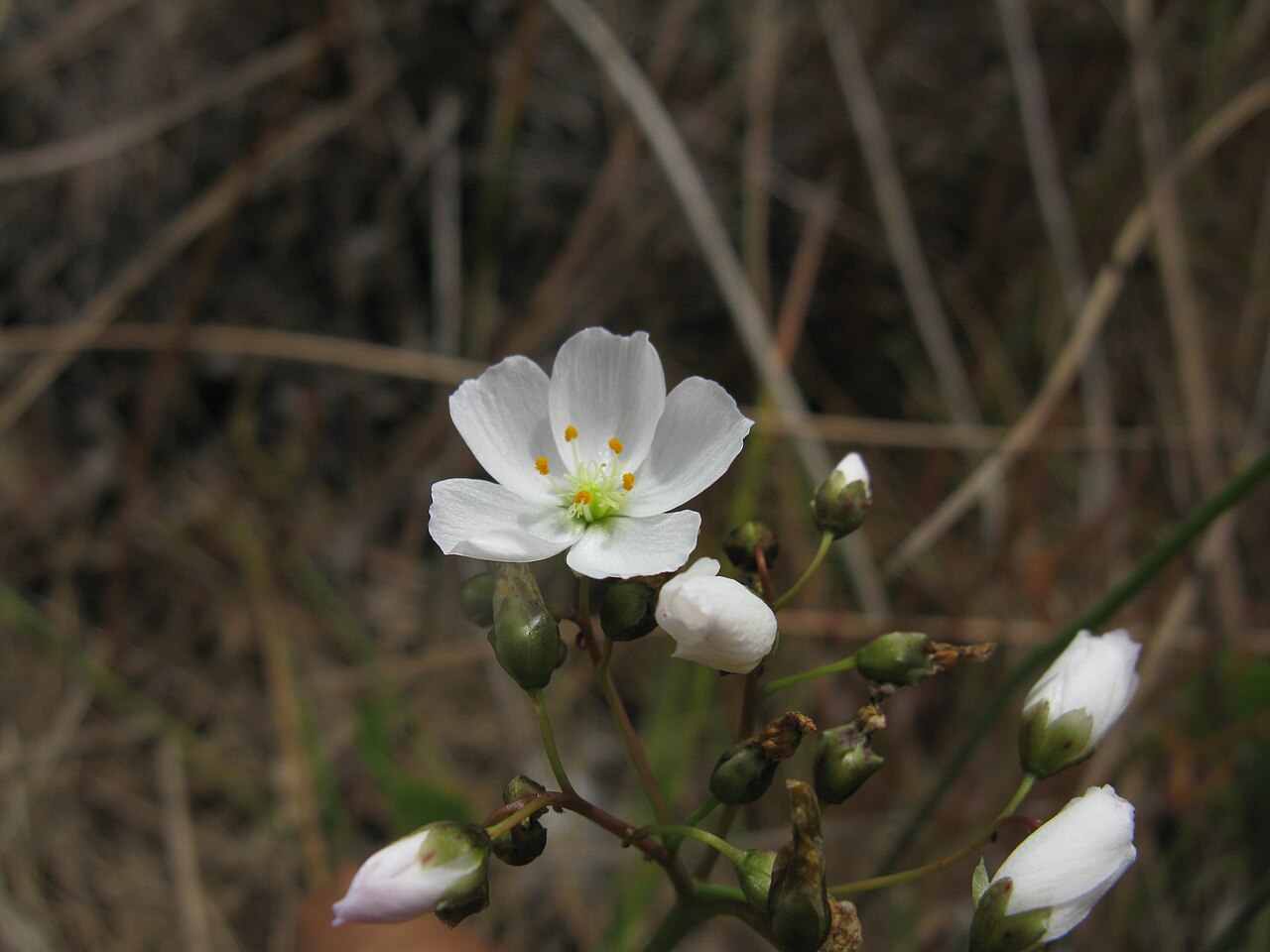
A fibrous-rooted herb that spreads into clumps from root buds; Western Australian plants reach 0.15 m high, and elsewhere in the range the plant grows considerably larger. Each leaf consists of a long, thin, hairless petiole carrying a narrow blade that divides in two immediately above it. The two arms may divide again, giving four or more points; in some plants this continues into a whole fan. Both sides of the fork carry stalked glandular hairs with a droplet along their full length, longer at the margin than in the middle, and they redden in sun. The leaves stand upright or lean outwards rather than lying flat on the ground as in most sundews. The flowers are white.
Similar species
With a full-grown leaf this is the easiest sundew in the world: no other species in the genus has a forked leaf. The difficulty is young plants, whose first leaves are still undivided and look like an ordinary narrow-leaved sundew. Then look at the petiole, which here is long and thin and lifts the blade above the vegetation, where rosette species such as Drosera rotundifolia keep their leaves flat on the ground. D. capensis also has a long narrow blade, but it is never divided and the plant belongs to another continent. The flower helps too: white, on a stalk that rises above the forked leaves.
The trap and how it works
An active flypaper trap, with the emphasis on height. Because the leaves stand upright on long stalks, the sticky surface hangs free in the air and this species takes mainly flying insects, where a ground-level rosette sundew has to make do with crawlers. Once an insect sticks to the glandular hairs, first the tentacles it touched and then those around them lean over it in minutes to hours; the narrow arm itself can bow along its length, but it does not roll around the prey as in D. capensis — it is too narrow for that. The forked leaf thus offers two catching surfaces working independently of each other. Digestion takes days, after which the tentacles straighten again.
Habitat and ecology
Ground that stands under water in winter and dries out in summer: peat swamps on black peat, wet heath, marsh margins and banks. In New Zealand it also grows on wet eroded banks and along seepages, and is common below about a thousand metres. Always on acid, nutrient-poor, open ground in full light; under closed shrub it disappears. The root buds mean a plant spreads on the spot, so it is usually found as a group rather than singly.
Distribution and elevation
South-eastern Australia, from Queensland south through New South Wales and Victoria to Tasmania and the south-east of South Australia, with a separate occurrence in the extreme south-west corner of Western Australia. Beyond that New Zealand, on both the North and the South Island, and the Chatham Islands far out in the Pacific. That spread across two countries makes it the only one of the five sundews in this guide not tied to a single country.
- Recorded (quarter-degree cells)
Forms and variation
No varieties are recognised, and the guide follows the accepted nomenclature in that. What does vary strongly in the wild is how often the leaf divides: from plants with a single fork to plants in which each arm splits twice or three times again and the leaf ends in a fan of points. That difference is partly regional and partly a matter of the plant's age and vigour, and a single population already offers a series. The form names in the trade for heavily branched plants are selections made in cultivation and have no place here.
Where and when to see it
Look up rather than down. Unlike most sundews this species holds its leaves at stalk height among the sedges and rushes, and the silhouette of a forked leaf against the light can be picked out from several metres away; the droplets do the rest. Search the margins of winter-wet hollows and wet banks. In Western Australia it is rare and carries a priority listing for species too poorly known to assess — leave the plants there alone and report a find to the herbarium rather than taking it with you.
Conservation status
Least Concern on the world list. Over most of its range it is common: in New Zealand and south-eastern Australia it is more often abundant than rare on suitable ground. At the western edge the picture differs. The Western Australian populations lie far from the rest, cover only a handful of sites in the extreme south-west, and the herbarium there keeps the species flagged as Priority Two: poorly known, from few localities, and therefore vulnerable for as long as nobody knows how many plants there are. The threats are the same everywhere — drainage of winter-wet hollows, land conversion, and open ground closing over.
Scientific name
Drosera binata | Labillardière, 1804
Described by Jacques Labillardière in 1805 (sometimes cited as 1804), in "Novae Hollandiae Plantarum Specimen", volume 1, p. 78, plate 105. Broadly stated as "Australia; New Zealand", without a more precise site. The material was first collected in 1792 during the Bruni d'Entrecasteaux expedition to Australia's southern coast. From the Latin binatus ("paired, in twos") — refers to the leaves, which fork dichotomously (sometimes twice) into two.
World Checklist of Vascular Plants (WCVP), via Plants of the World Online (POWO), Royal Botanic Gardens, Kew.