All species › Ericales › New World pitcher plant family › Darlingtonia californica
Darlingtonia californica | Cobra lily
Cobralelie | Lirio cobra
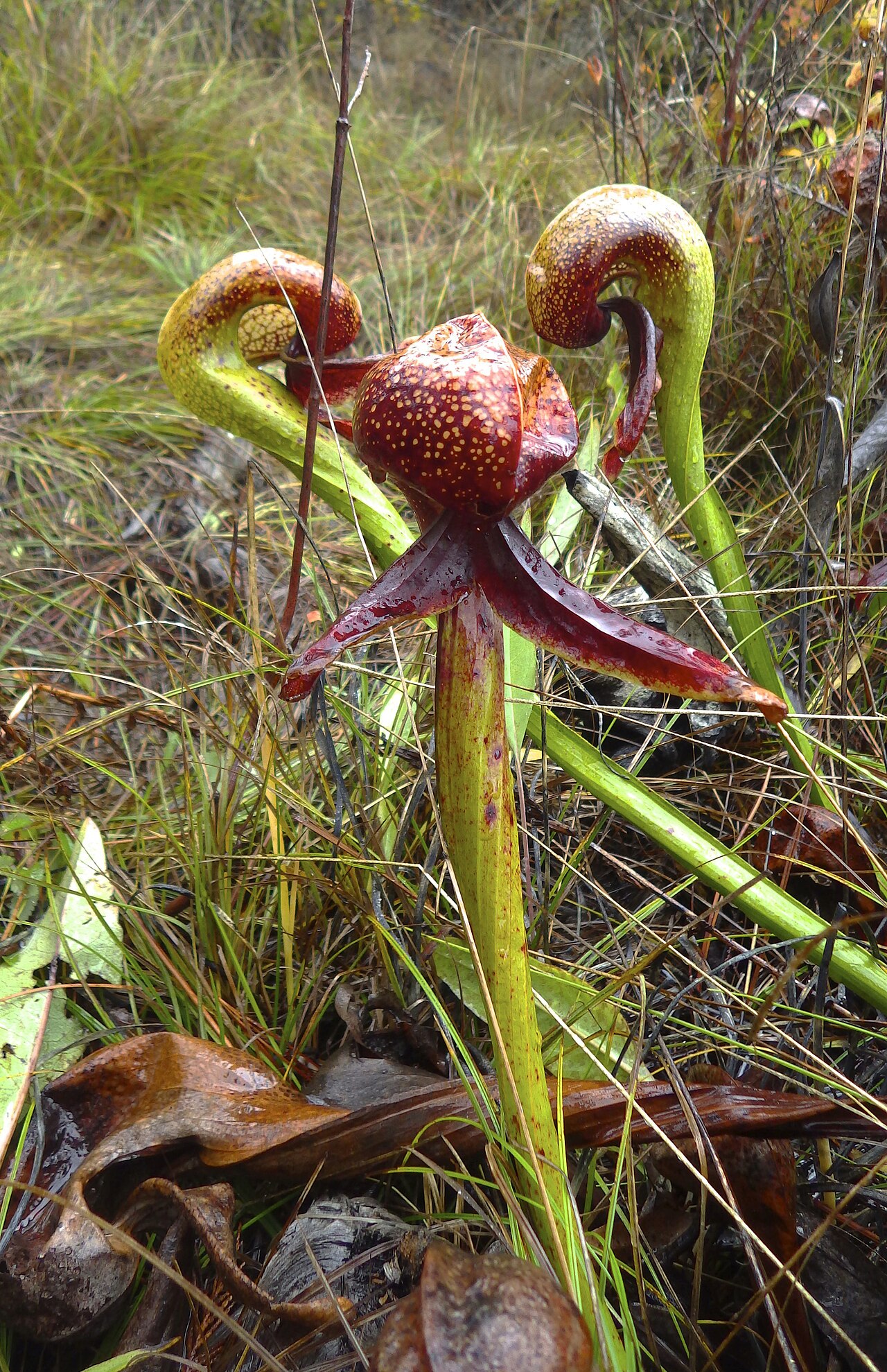
Of all carnivorous plants this is the best-engineered trap. The pitcher twists half a turn as it grows, arches at the top into a swollen dome with translucent windows, hides its entrance underneath and hangs a forked, nectar-bearing tongue below it. Anyone going into the field to see it seldom finds it alone: it stands in dense colonies in cold running seepage water, usually on serpentine.


Identification
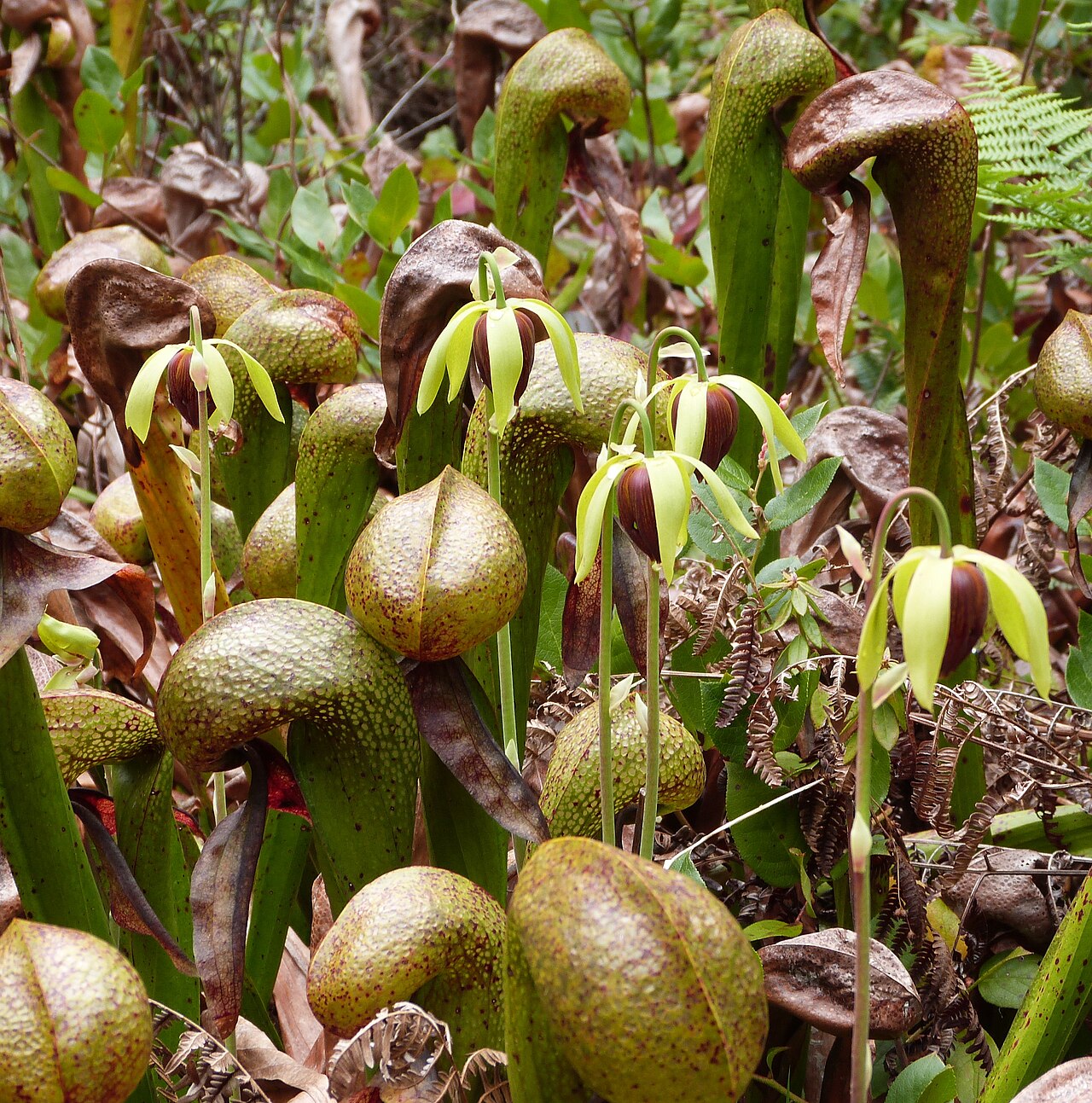
Nearly erect leaves 10 to 60, exceptionally 100 cm tall, yellow-green to deep red, widening upwards; below, a network of stolons about a metre long links the plants into dense colonies. The upper part of the leaf is inflated into a dome that curves over the tube, so that the opening faces not up but down. The dome is studded with translucent windows. Below the opening hangs a two-lobed appendage — the tongue, or fishtail — yellow, green or purple. The flower nods on a long scape: yellow-green, sometimes purple-tinged sepals 4 to 6 cm and narrowly ovate petals 2 to 4 cm, yellow-green between wide dark purple veins. The fruit is 2.5 to 4.5 cm long.
Similar species
Within its own range there is nothing to confuse it with: it is the only carnivorous pitcher plant of western North America. From the trumpet pitchers of the east it is separated by the twisted pitcher with its downward-facing opening; Sarracenia minor also has translucent windows and a hood over the mouth, but lacks the forked tongue and grows four thousand kilometres away. From Heliamphora it is separated by the absence of a drainage slit: the tepui plants let their rainwater run out through a slit in the wall, whereas Darlingtonia simply keeps the rain out and regulates its fluid itself.
The trap and how it works
Two mechanisms work together here, which is why the species carries two trap codes in this guide. It begins with the tongue: the forked appendage under the opening is densely set with nectar glands and serves as both landing platform and the trail that leads inside. An insect follows the sugar upwards and enters the dome through the downward-facing mouth. There the second part begins. The inside of the dome is dark except at the dozens of translucent windows, and an insect trying to escape flies towards the light — that is, into a window again and again, never into the small hole in the shadow it came through. Exhausted, it drops. From there the tube is a lobster pot: first a smooth waxy belt, below it a dense lining of retrorse hairs that give only downwards. Unlike Sarracenia the pitcher catches no rain — the opening faces down — and the plant keeps the fluid at level itself by secreting water drawn up through the roots. It was long held to leave digestion entirely to bacteria and to the larvae living in the fluid; recent work has shown that it secretes at least one proteolytic enzyme of its own. On the tongue the literature is soberer than the shape suggests: in a field experiment, removing it made no measurable difference to the amount of prey caught.
Habitat and ecology
Seeps and boggy ground with permanently running, cold water: spring runs, hillside fens and stream margins. The roots must stay cool and the water must keep moving; standing or warming water it will not take. Usually it grows on ultramafic soil — serpentine — whose high heavy-metal content and low nutrient content keep most other plants out. That is no accident: on such ground the return from catching insects counts for most. The range runs from coastal fens at sixty metres to mountain meadows at two thousand two hundred.
Distribution and elevation
The Klamath Ranges of north-western California and south-western Oregon form the core of the range, which continues north along the Oregon coast. Separate from these lie a few populations in the northern Sierra Nevada. Outside that natural area it has been planted in several places and holds on: in Washington, in British Columbia and in the California Coast Ranges. Those colonies are the work of people, not natural spread.
- Recorded (quarter-degree cells)
Forms and variation
No varieties or subspecies are recognised. The variation you see in the field is wide but not taxonomic: plants in full sun turn deep red while plants in shade stay yellow-green, and size depends strongly on the site. The Sierra Nevada populations lie far from the rest but have never been described as a separate unit. Crosses are impossible: the genus holds a single species and stands too far from its relatives.
Where and when to see it
April to June for the flower, but the pitchers stand all year and are more conspicuous than the flower. In the Klamath Ranges, follow a mountain road to where water runs across the verge; on serpentine the vegetation is low and open, and a colony of hundreds of heads shows up from a distance. Bring boots — you will be ankle-deep in seepage — and watch where you step, because the colonies are denser than they look. Look up at the dome from below: the windows light up, and in one glance the trap explains itself.
Conservation status
Least Concern on the Red List, and not listed in CITES. That is a verdict on the whole: the species is spread over a large area and is numerous in many places. Site by site it reads differently, because the seepage fens are small, depend on a continuous flow of water and vanish as soon as that flow changes. Mining and road works on serpentine, water abstraction, the closing over of open seeps and the digging of plants are the threats that exist; several serpentine fens have therefore been set aside as reserves.
Scientific name
Darlingtonia californica | Torrey, 1854
John Torrey described the species in 1854, establishing the genus Darlingtonia for it at the same time, based on material collected by botanist William D. Brackenridge during the 1841 Wilkes Expedition. The type locality lies near Mount Shasta in Northern California. The genus name Darlingtonia honours the American botanist William Darlington (1782-1863), to whom Torrey dedicated the genus. The species epithet californica refers to its origin: Northern California and adjoining south-western Oregon.
World Checklist of Vascular Plants (WCVP), via Plants of the World Online (POWO), Royal Botanic Gardens, Kew.