All species › Ericales › New World pitcher plant family › Sarracenia purpurea
Sarracenia purpurea | Purple pitcher plant
Paarse trompetbekerplant
The pitcher plant with the longest reach: from the Gulf of Mexico to Labrador and the tundra of the Northwest Territories, further north than any other American carnivorous plant. It is also the only species in this book a European walker can meet in the wild — although it does not belong there.
Varieties

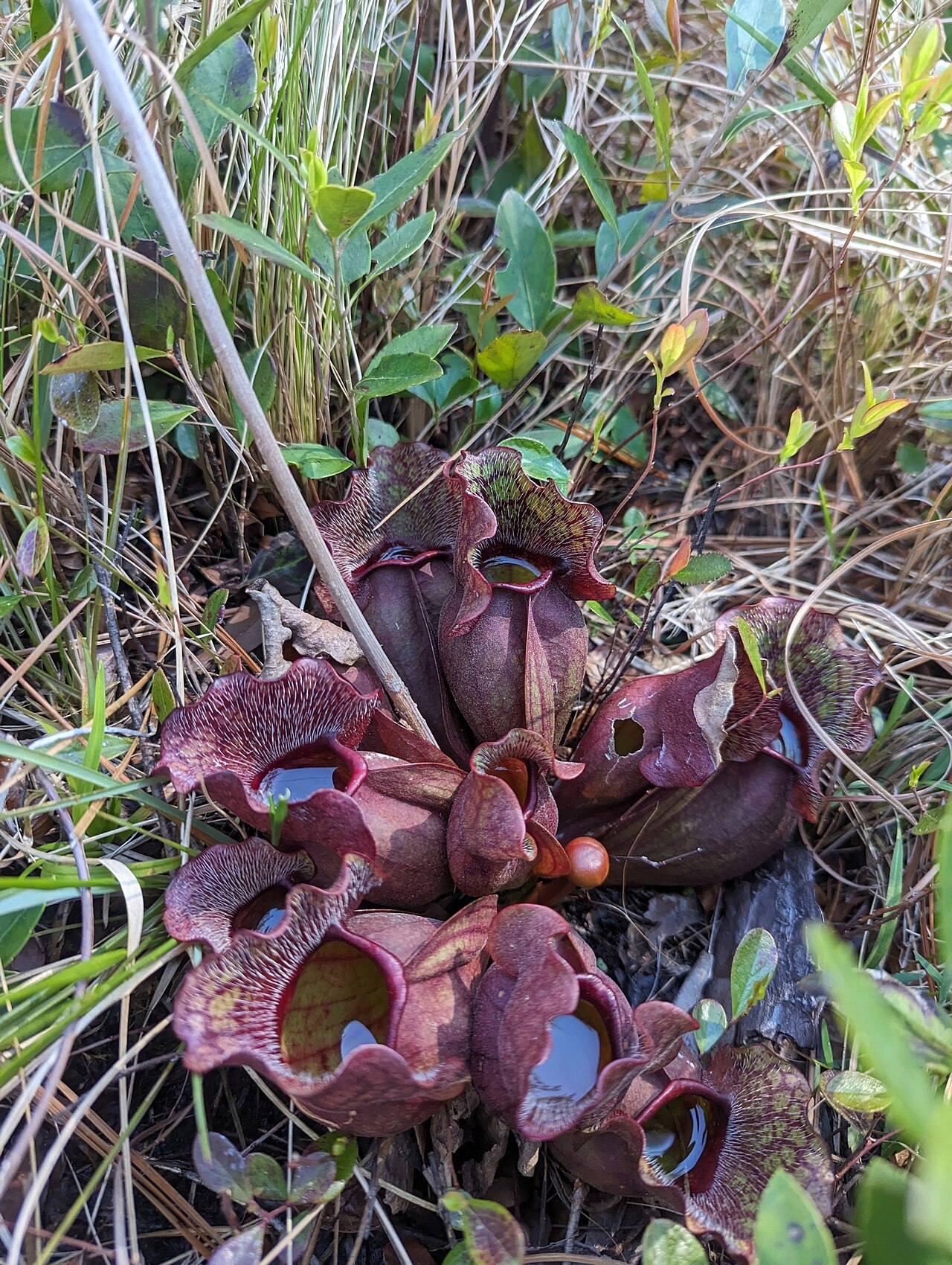
Identification
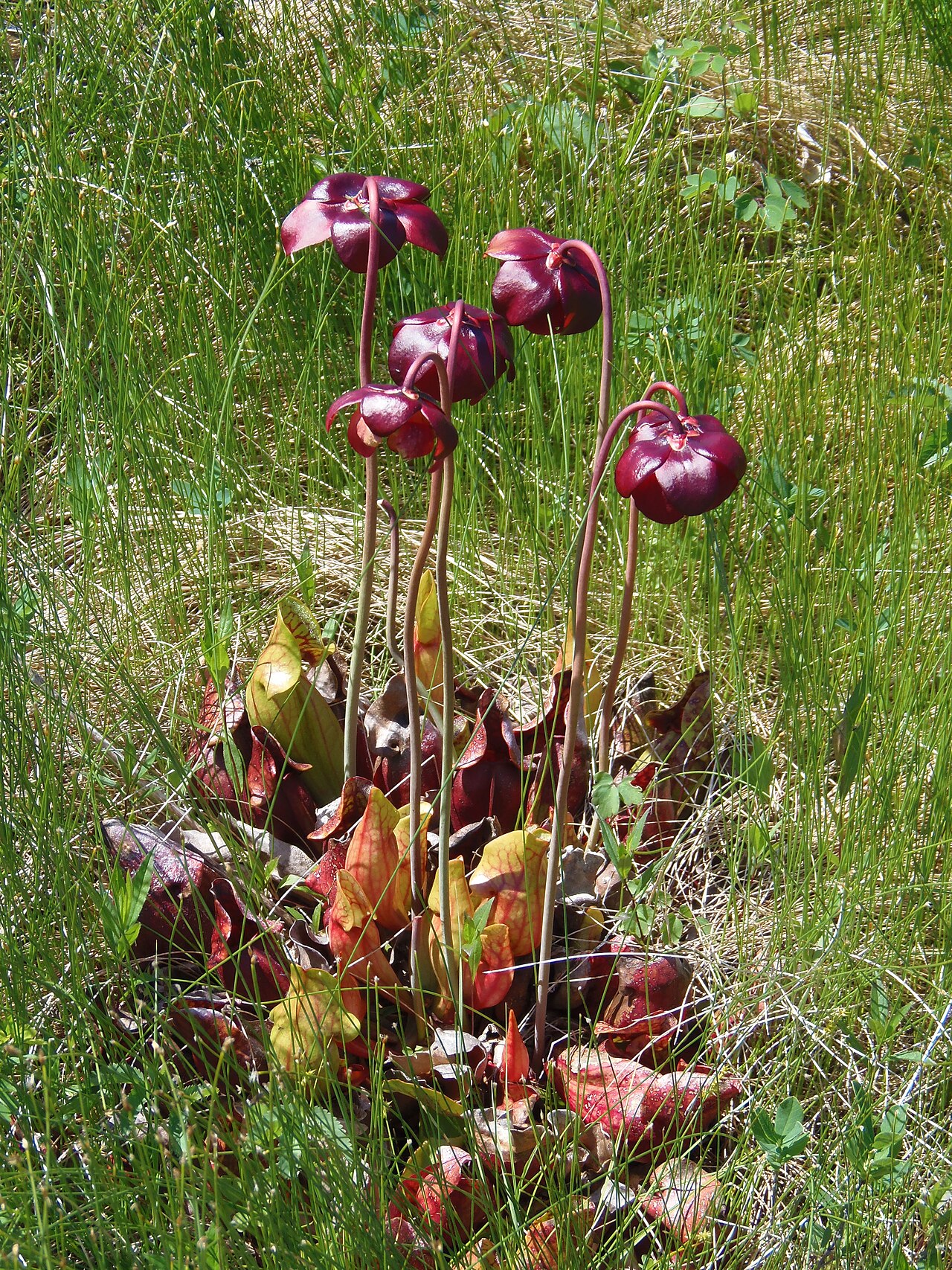
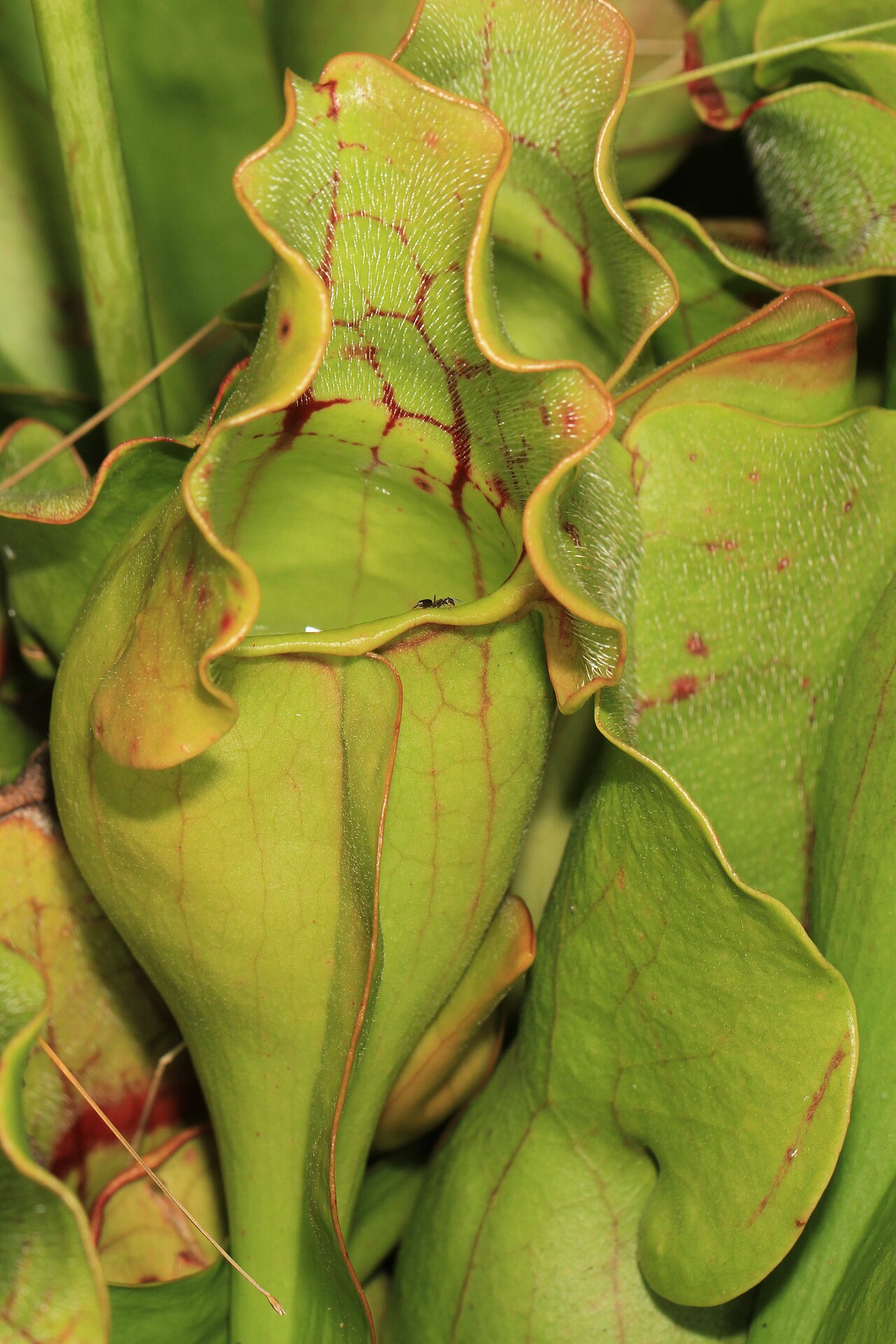
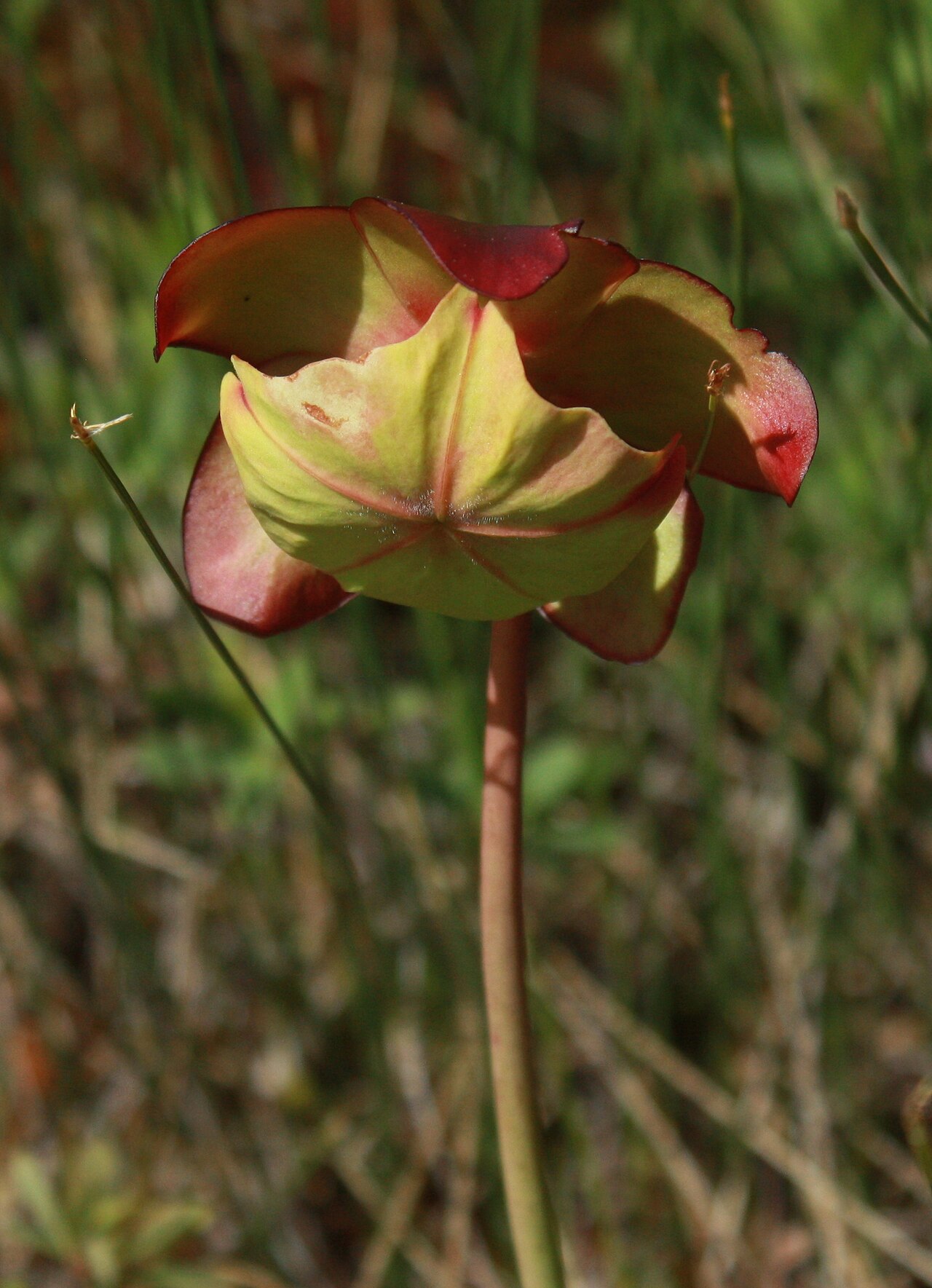
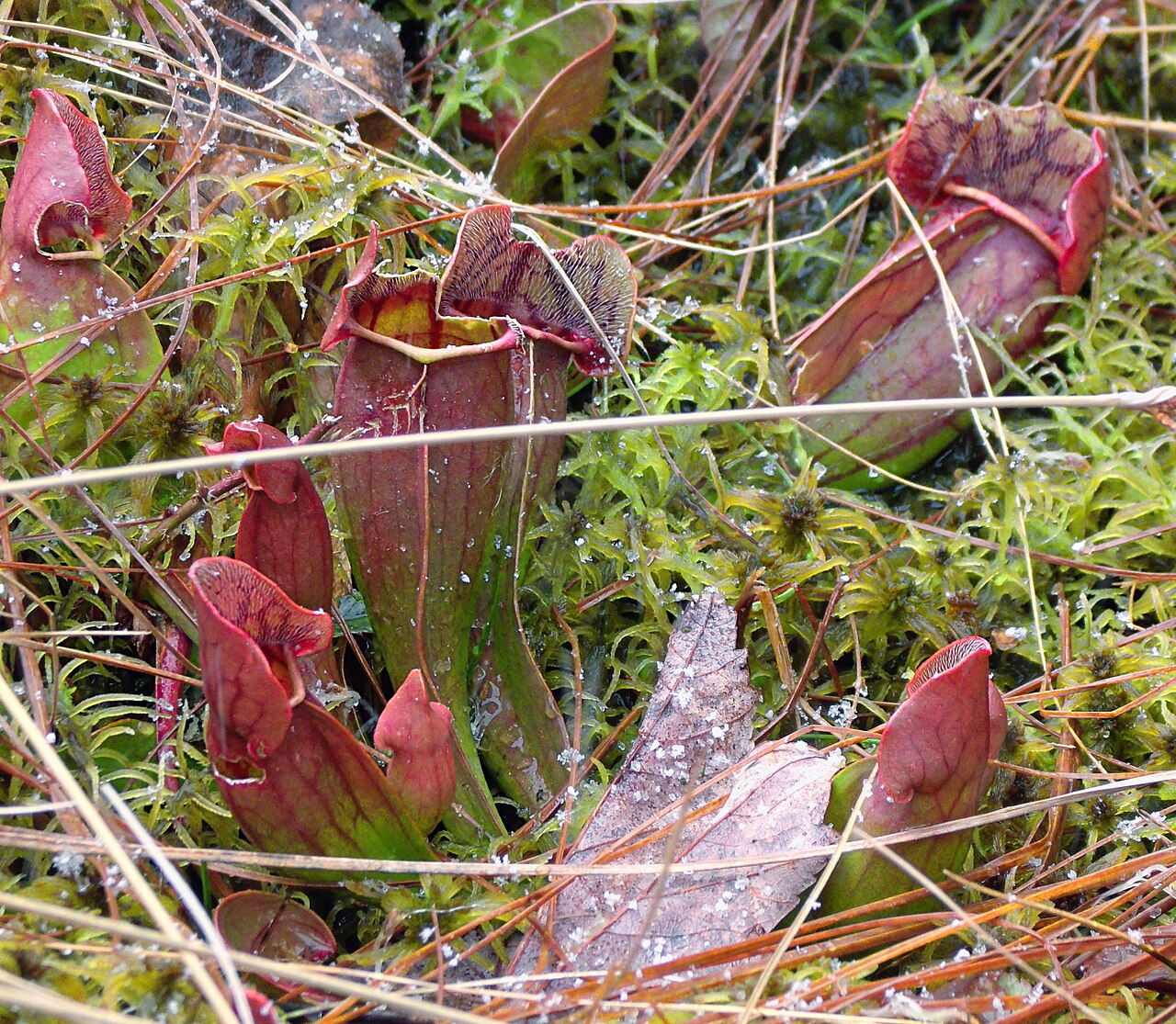
A rosette of decumbent to ascending pitchers 5 to 25 cm long, thick and bellied, with a broad wing running their whole length. The lid stands upright behind the mouth instead of over it, so the pitcher catches rain and is almost always half full of water — enough to name the species from a distance. The inner wall carries downward-pointing hairs; colour runs from green with red veins to almost wholly wine-red. On a bare scape 22 to 79 cm tall hangs a single nodding flower 5 to 7 cm across, deep red to purple, its petals 33 to 53 mm long falling over the umbrella-shaped style disc.
Similar species
Within the genus it is the only one with decumbent, water-holding pitchers and an upright lid. On the Gulf coast grows its twin Sarracenia rosea, separated from it in 1999: that one has pink rather than deep purple-red flowers, with broad spatulate petals, and a shorter, stouter pitcher with a wider, strongly undulate lid. This guide follows POWO and keeps the two apart as species. S. psittacina also lies on the ground, but has a closed globular hood with a small entrance hole and holds no water. Outside America, on the European bogs where it has been planted, confusion is impossible: no other pitcher plant grows there at all.
The trap and how it works
A trap without movement and without haste. The pitcher catches rainwater and keeps it; whatever walks over the slippery, nectar-studded rim slides in and cannot climb back past the downward-pointing hairs. What sets this species apart is that it largely contracts out the digestion. The water in the pitcher holds a community found nowhere else: the larvae of the mosquito Wyeomyia smithii, those of the midge Metriocnemus knabi, mites, rotifers and bacteria. The larvae shred the prey, the bacteria turn it into nitrogen, and the plant takes up what is released. Its own digestive enzymes are secreted mainly in young pitchers, and far less lavishly than in its upright relatives. The bulk of the catch is ants and other crawling insects walking over the sphagnum.
Habitat and ecology
Raised bog and quaking bog with sphagnum: the plant roots in living moss and grows upward with it. Also fen, wet heath, pool margins and, in the south of its range, seepage bog and wet longleaf pine savanna. Always on acid, permanently wet, extremely nutrient-poor ground in full sun. In the north winter is no limit: the pitchers overwinter under the snow and simply carry on in spring.
Distribution and elevation
By far the largest range in the genus: from the Gulf coast and the Atlantic coastal plain north through eastern North America, across the Canadian Shield peatlands to Labrador, Newfoundland, the Northwest Territories and Nunavut, and west to Alberta and British Columbia. Beyond that it has naturalised where people put it: on the American west coast in California and Washington, and in Europe in Great Britain, France, Germany, Switzerland, Austria, Czechia and Slovakia, Denmark and Sweden. In the Netherlands small populations sit on a few raised bogs — the Fochteloërveen is the best-known site — but the Dutch distribution atlas still counts them as adventive escapes, and the Netherlands does not appear in the list this guide follows.
- Recorded (quarter-degree cells)
Forms and variation
The northern and southern races can be told apart in the field: var. purpurea has a glabrous pitcher exterior and grows from the northern states into Canada, var. venosa is finely hairy with a broader lid and grows on the southern coastal plain, and in the southern Appalachians var. montana stands between them. There is also an anthocyanin-free form (f. heterophylla): wholly yellow-green pitchers and yellow flowers, rare but widespread. In the field the species crosses with almost every relative it stands beside — S. × catesbaei with S. flava, S. × chelsonii with S. rubra, S. × swaniana with S. minor — and at many sites the hybrids outnumber the pure plants. A pitcher that half reclines yet carries a half-closed hood is almost certainly a hybrid.
Where and when to see it
For anyone living in Europe this is the one species in the guide growing wild within walking distance. Several bogs in Britain and Ireland and in the Swiss Jura carry large populations decades old, planted by enthusiasts; in the Netherlands it is a handful of small groups on raised bog. Look in May and June, when the dark red flowers stand above the sphagnum — the pitchers themselves lie in the moss and appear only once you kneel. Take nothing and plant nothing: on a European bog this is an alien that crowds out the sphagnum and its own insect world, and several site managers are busy removing it.
Conservation status
On the Red List the species is not evaluated, so a global assessment is lacking. With a range like this that is hardly surprising: taken as a whole it is common and abundant. It has, however, declined sharply on the southern coastal plain as the wet savanna disappeared, and it stands on state or provincial lists in several north-eastern states where the peat has been cut or drained. As a member of the genus Sarracenia it falls under CITES Appendix II. In Europe the roles are reversed: there it counts as an invasive alien of raised bogs.
Scientific name
Sarracenia purpurea | Linnaeus, 1753
Linnaeus described the species in 1753 in Species Plantarum, building on earlier work by the French botanist Joseph Pitton de Tournefort, who had described the plant in the late 17th century from live material sent to Paris by the Canadian physician-botanist Michel Sarrazin. No precise type locality was given; the species occurs naturally in eastern North America, from Canada down to the Gulf Coast. The genus name Sarracenia honours Michel Sarrazin, who first brought the plant to the attention of European botanists. The species epithet purpurea is Latin for 'purple', referring to the purplish-red colour of the pitchers and flowers.
World Checklist of Vascular Plants (WCVP), via Plants of the World Online (POWO), Royal Botanic Gardens, Kew.