All species › Caryophyllales › Sundew family › Drosera affinis
Drosera affinis
A sundew of the miombo plateaux of south-central Africa, first collected by the Austrian botanist Friedrich Welwitsch in Angola and published by Oliver in 1871 in the Flora of Tropical Africa. The name affinis — 'related' — refers to its resemblance to D. madagascariensis.
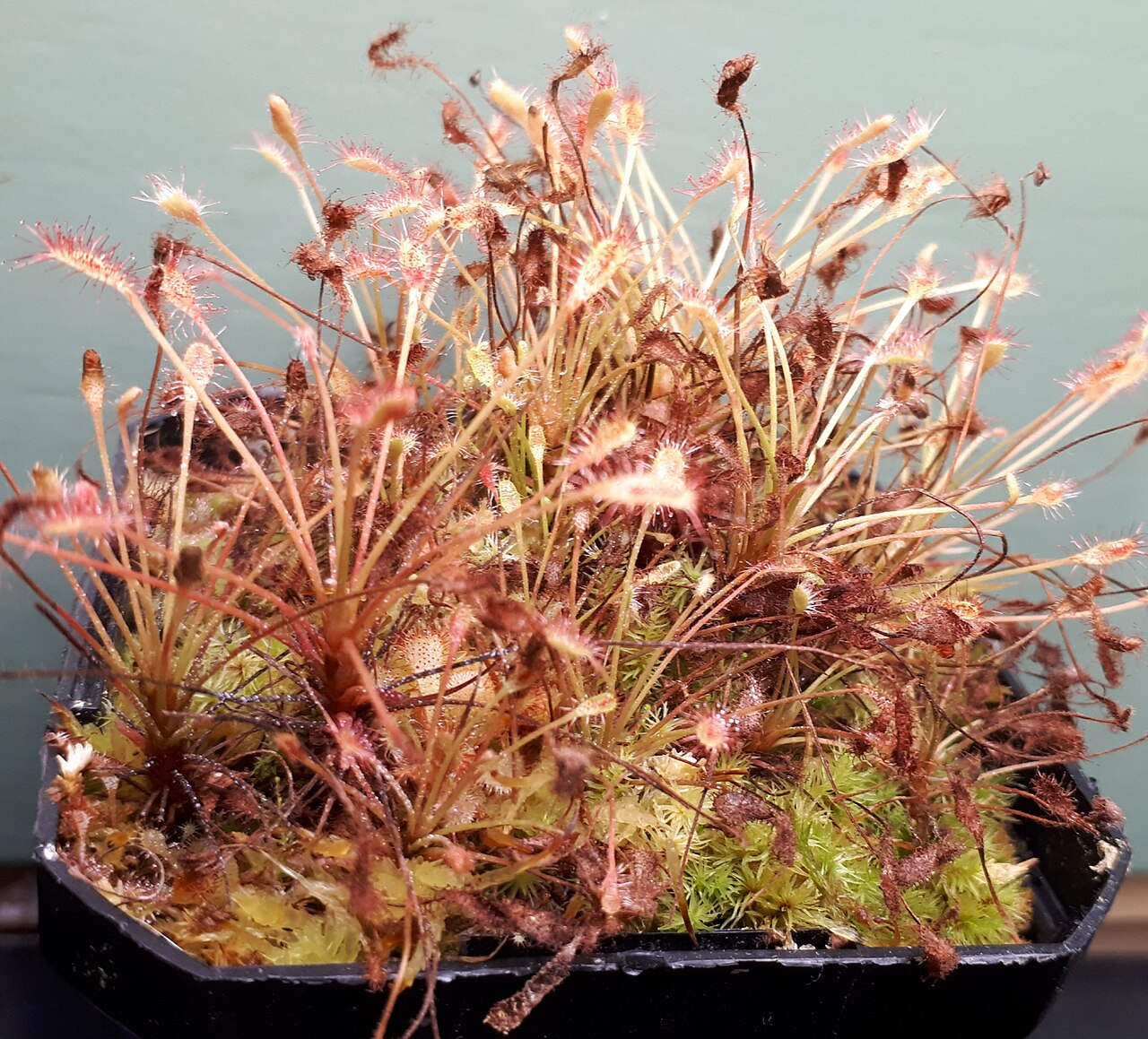
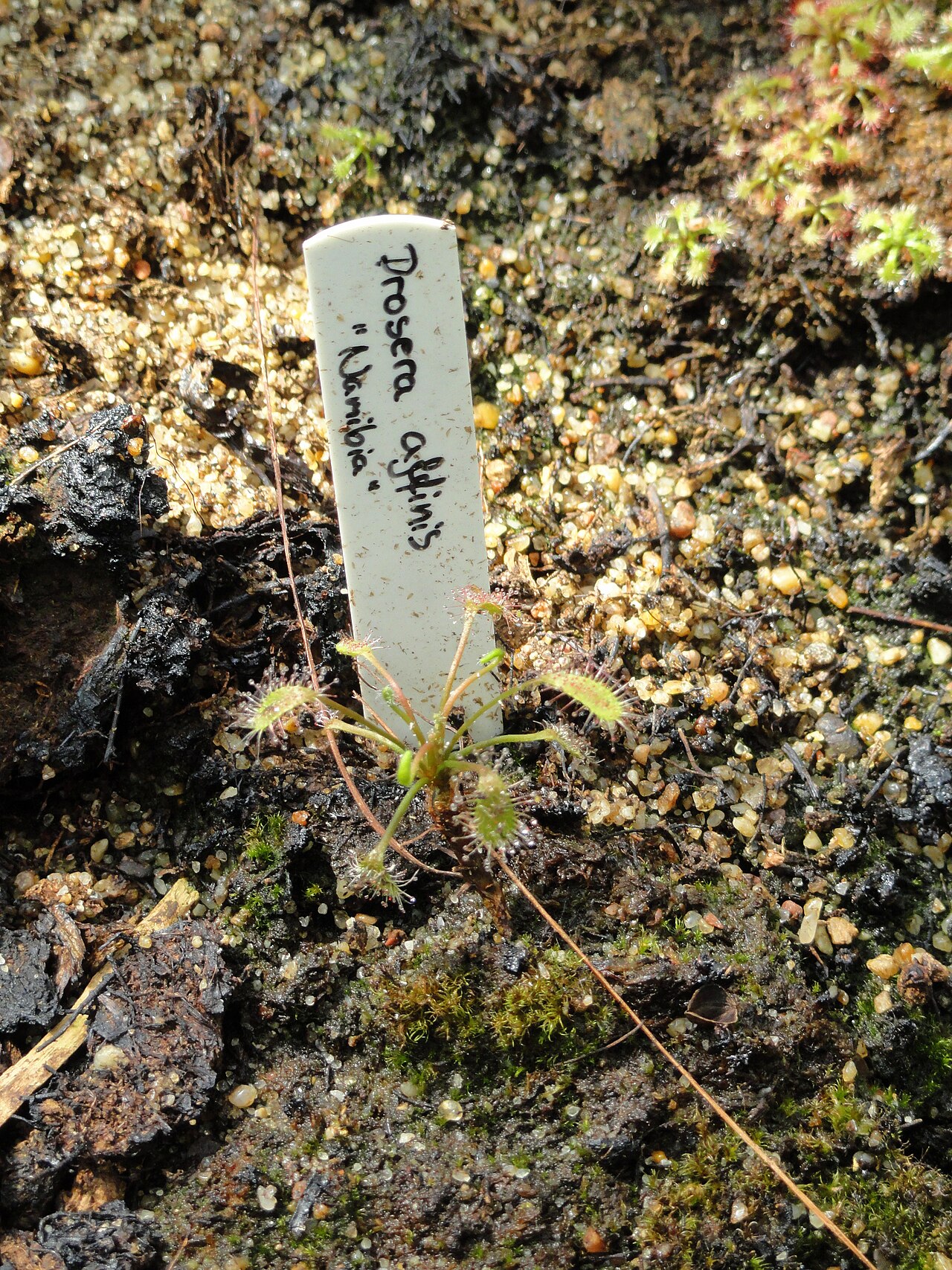
Identification
A sundew that, like D. madagascariensis, can form an ascending stem with scattered leaves; the leaves have a narrow petiole and a small glandular trapping blade. The flowers are pink to purple. Reliable measurements from a flora were not available for this text; the measurement fields are left empty.
Similar species
Drosera madagascariensis is its closest relative and main confusion species; the two are separated on details of leaf, calyx and seed. Drosera elongata also has an elongated stem. The rosette species D. burkeana and D. dielsiana form no stem.
The trap and how it works
An active flypaper trap. The trapping leaves are spread along the stem, so the plant catches at different heights among grasses and sedges. After contact the tentacles bend towards the prey and the glands secrete enzymes.
Habitat and ecology
Wet, open places on the plateaux: dambos (shallow, seasonally wet valley floors), marsh margins, seeps and wet grassland in miombo woodland and savanna (W4, W7, B6).
Distribution and elevation
Southern tropical Africa, from Angola east through Zambia and southern DR Congo to Zimbabwe, and possibly further to Malawi and Tanzania. Altitudinal limits were not found.
- Recorded (one-degree cells)
Forms and variation
The species is closely related to D. madagascariensis and in some older works is confused with it or even placed under it. No varieties are recognised.
Where and when to see it
Search in the rainy season (November to April) in dambos and along streams on the plateaux. The plant grows up among the grass; look for red trapping blades on long stalks.
Conservation status
Assessed on the IUCN Red List as Least Concern; not in CITES. Dambos are locally cleared for gardens and farming, but the range is large.
Scientific name
Drosera affinis | Welwitsch ex Oliver, 1871
Described by Friedrich Welwitsch (manuscript name validated by Daniel Oliver), in "Flora of Tropical Africa", volume 2, p. 402 (1871). In the same publication, the authors also described the closely related Drosera flexicaulis, now considered a synonym. The precise type locality could not be established with certainty. The species occurs in wet savanna areas across Angola, DR Congo, Malawi, Mozambique, Namibia, Congo, Tanzania, Zambia and Zimbabwe. From the Latin affinis ("related, resembling") — a commonly used descriptive epithet indicating resemblance to a related species; which species was specifically meant could not be confirmed.
World Checklist of Vascular Plants (WCVP), via Plants of the World Online (POWO), Royal Botanic Gardens, Kew.