All species › Caryophyllales › Sundew family › Drosera aberrans
Drosera aberrans
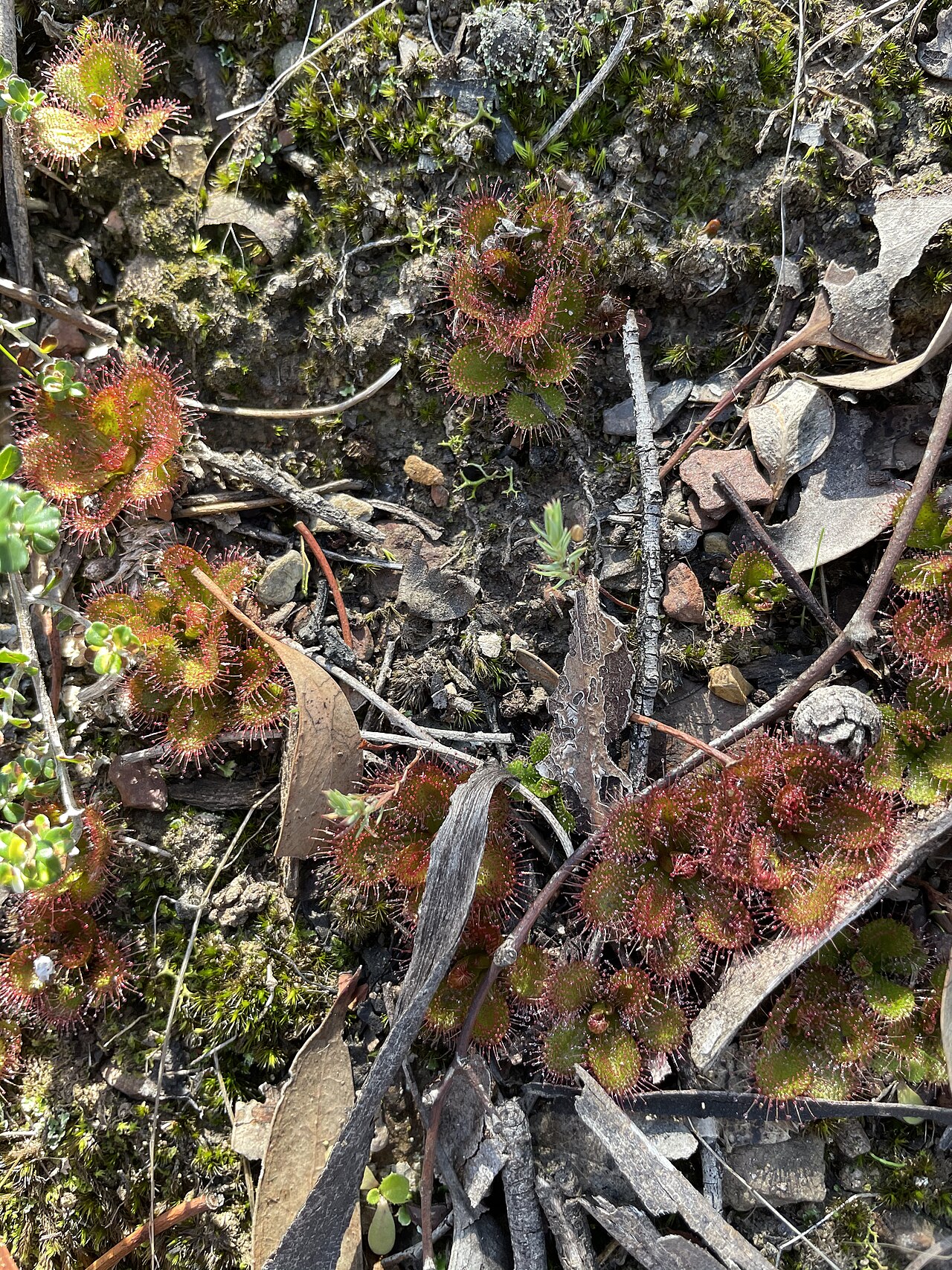
According to the Victorian Carnivorous Plant Society, Drosera aberrans is the commonest carnivorous plant in Victoria. This tuberous sundew forms winter carpets of flat red to green rosettes on the forest floor and in heath, and bears scented white flowers. Until 2008 it was treated as a subspecies of D. whittakeri; since then it has been recognised as a species in its own right, and many older Victorian records of 'D. whittakeri' turn out to refer to it.

Identification
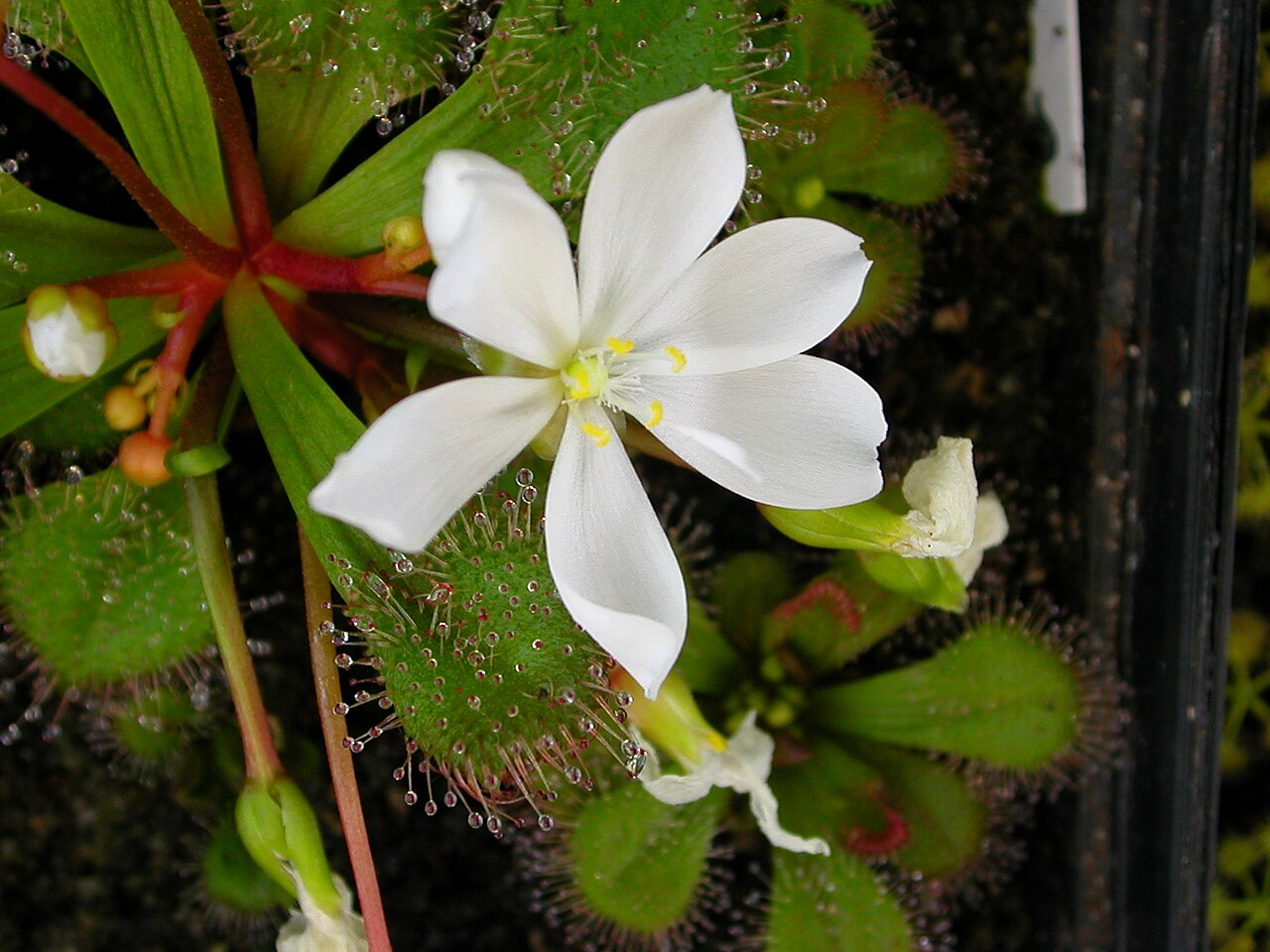
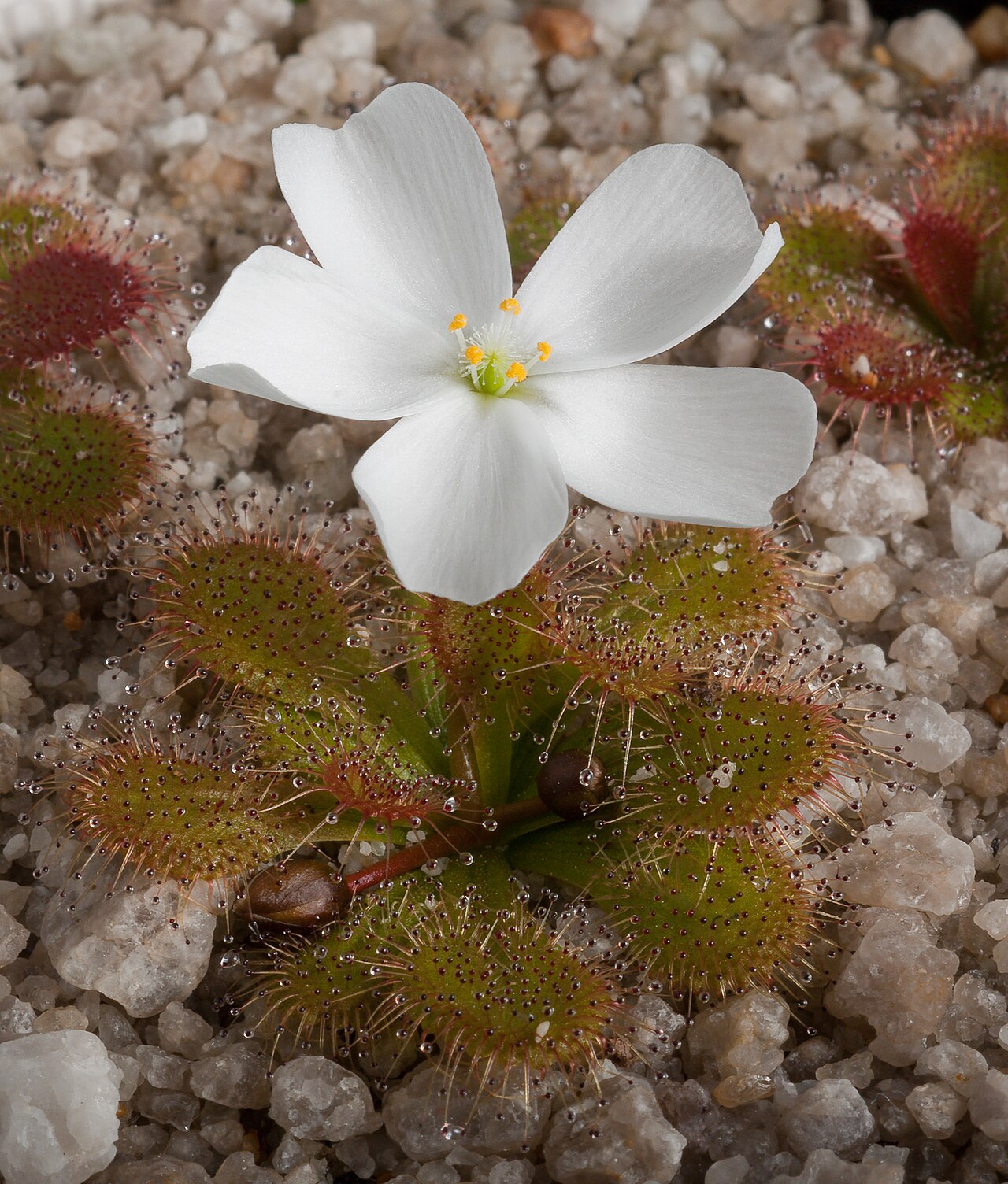
A flat basal rosette about 2 to 5 cm across that grows in the cool season from an ellipsoid to globose tuber; the tuber is red, orange or pale. The leaves are spatulate and sessile, (10–)13 to 25 mm long, red in sun and green in shade. The key character is underground: the plant forms stolons on which new tubers develop, so it builds dense clonal colonies. The inflorescence carries one to about six white or pink, scented flowers, with petals truncate or shallowly notched at the tip.
Similar species
Drosera whittakeri is its closest relative: it occurs only in South Australia, has no stolons and carries more flowers per plant. D. schmutzii of Kangaroo Island has very narrow, eglandular petioles and semi-erect leaves. D. spatulata has smaller, spoon-shaped leaves with a distinct stalk, no tuber and stays green all year. Young rosettes of species of the D. peltata complex have small crescent-shaped leaves.
The trap and how it works
An active flypaper trap. The tentacles on the leaves catch small insects and other arthropods crawling over the forest floor or flying low. The tentacles bend towards the prey and the blade can curl somewhat around the catch. Because the plant is above ground only in the cool, wet season, trapping falls in the Australian autumn, winter and spring.
Habitat and ecology
Clay-rich soil or sand over clay in herbfields, heathland (B5) and open eucalypt forest (B6, B2). The plant grows both in shade and in full sun. In summer, when the soil dries out, it survives as a tuber; in autumn it sprouts again.
Distribution and elevation
South-eastern Australia: much of Victoria, and also South Australia and New South Wales. The range description 'south-eastern Australia (New South Wales, South Australia, Victoria)' fits. Altitudinal limits are not published in the sources consulted; the elevation field is left empty.
- Recorded (quarter-degree cells)
Forms and variation
The species was originally described by Lowrie and Carlquist as a subspecies of D. whittakeri and raised to species rank by Lowrie and Conran in 2008. Colour differences in rosette and tuber follow site and light. Because the plant reproduces mainly vegetatively by stolons, colonies often consist of one or a few clones.
Where and when to see it
Search from late autumn to early spring in open forest and heath on clayey ground; flowering runs from June to October. The colonies of flat rosettes are easy to find on the forest floor, especially after rain, when the droplets glisten. Kneel by a flowering plant to smell the scent. Do not dig up tubers; they lie deep and the plant needs them to survive the summer.
Conservation status
On the IUCN Red List the species is Least Concern (LC); it is not listed in CITES. In Victoria it is common and widespread. Locally it declines with the loss of native vegetation and through invasive grasses. VicFlora notes that the species is suspected of being poisonous to livestock.
Scientific name
Drosera aberrans | (Lowrie & Carlquist) Lowrie & Conran, 2008
Originally described as Drosera whittakeri subsp. aberrans by Lowrie & Carlquist, in Phytologia, volume 73, no. 2, p. 113 (7 October 1992). Raised to full species rank by Lowrie & Conran, in Telopea, volume 12, no. 2, p. 151 (11 November 2008). The precise type locality could not be established with certainty. The species occurs in southern inland South Australia and southern/central Victoria, with one record from New South Wales, in mallee woodland, heathland and open forest on sand, laterite or limestone clay. From the Latin aberrans ("deviating, differing") — likely because this species deviates from the closely related D. whittakeri, of which it was initially considered a subspecies; the describers' exact reasoning is not confirmed with certainty.
World Checklist of Vascular Plants (WCVP), via Plants of the World Online (POWO), Royal Botanic Gardens, Kew.