All species › Caryophyllales › Sundew family › Drosera roraimae
Drosera roraimae
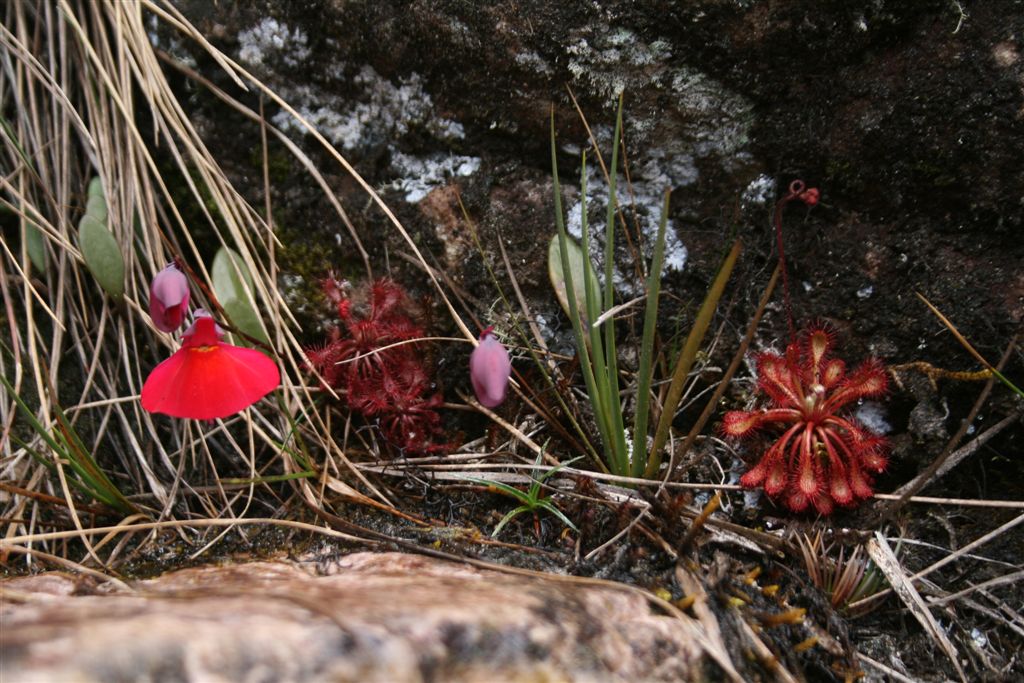
The table-mountain sundew par excellence. Drosera roraimae is named after Roraima, the famous tepui at the tripoint of Venezuela, Guyana and Brazil, and grows on the summits of a series of table mountains in the Guiana Highlands. It is the sundew that hikers on Roraima meet most often: among bog moss, in wet sandy hollows and around the foot of boulders in the lunar landscape of the summit.


Identification
A perennial plant with a rosette of semi-erect leaves on long, narrow petioles, ending in an oblong blade full of red tentacles. With age the plant may form a short stem clothed in old leaves. The scape rises above the rosette and carries white to pale pink flowers. Diels originally published the plant as a variety of another species; Maguire and Laundon raised it to species rank. Measurements from their work could not be checked here.
Similar species
More sundews grow on the tepuis. Drosera hirticalyx has a conspicuously hairy calyx; Drosera meristocaulis of Neblina forms branching cushions with small red leaves and large pink flowers; Drosera kaieteurensis and Drosera solaris are smaller, with nearly round blades. The somewhat similar-looking Drosera cendeensis grows in the Venezuelan Andes, but belongs to a different, Andean group. The long petioles with a narrow oblong blade are the best field character of D. roraimae.
The trap and how it works
An active flypaper trap. Because the leaves stand upright, the plant catches flying as well as crawling insects, such as the gnats that hang in the mist over the summits. The tentacles bend towards the prey and the leaf can curl lengthwise around the catch.
Habitat and ecology
The cool, constantly wet summits of the tepuis: bare sandstone with water in cracks and hollows, boggy bog-moss cushions and mires, and the edges of dwarf and cloud forest (R5, W1, B4). The climate is misty, with almost daily rain and cool nights. The soils are extremely poor, acid and often no more than a thin layer of sand or peat on the rock.
Distribution and elevation
The Guiana Highlands, on the summits of several table mountains in Venezuela, Guyana and the far north of Brazil, with Roraima as the type locality. A reliably published altitudinal range for the whole species could not be checked.
- Recorded (one-degree cells)
Forms and variation
No varieties are recognised, but the species varies between tepuis in size, leaf shape and colour. Since each table mountain is an isolated island, a modern revision with DNA studies may well recognise some populations as separate species, as has already happened with other tepui plants.
Where and when to see it
The trek to the summit of Roraima from Venezuela is one of the few ways to see a tepui sundew without an expedition. On the summit look in the wet hollows, among the bog moss and along the edges of pools. Keep to the trail: summit vegetation barely recovers from trampling, and collecting is strictly forbidden.
Conservation status
Not assessed for the global IUCN Red List and not listed in CITES. The species grows on several tepuis, largely in national parks. Tourism on Roraima causes local trampling and illegal collecting; climate change is a long-term risk for all cold-summit species.
Scientific name
Drosera roraimae | (Klotzsch ex Diels) Maguire & Laundon, 1957
The name was published at species rank in 1957 by Bassett Maguire & John Ramsbottom Laundon, in Memoirs of the New York Botanical Garden, volume 9: 333. It had earlier existed as a variety, Drosera montana var. roraimae Klotzsch ex Diels (1906), which is the basionym. The original type material of the basionym was collected in November 1842 on Mount Roraima in Guyana by Robert Schomburgk (no. 1034; holotype at B, possibly lost, isotype at K). For the species-rank combination a lectotype was designated: on Mount Roraima, in the upper rock zone, at about 2500 m elevation, collected by Ernst Ule (no. 8610) in December 1909. The epithet roraimae is a toponym: it refers directly to Mount Roraima, a tepui (table-top mountain) at the tripoint of Guyana, Venezuela and Brazil, where the type material was collected.
World Checklist of Vascular Plants (WCVP), via Plants of the World Online (POWO), Royal Botanic Gardens, Kew.