All species › Caryophyllales › Sundew family › Drosera aurantiaca
Drosera aurantiaca
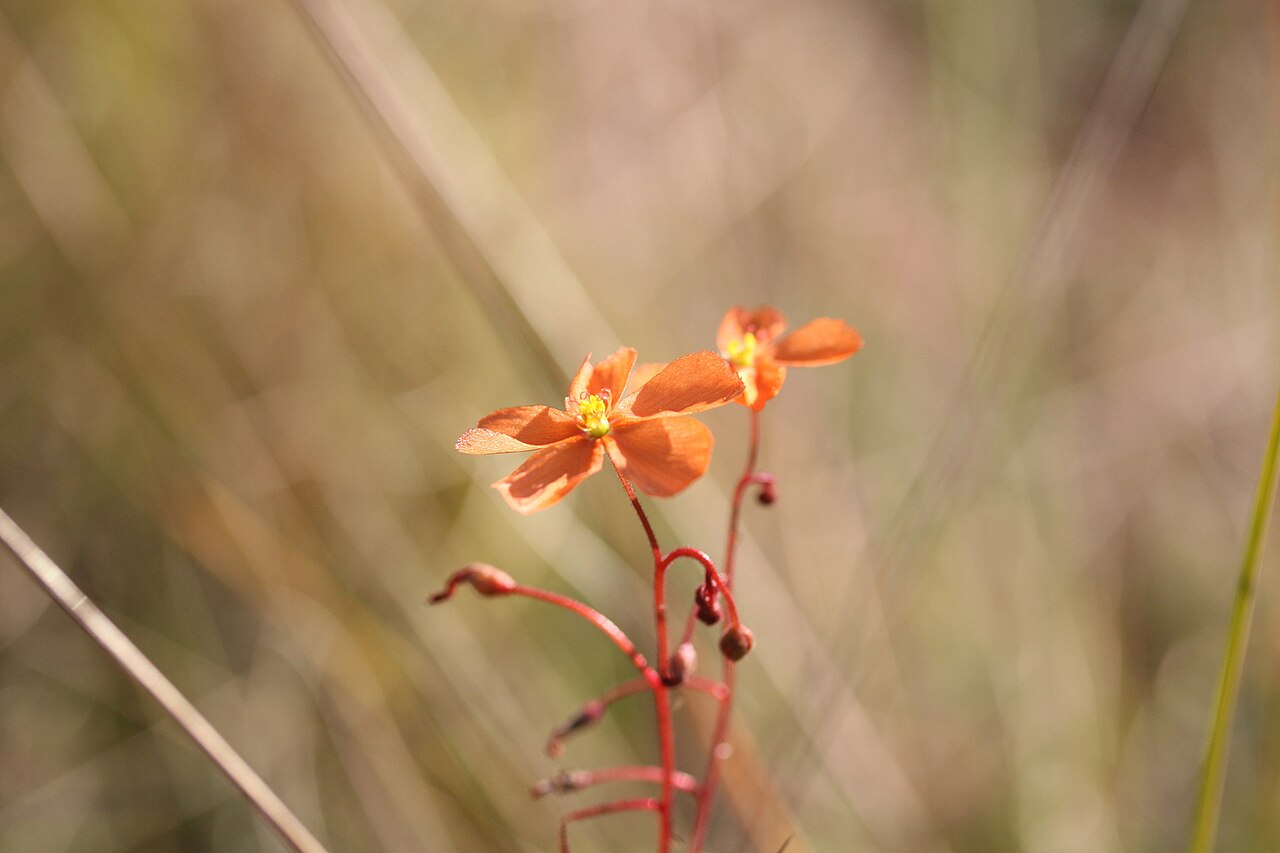
Orange flowers are not unusual among the pygmy sundews of the south-west, but they are in the group around Drosera indica, where pink and white are the rule. Drosera aurantiaca, 'the orange-coloured one', was described in 2014 by Allen Lowrie and named for that flower colour. It is an annual of the tropical north, not of the south-west as the base list states.
Identification
An annual sundew of section Arachnopus. Species of that section grow with an erect or decumbent stem bearing long, linear leaves covered along their whole length with stalked glands, and form flower racemes opposite the leaves. The feature after which the species is named is its orange flower. Precise measurements and flowering time could not be found in the accessible sources; Lowrie's description (2014) is, as far as known, the only detailed source.
Similar species
The closest relatives are the other northern Australian members of section Arachnopus, such as Drosera indica in the broad sense, D. aquatica, D. barrettiorum, D. cucullata and D. glabriscapa. Within that group the orange flower colour is the most striking feature of D. aurantiaca; reliable identification requires the full flower and seed characters of the original description.
The trap and how it works
An active flypaper trap. The long, narrow leaves are covered in stalked glands secreting sticky droplets, hanging like flypapers along the stem. Small insects landing on them stick; the tentacles curve towards the prey and the glands secrete digestive enzymes. For an annual that must germinate, grow, flower and set seed within one wet season, that rapid supply of nutrients matters.
Habitat and ecology
The accessible sources give no habitat description. Members of section Arachnopus in northern Australia usually grow in sandy or loamy soil that becomes waterlogged in the wet season, in open savanna and along seasonal swamps; codes W7 and B6 are based on that general knowledge and should be regarded as provisional.
Distribution and elevation
Endemic to northern Australia: the Northern Territory and the north of Western Australia. For Western Australia FloraBase lists the Central Kimberley, Dampierland and Northern Kimberley bioregions. The label 'south-western Australia' in the base list differs sharply from this.
- Recorded (quarter-degree cells)
Forms and variation
No subspecies or varieties have been described. The species belongs to a series that Lowrie split off in 2014 from the broad concept of Drosera indica; the boundaries between these new species have been little tested by other researchers.
Where and when to see it
Search in the wet season, roughly December to April, when annual sundews come up and flower in the Kimberley. The orange flowers open in sunshine and can then be seen from some distance. Many sites are hard to reach in the rainy season; plan carefully and respect the rules for Aboriginal land and national parks.
Conservation status
Assessed as Least Concern (LC) on the IUCN Red List and listed as not threatened in Western Australia. Not in CITES. Because of its remoteness and the short time since description, little is known about population size and trends. The source base for this text is thin: Lowrie's original description (2014) is the only good source and could not be consulted for this guide.
Scientific name
Drosera aurantiaca | Lowrie, 2013
Described by Allen Lowrie, described December 2013, published 2014, in "Carnivorous Plants of Australia Magnum Opus", volume 3, p. 1268 — the same publication as D. aquatica, earlier in this golf. Likely collected on 7 June 1995 at a crossing of Grevillea Creek, Kimberley region, Western Australia — this is collection data that very probably, but not certainly, corresponds to the holotype. From the Latin aurantiaca ("orange-coloured") — refers to this species' orange flowers.
World Checklist of Vascular Plants (WCVP), via Plants of the World Online (POWO), Royal Botanic Gardens, Kew.