All species › Caryophyllales › Sundew family › Drosera barrettiorum
Drosera barrettiorum
A sundew that owes its name to two brothers. Russell and Matthew Barrett found the plant near their home in the Kimberley, and Allen Lowrie named it after them in 2014. Drosera barrettiorum is an annual of the tropical north of Western Australia; the label 'south-western Australia' in the base list is not correct.
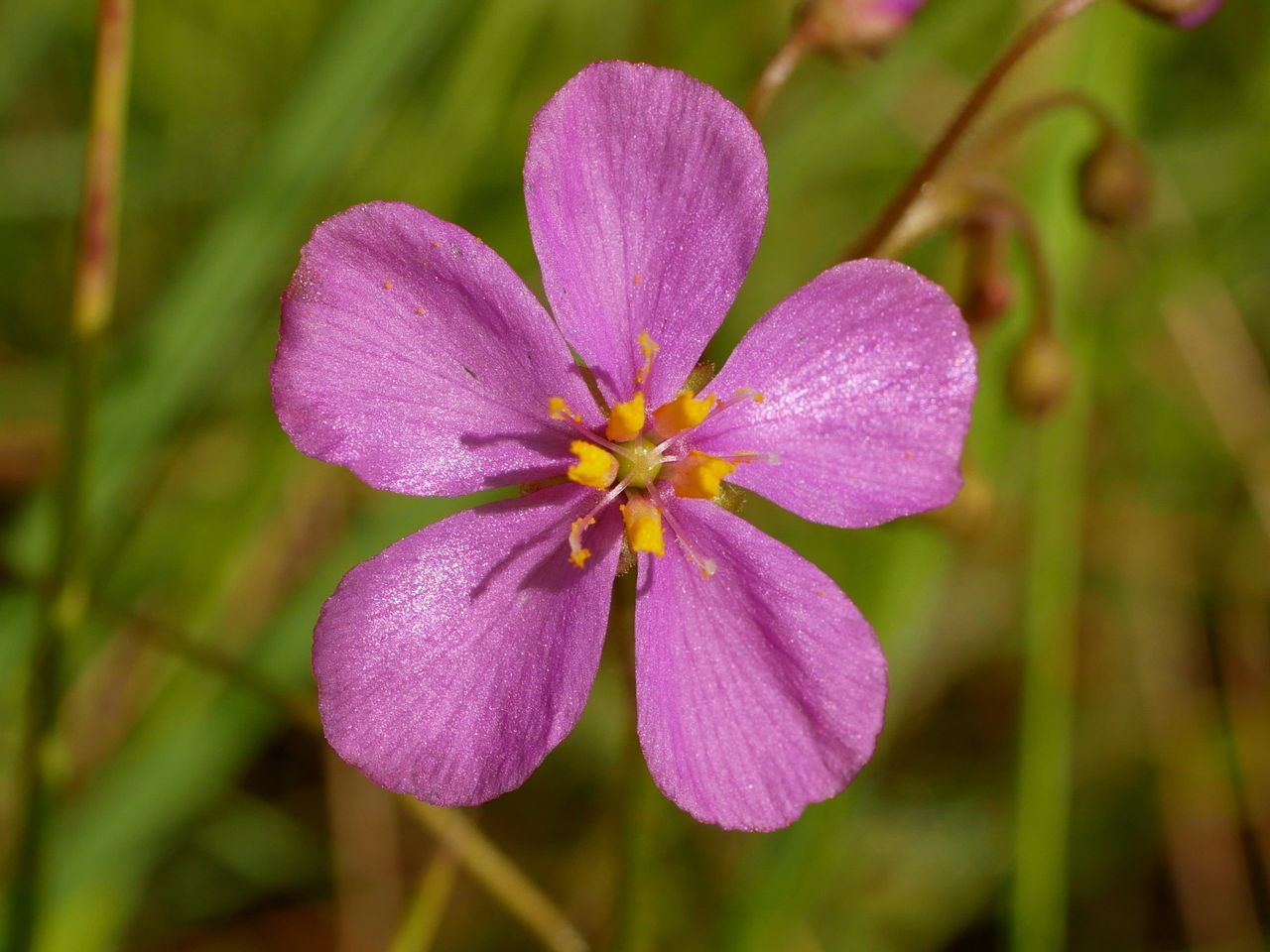
Identification
An annual sundew of section Arachnopus, the kinship group of Drosera indica. Plants of that section have an erect or sprawling stem with long, narrow leaves covered along their whole length with stalked glands, and flower racemes opposite the leaves. Specific characters, measurements, flower colour and flowering time of this species could not be found in the sources accessible for this guide. All measurement fields are therefore left empty; Lowrie's original description (2014) is the only detailed source.
Similar species
Confusion is likely with the other northern Australian members of the section that Lowrie described in 2014, such as D. aquatica, D. aurantiaca, D. cucullata and D. glabriscapa, and with Drosera indica in the broad sense. Without the flower and seed characters of the original description a reliable identification in the field cannot be given.
The trap and how it works
An active flypaper trap. The long, linear leaves are covered in stalked glands carrying sticky droplets. Small flying insects become entangled; the tentacles bend towards the prey, after which the glands secrete digestive enzymes and absorb the dissolved nutrients. In this group dozens of trapping leaves often hang along a single stem, so the plant works like a fine-meshed net.
Habitat and ecology
The accessible sources give no habitat details. Related annual sundews in the Kimberley grow in sandy soil that is waterlogged in the wet season, in open savanna and along seasonal swamps. Codes W7 and B6 are based on that general knowledge and are provisional.
Distribution and elevation
Endemic to the north of Western Australia, in the Kimberley. A more precise distribution was not available in the accessible sources.
- Recorded (quarter-degree cells)
Forms and variation
No subspecies or varieties have been described. The name was amended after publication: Lowrie originally wrote 'barrettorum', but because the name honours two people it was corrected in 2017 to 'barrettiorum' under Article 60 of the International Code of Nomenclature. FloraBase still lists the old spelling as a non-current name.
Where and when to see it
The best chance of finding this species is in the wet season, roughly December to April. Many Kimberley roads are impassable then; check access in advance and respect the rules for Aboriginal land. If you find it, photograph the flower closely and from the side, so its features can later be compared with the description.
Conservation status
Assessed as Least Concern (LC) on the IUCN Red List. Not in CITES. Little is known about numbers and trends. The source base for this text is very thin: Lowrie's original description (2014) is the only good source and could not be consulted for this guide; what is written here rests on the brief data in Wikipedia and FloraBase.
Scientific name
Drosera barrettiorum | Lowrie, 2013
Described by Allen Lowrie, in "Carnivorous Plants of Australia Magnum Opus", volume 3, p. 1269 (title page 2013, published December 2013/2014). The original spelling "barrettorum" was corrected to "barrettiorum" in 2017 (in "Drosera of the World"), in accordance with the rules of the international nomenclature code. Crossing of Grevillea Creek, Beverley Springs Station, Kimberley region, Western Australia (16°29'23"S, 125°21'11"E). Named in honour of brothers Russell L. Barrett and Matthew D. Barrett, who first discovered the species near their home in the Kimberley.
World Checklist of Vascular Plants (WCVP), via Plants of the World Online (POWO), Royal Botanic Gardens, Kew.