All species › Caryophyllales › Sundew family › Drosera barbigera
Drosera barbigera
The 'bearded' pygmy sundew: barbigera means 'bearing a beard' and refers to the hairy, frayed stipules at the heart of the rosette. Jules Émile Planchon described the species as early as 1848 from early collections made in the Swan River colony. It is one of the orange- to red-flowered pygmy sundews that colour the laterite hills of the south-west in spring.
Identification
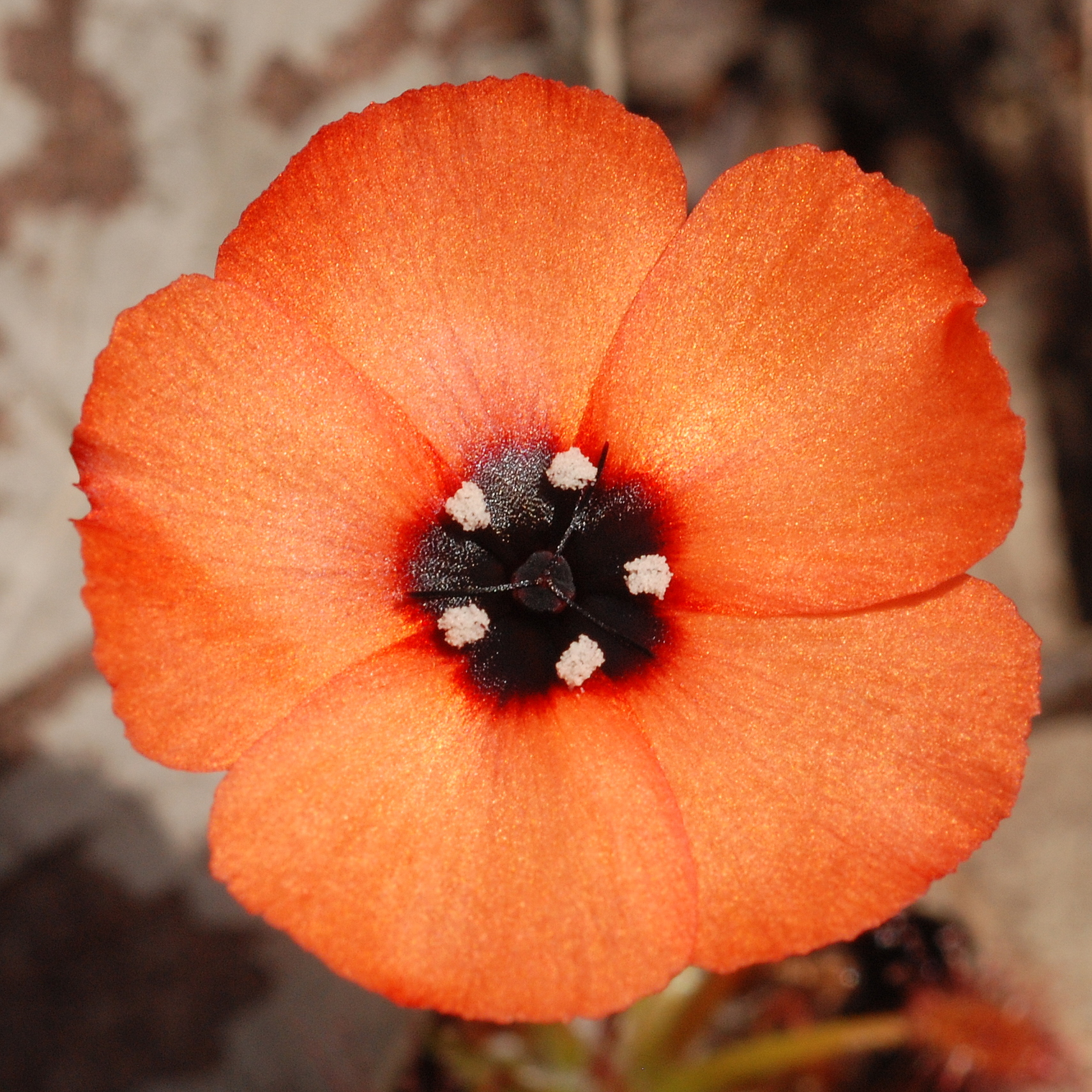
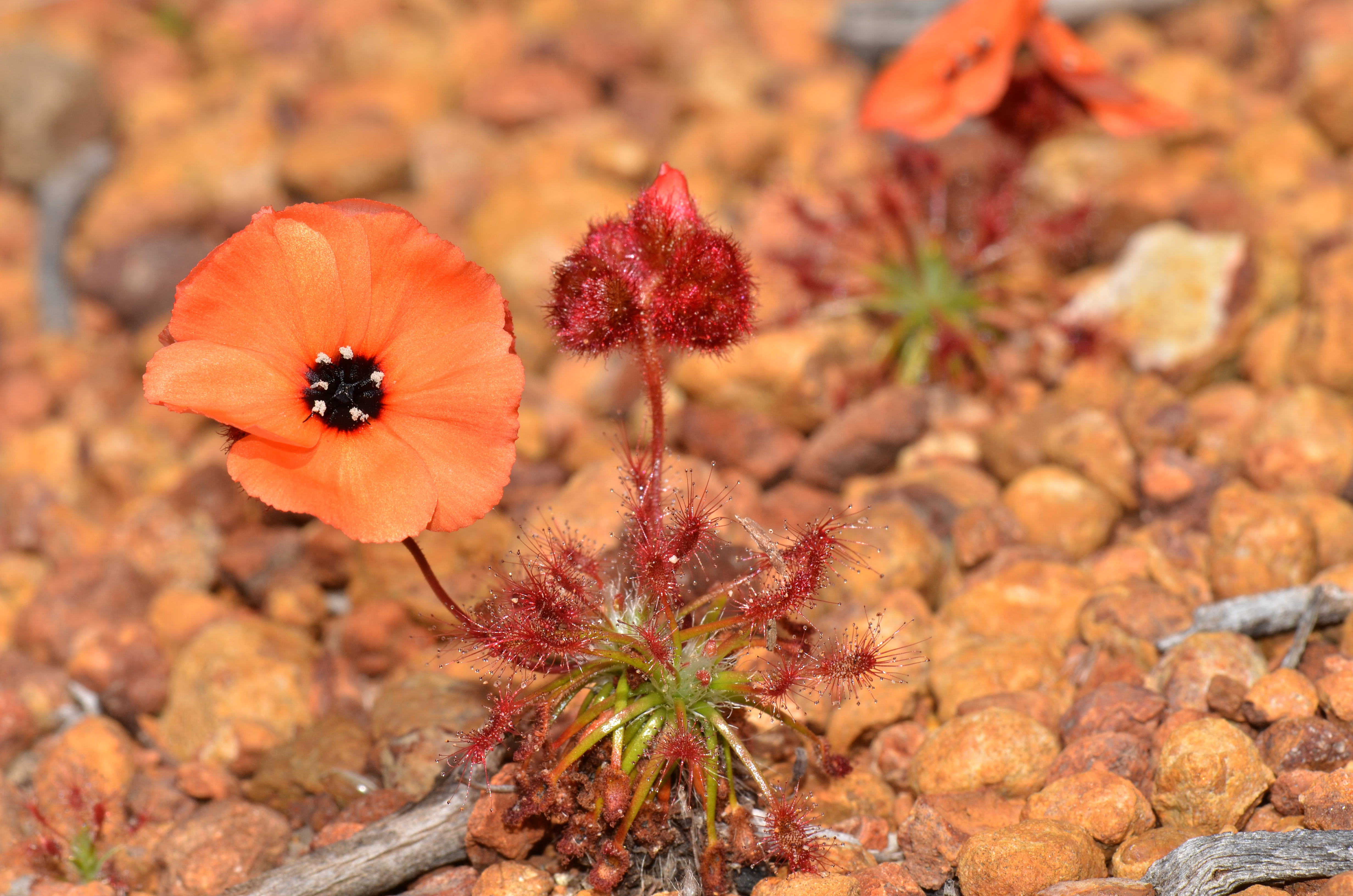
A perennial, fibrous-rooted pygmy sundew 4 to 10 cm tall forming an open rosette. At its heart stands the cone of silvery stipules, which in this species is conspicuously hairy, hence the name. The flowers are orange to red and appear from August to October. Leaf and flower measurements were not available in the sources consulted.
Similar species
There are several orange-flowered pygmy sundews in the south-west, including Drosera miniata, Drosera callistos, Drosera echinoblastus and Drosera albonotata, described in 2018. Boundaries within this group have shifted several times over the years, and FloraBase includes plants with orange to red flowers in D. barbigera. The hairy stipules and the markings at the heart of the flower are the key features; a hand lens is essential. A related form from the forests of the south-west, originally described as D. silvicola, was placed under D. barbigera as a subspecies by Schlauer.
The trap and how it works
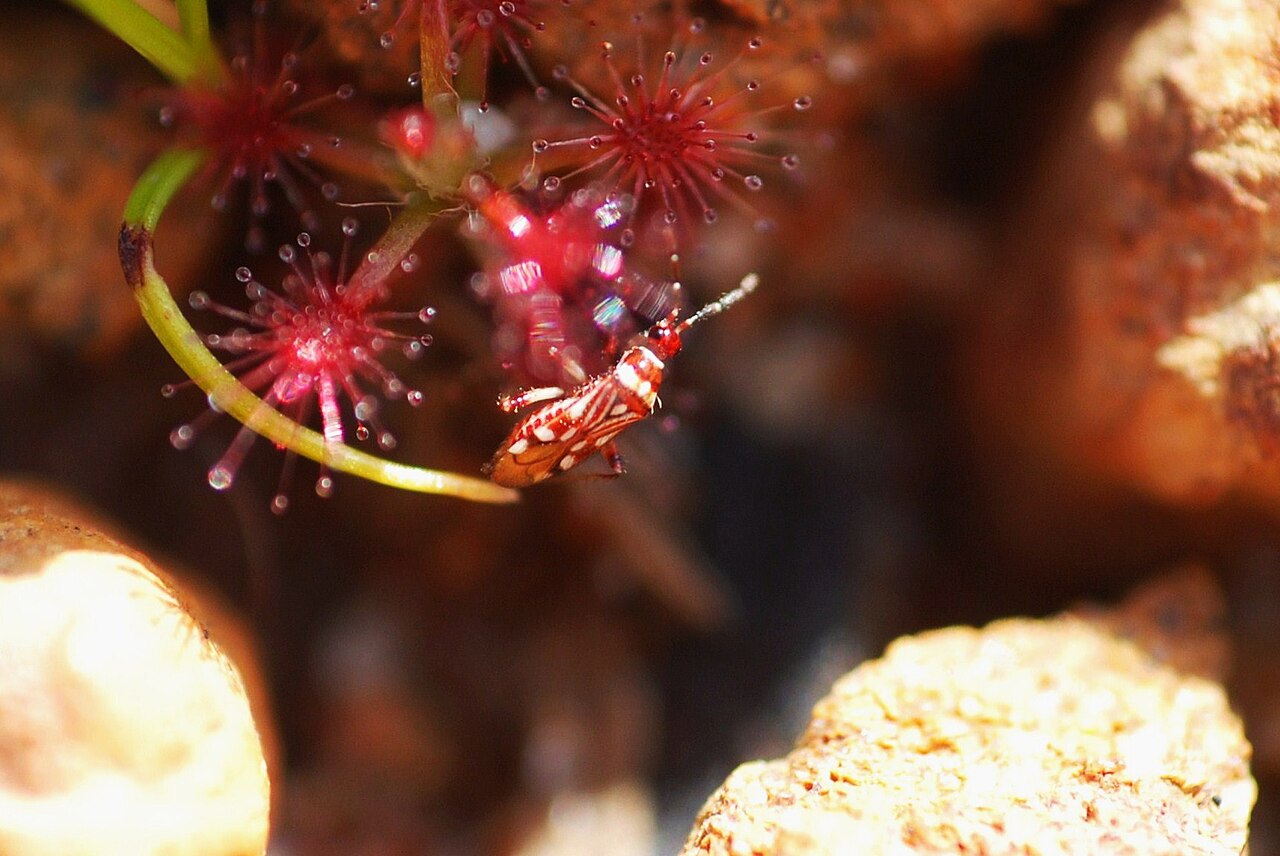
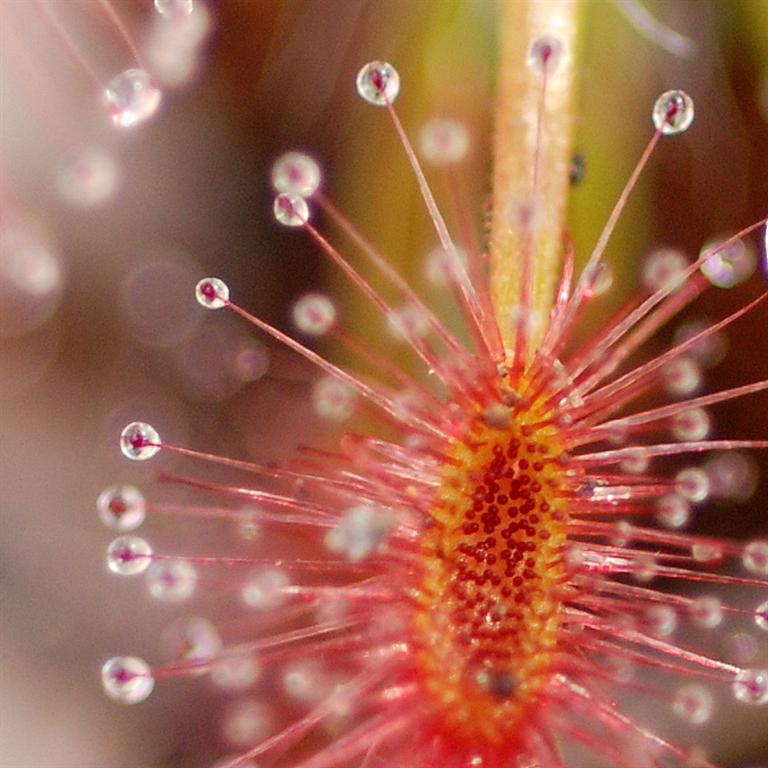
An active flypaper trap. The small leaves bear stalked glands with droplets of glue; springtails, mites and minute flies that touch them stick fast. The tentacles bend towards the prey and secrete enzymes. On poor, gravelly laterite this by-catch is an important source of nitrogen and phosphorus.
Habitat and ecology
Lateritic soils on hilltops (FloraBase): the gravelly, iron-rich surface of the ancient weathering crust covering much of the south-west (D3). The vegetation is open heath and low shrubland (B5). In winter the gravel stays moist; in summer it dries out completely and the plant survives as a resting bud.
Distribution and elevation
Endemic to the south-west of Western Australia. FloraBase lists the Avon Wheatbelt, Geraldton Sandplains, Jarrah Forest, Mallee and Swan Coastal Plain bioregions: a broad area from the northern sandplains to the interior.
- Recorded (quarter-degree cells)
Forms and variation
FloraBase recognises subspecies D. barbigera subsp. silvicola, originally described by Lowrie and Carlquist as a species, D. silvicola, and reduced to a subspecies by Schlauer; elsewhere D. silvicola is again treated as a species. The relationship with the orange-flowered D. miniata has also been revised recently. This guide follows the FloraBase species concept but notes that it is not undisputed.
Where and when to see it
Visit a laterite hill with open heath in September; the orange flowers open on sunny afternoons and can then be seen from a few metres away. Search the bare gravel patches between shrubs. Examine the rosette with a hand lens to see the 'beard' of hairs on the stipules, the feature that gives the species its name.
Conservation status
Assessed as Least Concern (LC) on the IUCN Red List and listed as not threatened in Western Australia. Not in CITES. Lateritic hills have been affected in parts of the south-west by gravel extraction and bauxite mining, but the species' range is large. Because of the uncertain boundaries with related species, older records and herbarium data may partly refer to other species.
Scientific name
Drosera barbigera | Planchon, 1848
Described by Jules Émile Planchon in 1848, in Annales des Sciences Naturelles, Botanique, series 3, volume 9, p. 287. A subspecies, D. barbigera subsp. silvicola, was described in 1996 based on the previously known D. silvicola Lowrie & Carlquist. The type locality could not be established — the botanical databases explicitly indicate they hold no type data for this species. From the Latin barbiger ("bearded") — probably referring to a hairy or "bearded" floral or leaf feature.
World Checklist of Vascular Plants (WCVP), via Plants of the World Online (POWO), Royal Botanic Gardens, Kew.