All species › Caryophyllales › Sundew family › Drosera finlaysonii
Drosera finlaysonii
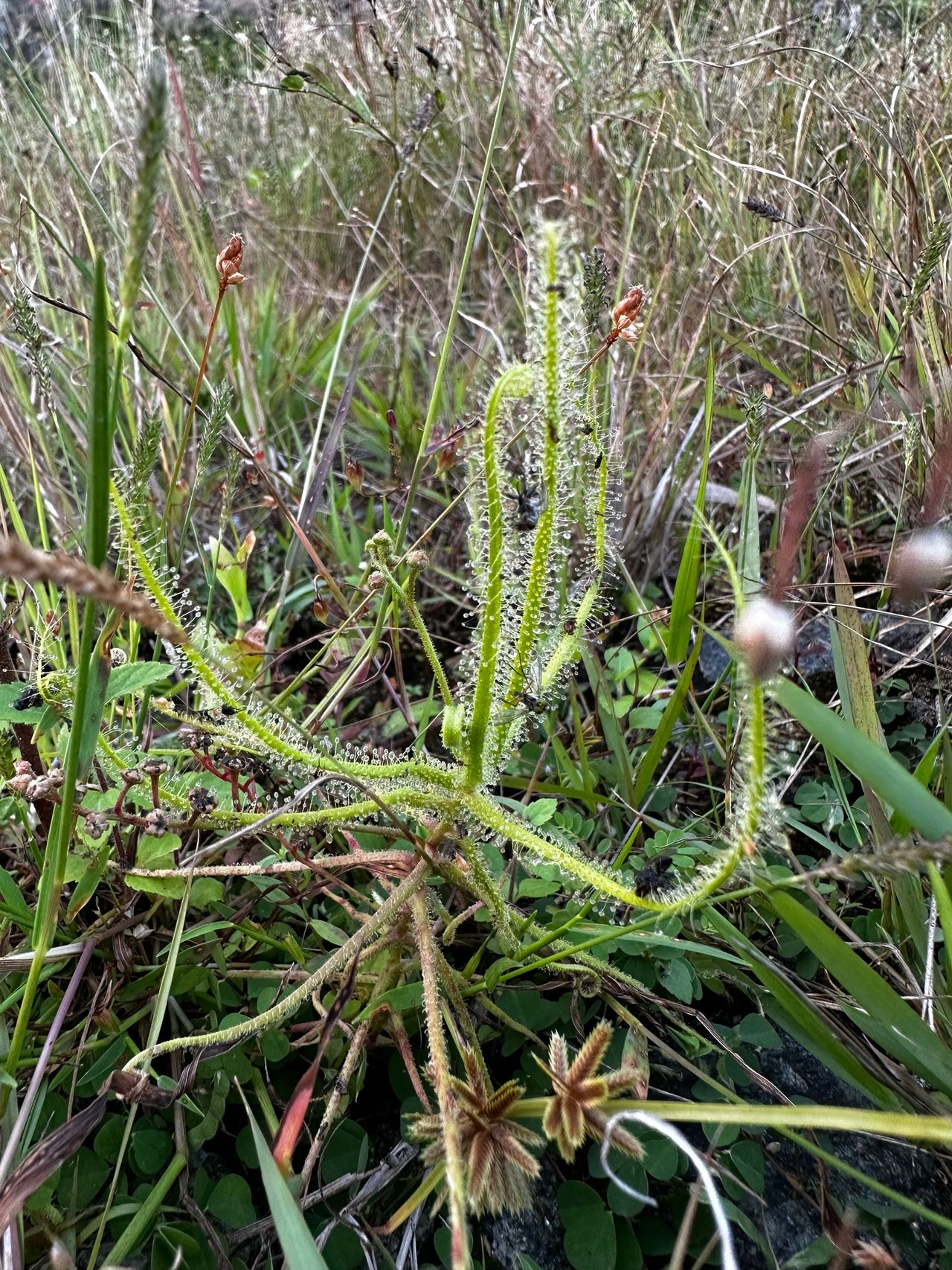
An annual sundew of the monsoon regions that grows not as a flat rosette but as an upright little stem with narrow, sticky leaves — one of many plants long lumped together under the collective name Drosera indica. Drosera finlaysoniana is named after George Finlayson, the Scottish surgeon and naturalist who in 1821–22 travelled with a British mission to Siam and Cochin-China and collected the type material there, near present-day Da Nang in Vietnam. Only in 2013 did Barrett and Lowrie bring the name back out of synonymy with D. indica.
Identification
An annual with an erect, unbranched or sparingly branched stem carrying long, narrow, linear leaves covered along their length with tentacles. The characters separating the species within the D. indica group (section Arachnopus) are subtle and lie mostly in details: the stalked glandular hairs do not reach the stem base, there are only sparse simple hairs among the glands, the anthers are normally shaped (not hooded as in some relatives), and the seed is relatively small with a distinctly reticulate surface. Reliable measurements from the revision could not be consulted for this guide; the size fields are therefore left empty.
Similar species
The whole group of annual, upright sundews with linear leaves in tropical Asia and northern Australia look alike: Drosera indica in the strict sense, and in Australia a series of recently separated species such as D. aurantiaca, D. cucullata, D. fragrans, D. glabriscapa and D. hartmeyerorum. Separation relies mainly on flower colour, hairiness of stem and scape, anther shape and seed structure — with a hand lens, not by eye. Where only vegetative plants are present, a certain identification is often not possible.
The trap and how it works
An active flypaper trap on an unusual frame. The long, narrow leaves stand obliquely upwards or droop somewhat and carry tentacles with sticky droplets along their whole length. Small flying insects moving between the leaves stick fast; the tentacles bend towards the prey and with larger prey the leaf curls round the insect too. Enzymes from the glands digest the prey. Because the plant stands clear of the ground, it catches relatively much flying prey.
Habitat and ecology
Seasonally wet ground in a monsoon climate: hollows flooded in the rainy season that dry out afterwards (W7), and open, wet patches in savannas and open woodland (B6). In the south of its Australian range it grows mainly inland, in eucalypt woodland subject to periodic flooding. Its life cycle fits that rhythm: the plant germinates when the ground becomes wet, flowers, sets seed and dies when the dry season arrives.
Distribution and elevation
Australia, mainly in the north (northern Western Australia, the Northern Territory and Queensland), with further southern sites inland in New South Wales and South Australia; and tropical Asia: Hainan, Taiwan, the Philippines and mainland South-East Asia, including Vietnam, where the type was collected. Note: the short range entry in this guide's species list (Thailand to Indochina) covers only the Asian part; most documented records actually come from Australia. No published altitudinal range was found.
Forms and variation
No varieties are recognised within the species. The whole of section Arachnopus has been in strong taxonomic flux over the last fifteen years: where one widespread species used to be assumed, more than ten are now accepted. The delimitation of D. finlaysoniana, especially in Asia, has not yet been tested for all populations. The related name D. finlaysonii is another spelling of the same name from Wallich's catalogue; it has a separate cross-reference page in this guide.
Where and when to see it
Search at the end of the rainy season, when the plants are full grown and flowering; in northern Australia that is roughly the end of the wet, further south later. The plants grow in open, wet hollows, often among grasses, and stand out by the glitter of droplets along the thin leaves. Take a hand lens to examine flower and anthers, because without those details the species cannot be told reliably from its relatives.
Conservation status
The species is listed as Least Concern (LC) on the global IUCN Red List and is not in CITES. Its range is large and it is widespread in northern Australia. Because its separation from related species is recent, older assessments and counts of 'D. indica' do not always say anything about this species in its present sense. Local threats are drainage, grazing and conversion of seasonally wet land to agriculture.
Scientific name
Drosera finlaysonii | Wallich ex Arnott, 1837
Described by Nathaniel Wallich, validly published by George Arnott Walker Arnott in 1837, in Companion to the Botanical Magazine, volume 2, p. 314-315. Originally published as "finlaysoni". The precise type locality could not be established. The species is native to South East Asia. Very likely named after George Finlayson (1790-1823), the Scottish naturalist who travelled with the Crawfurd mission to Siam (Thailand) and Cochinchina (Vietnam) in 1821-1822 and whose collections were studied by Wallich. This remains a strong inference, however, not a literally confirmed fact for this specific plant.
World Checklist of Vascular Plants (WCVP), via Plants of the World Online (POWO), Royal Botanic Gardens, Kew.