All species › Caryophyllales › Sundew family › Drosera oblanceolata
Drosera oblanceolata
A small rosette-forming sundew from southern China, described only in 1981 by the Chinese botanist Y.Z. Ruan. Drosera oblanceolata owes its name to the oblanceolate blade — narrow at the base and widest beyond the middle. Most of what is known about the species comes from Hong Kong, where it grows on a handful of islands and hills; beyond that there are only scattered records from Guangdong, Guangxi and Fujian. It belongs to the relationship of the widespread D. spatulata.
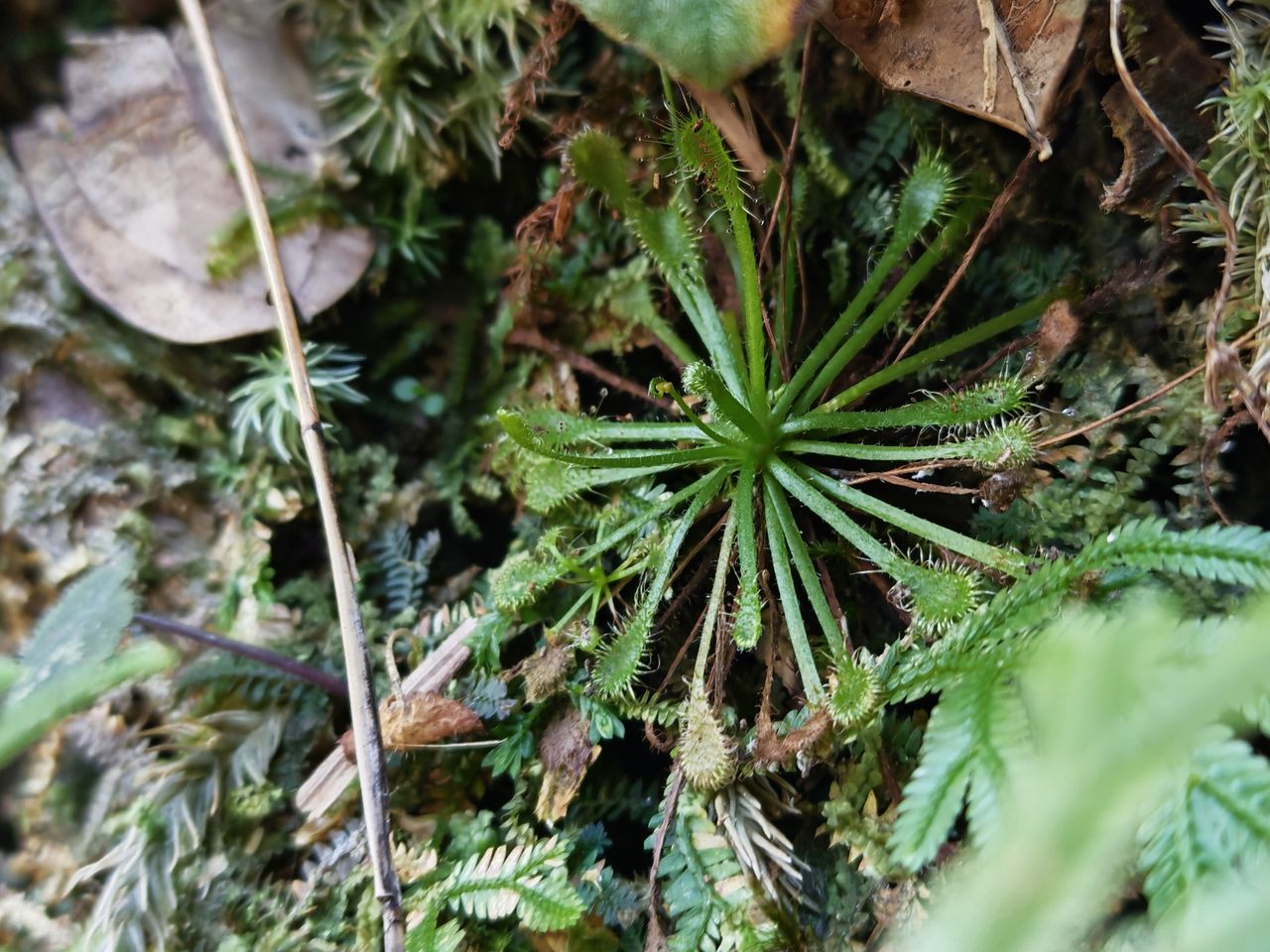
Identification
A perennial, flat to semi-erect rosette of oblanceolate leaves: the blade tapers gradually to the base without a sharply defined petiole and carries red tentacles on the upper surface and along the margin. The scapes rise from the centre of the rosette and carry a one-sided raceme of a few flowers. No reliable source for measurements and flower colour could be consulted for this guide — the original description and the treatment in the Flora of China were not accessible — so the size fields are left empty.
Similar species
The most obvious confusion is with Drosera spatulata, which occurs in the same area and has a spatulate blade on a shorter, more clearly defined stalk; D. oblanceolata has longer, narrower and more gradually tapering leaves. Southern China also has D. burmannii, with a flat rosette of short wedge-shaped leaves and five styles, and D. peltata, which forms an erect stem with peltate leaves. According to the authors of D. ultramafica, D. oblanceolata is also related to that species and to D. neocaledonica; their ranges do not overlap.
The trap and how it works
An active flypaper trap. The red tentacles on the blade each carry a droplet of sticky mucilage; a small insect landing in it is held, after which the tentacles bend towards the prey. The glands secrete enzymes and absorb the released nutrients. With rosettes of this size the catch is mainly small midges, flies, ants and springtails.
Habitat and ecology
In Hong Kong the species grows on wet, open spots on hillsides: on damp rocks and bare ground with seeping water, along stream banks and in wet, open grassland and marsh vegetation (R1, W4). The ground is always acid, nutrient-poor and well lit. More detailed habitat descriptions from the original literature could not be consulted for this guide; the codes give the general picture.
Distribution and elevation
Southern China: Hong Kong, where most documented records come from, and scattered in Guangdong, Guangxi and Fujian. The species is not known outside China. No published altitudinal range was found; the elevation field is left empty.
- Recorded (one-degree cells)
Forms and variation
No varieties are recognised. The species belongs to the difficult group around D. spatulata, in which several closely related species have been described in recent decades. Not all authors agree whether D. oblanceolata is an independent species or falls within the variation of D. spatulata; Plants of the World Online accepts it as a species.
Where and when to see it
Search in the wet season, from late spring into summer, on open, wet hillsides with seepage, along the trails of Hong Kong's country parks. The rosettes are small and often lie among moss and grass; look where water runs over the ground or over small rocks. Keep to the paths, because these wet spots are small and easily trampled.
Conservation status
The species has not been assessed for the global IUCN Red List and is not in CITES. Its known range is small and lies in one of the most densely populated parts of the world; urbanisation, road building and changes in drainage are plausible threats. In Hong Kong some of its sites lie within protected country parks.
Scientific name
Drosera oblanceolata | Ruan, 1981
Drosera oblanceolata was described in 1981 by the Chinese botanist Y.Z. Ruan, in Acta Phytotaxonomica Sinica, volume 19(3), p. 340, with an accompanying figure (fig. 1). The species is known from China (including Hong Kong and adjoining coastal provinces). The precise type locality (province), collector and collection date could not be established with certainty. The name is descriptive botanical Latin: the prefix "ob-" ("reversed, inverted") combined with "lanceolata" ("lance-shaped") gives "oblanceolate", referring to the shape of the leaf blade, which is lance-shaped but broadest near the tip rather than near the base.
World Checklist of Vascular Plants (WCVP), via Plants of the World Online (POWO), Royal Botanic Gardens, Kew.