All species › Caryophyllales › Sundew family › Drosera caduca
Drosera caduca
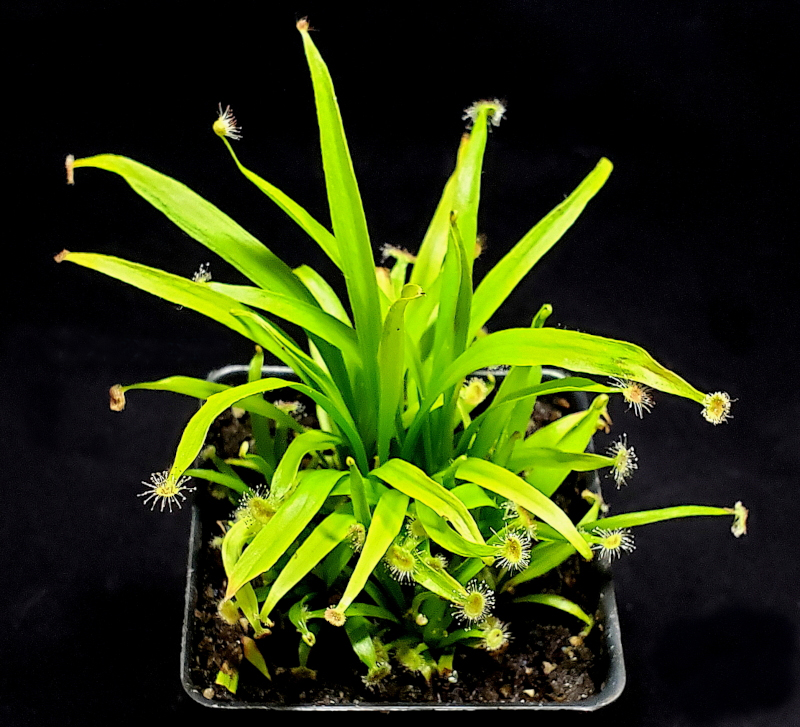
Drosera caduca is a puzzling sundew: a carnivorous plant that largely gives up its trapping apparatus. Only the juvenile leaves carry the sticky tentacles that characterise the genus; the adult leaves lack them. The epithet, Latin for 'falling' or 'transient', refers to this early loss. The species is endemic to the northern Kimberley of Western Australia.
Identification
A perennial rosette plant of the D. petiolaris complex, often forming several rosettes at once from its root system so that small clusters arise. The juvenile leaves, as in its relatives, have a long stalk with a small trapping blade bearing glandular tentacles. In the adult leaves these tentacles are absent; the blade is then no longer sticky. This is the most reliable field character. The flowers are white. Reliable measurements were not available for this guide; the measurement fields are therefore left empty.
Similar species
Other species of the D. petiolaris complex in the Kimberley, such as D. petiolaris, D. derbyensis and D. dilatatopetiolaris, carry glandular tentacles on all leaves. An adult rosette without sticky blades is therefore already strong evidence for D. caduca within the group. Young plants with fully glandular juvenile leaves can hardly be told from relatives without locality data.
The trap and how it works
An active flypaper trap, but only in youth. The juvenile leaves carry glandular tentacles that, as in other sundews, catch and digest small insects in sticky mucilage. As the plant matures, the tentacles disappear from new leaves, and with them largely the carnivorous function. Why the plant does this has not been explained; perhaps in its habitat the saving from not producing glands outweighs the yield of the catch.
Habitat and ecology
White sandy soil along creek margins (D1), in places that are wet in the rainy season and dry out afterwards (W7), in a landscape of savanna and open woodland on sandstone (B6).
Distribution and elevation
Endemic to the northern Kimberley of Western Australia: from the Edkins Range to the southern part of Prince Regent National Park, and on Augustus Island. The range description 'tropical northern Australia' is therefore broader than the actual range, which is confined to Western Australia. Altitudinal limits are not published in the sources consulted; the elevation field is left empty.
- Recorded (one-degree cells)
Forms and variation
No varieties are recognised. The species was described in 1996 by Allen Lowrie. The loss of tentacles on adult leaves is very unusual in the genus; it is therefore important to examine adult, not only young, leaves when identifying it.
Where and when to see it
The sites lie in one of the most remote parts of Australia and are mostly reachable only by boat, helicopter or long overland expeditions. Anyone who gets the chance should search in the late wet season along creeks with white sand for clusters of rosettes whose leaves do not glisten. The area is partly national park and partly Aboriginal land; access requires permission.
Conservation status
On the IUCN Red List the species is Least Concern (LC); it is not listed in CITES. The range is small but lies in one of the least disturbed parts of Australia, partly within Prince Regent National Park. Possible threats are changes in fire regime and feral grazing animals.
Scientific name
Drosera caduca | Lowrie, 1996
Described by Allen Lowrie in 1996, in Nuytsia, volume 11, no. 1, p. 55-69. August Island, Western Australia; type material collected on 27 May 1993. From the Latin caducus ("dropping off early") — refers to the absence of sticky trapping hairs on all but the youngest leaves: mature leaves lose their glandular traps.
World Checklist of Vascular Plants (WCVP), via Plants of the World Online (POWO), Royal Botanic Gardens, Kew.