All species › Caryophyllales › Sundew family › Drosera darwinensis
Drosera darwinensis
Drosera darwinensis is the sundew of Darwin's back yard: a member of the D. petiolaris complex with a small range south and east of the Northern Territory's capital. Allen Lowrie described it in 1996 and named it after the region where it grows; the type was collected near Palmerston in April 1990.
Identification
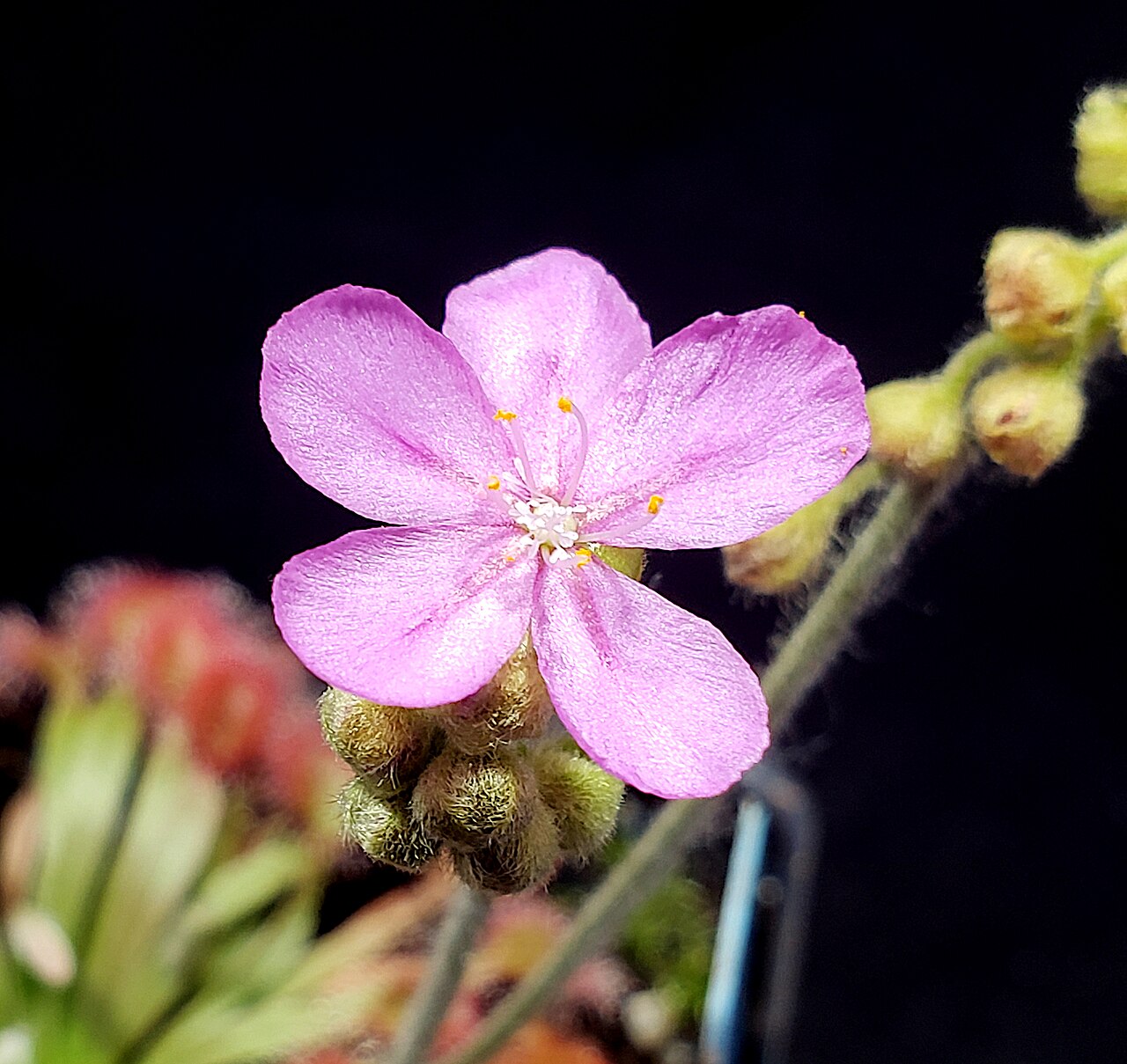
A perennial rosette of leaves with long, narrow stalks and a small round trapping blade at the tip, as is characteristic of the D. petiolaris complex. The most useful feature is the inflorescence: at 5 to 15 cm it is strikingly short compared with that of the closely related D. brevicornis, which reaches 30 to 40 cm. The flowers are pink or white. Reliable leaf measurements were not available for this guide; that field is left empty.
Similar species
Its closest relative is Drosera brevicornis, from which it differs mainly in its much shorter inflorescence. D. fulva, which occurs in the same area around Darwin, has reddish-brown hairs and tall inflorescences of 25 to 45 cm; D. dilatatopetiolaris has broadened green petioles; D. petiolaris also has taller inflorescences. Without flowers these species are hard to tell apart.
The trap and how it works
An active flypaper trap. The round blades at the ends of the long stalks carry glandular tentacles with sticky mucilage in which small insects get stuck; the tentacles then bend towards the prey and the glands digest it. Because the blades stand just above the ground, the catch consists mainly of small low-flying and crawling insects.
Habitat and ecology
Clayey sand that becomes wet in the rainy season (W7), in open savanna woodland (B6). Like its relatives, the plant survives the dry season as a small, protected bud of smaller leaves and sprouts again when the rains return.
Distribution and elevation
Endemic to the Northern Territory, in a small area south and east of Darwin: from Palmerston to Berry Springs and east to Humpty Doo. The range description 'around Darwin' is thus accurate. Altitudinal limits are not published in the sources consulted; the elevation field is left empty.
- Recorded (quarter-degree cells)
Forms and variation
No varieties are recognised. The species was described in 1996 by Allen Lowrie, together with other species of the D. petiolaris complex. The short inflorescences are the main difference from D. brevicornis; intermediates or hybrids between the two are not described in the sources consulted.
Where and when to see it
Search in the wet season, December to April, when the plants are in flower, on open, wet sandy ground in savanna around Palmerston, Berry Springs and Humpty Doo. The short flowering stems make the plant less conspicuous than its relatives; look above all for the star-shaped rosettes with red blades on the sand. The area is developing fast: many sites lie on or next to building or farm land, where the owner's permission is needed.
Conservation status
On the IUCN Red List the species is Least Concern (LC); it is not listed in CITES. Its small range, however, lies in the fastest-growing region of the Northern Territory, around Darwin and Palmerston. Expansion of housing, agriculture and infrastructure, changes in fire regime and the spread of invasive grasses are therefore real local threats.
Scientific name
Drosera darwinensis | Lowrie, 1996
Described by Allen Lowrie in 1996, in "New species in Drosera section Lasiocephala (Droseraceae) from tropical northern Australia", Nuytsia, volume 11, no. 1, p. 61 (article p. 55-69) — the same publication as D. derbyensis, later in this golf. 0.9 km south of Temple Avenue, Palmerston, Northern Territory, collected on 8 April 1990. Named after the Darwin region, Northern Territory, where the species is abundant.
World Checklist of Vascular Plants (WCVP), via Plants of the World Online (POWO), Royal Botanic Gardens, Kew.