All species › Caryophyllales › Sundew family › Drosera chimaera
Drosera chimaera
In Greek mythology a chimaera is a monster made up of parts of different animals, and in biology an organism combining features of different origins. Drosera chimaera was described in 2015 by Paulo Gonella and Fernando Rivadavia in the major revision of the Drosera villosa complex. The name refers to a plant that seems to combine characters found separately in other species of the group.
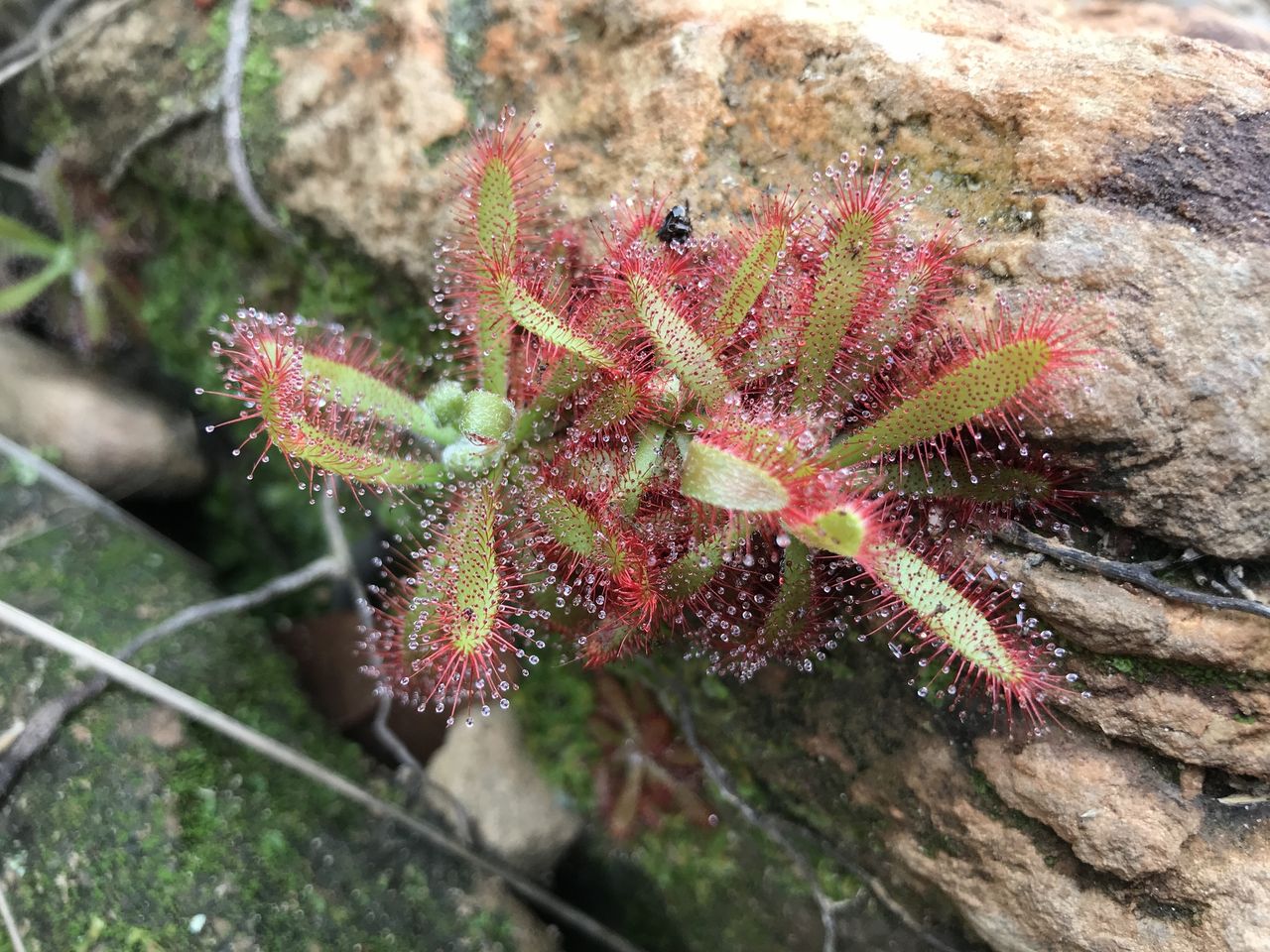
Identification
A perennial rosette plant of the group of long-leaved, hairy mountain sundews around Drosera villosa. Like its relatives it has semi-erect leaves whose young tips are coiled inwards, with a blade full of red tentacles and a long scape. The combination of characters that separates it from its relatives is set out in the 2015 revision; exact measurements and a confirmed flower colour could not be checked here, so the size fields are left empty.
Similar species
Within the D. villosa complex, Drosera villosa, Drosera latifolia, Drosera graminifolia and Drosera ascendens are the obvious confusion species; they differ in the ratio of petiole to blade, the width of the blade, the hairs and the shape of the stipules. D. latifolia is by far the most widespread species of the group and may occur in the same area. Identification requires the key in the revision.
The trap and how it works
An active flypaper trap. The tentacles on the blade catch small insects in their mucilage droplets, after which the surrounding tentacles bend towards the prey and the leaf may partly curl around the catch. Because the leaves are semi-erect, both crawling and flying insects are caught.
Habitat and ecology
Wet places in the campos rupestres of northern Minas Gerais: seepage zones along rock slabs, boggy sandy ground and the wet edges of streams, in a landscape of quartzite mountains with open, grassy vegetation (R1, W4, D2). The photographs accompanying the description show the type locality near Cristália.
Distribution and elevation
Endemic to the state of Minas Gerais in south-eastern Brazil and, according to the distribution maps in the 2022 Brazilian synopsis, confined to the northern part of the Espinhaço range. A published altitudinal range has not been adopted.
- Recorded (one-degree cells)
Forms and variation
No varieties are recognised. The species is one of the new species distinguished in the 2015 revision, when it emerged that a whole series of species lay hidden under the name D. villosa. As the name suggests, it shares characters with several relatives; the possibility of a hybrid origin is, as it were, hinted at in the name, but the authors treat it as a separate, stable species.
Where and when to see it
The wet season, November to March, is the best time. Search seepages and stream edges in the quartzite mountains of northern Minas Gerais. Photograph petiole, blade, stipules and scape close up: those are the characters on which the species of the complex are separated.
Conservation status
Not assessed for the global IUCN Red List and not listed in CITES. The range is small and confined to one region of one state. Threats to the campos rupestres of northern Minas Gerais are fire, invasive grasses, eucalyptus plantations, mining and changes to the water regime.
Scientific name
Drosera chimaera | Gonella & Rivadavia, 2014
Described by Gonella & Rivadavia in 2014, in Phytotaxa, volume 156, no. 1, p. 34. Brazil, Minas Gerais, Cristália municipality, sandstone outcrop beside a sandbank on the right bank of the Rio Itacambiruçu, at 695 m elevation. Collected by Gonella et al. (no. 500) on 7 September 2011; holotype at herbarium SPF, isotypes at BHCB, P and RB. The meaning of the name could not be confirmed with certainty. "Chimaera" refers to the mythological hybrid creature of Greek mythology and may allude to this species' intermediate form relative to the closely related D. latifolia and D. tomentosa, but this remains a guess.
World Checklist of Vascular Plants (WCVP), via Plants of the World Online (POWO), Royal Botanic Gardens, Kew.