All species › Caryophyllales › Sundew family › Drosera cuneifolia
Drosera cuneifolia
The sundew of Table Mountain. Drosera cuneifolia grows nowhere but in the mountain complex around Cape Town, and is a familiar sight there on the wet patches along the trails. The name refers to the wedge-shaped leaves, which look as if cut off at the tip.
Identification
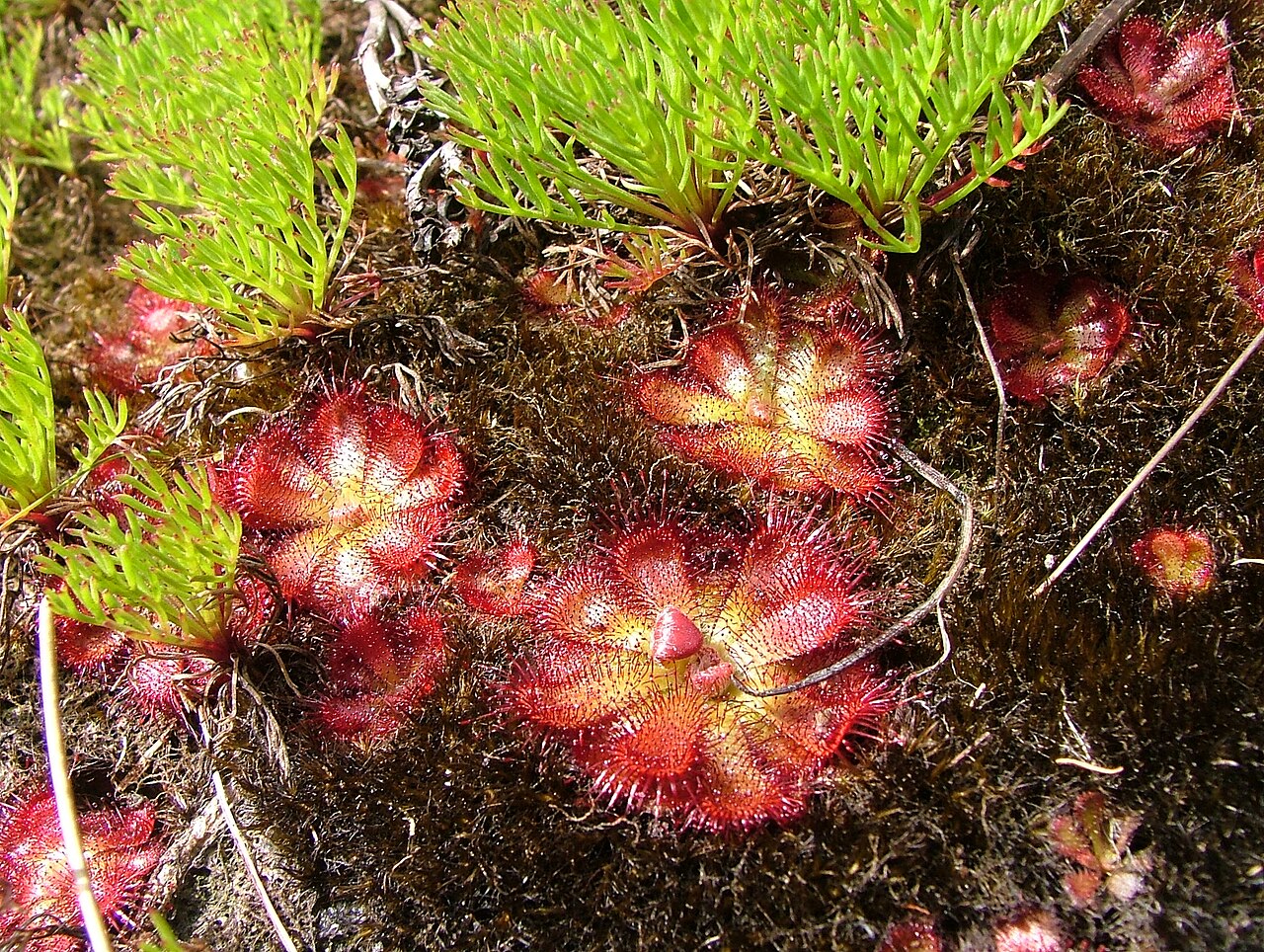
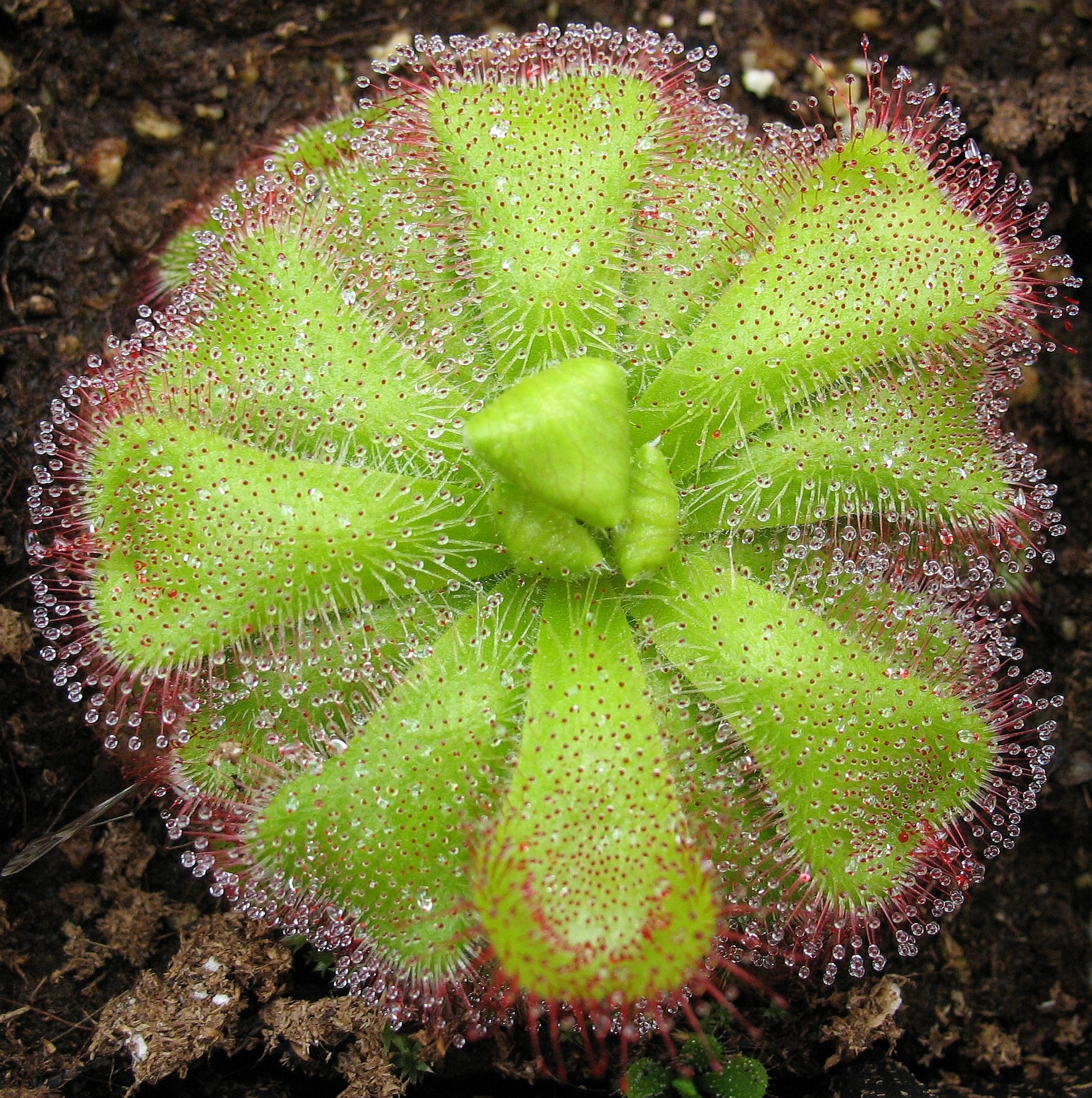
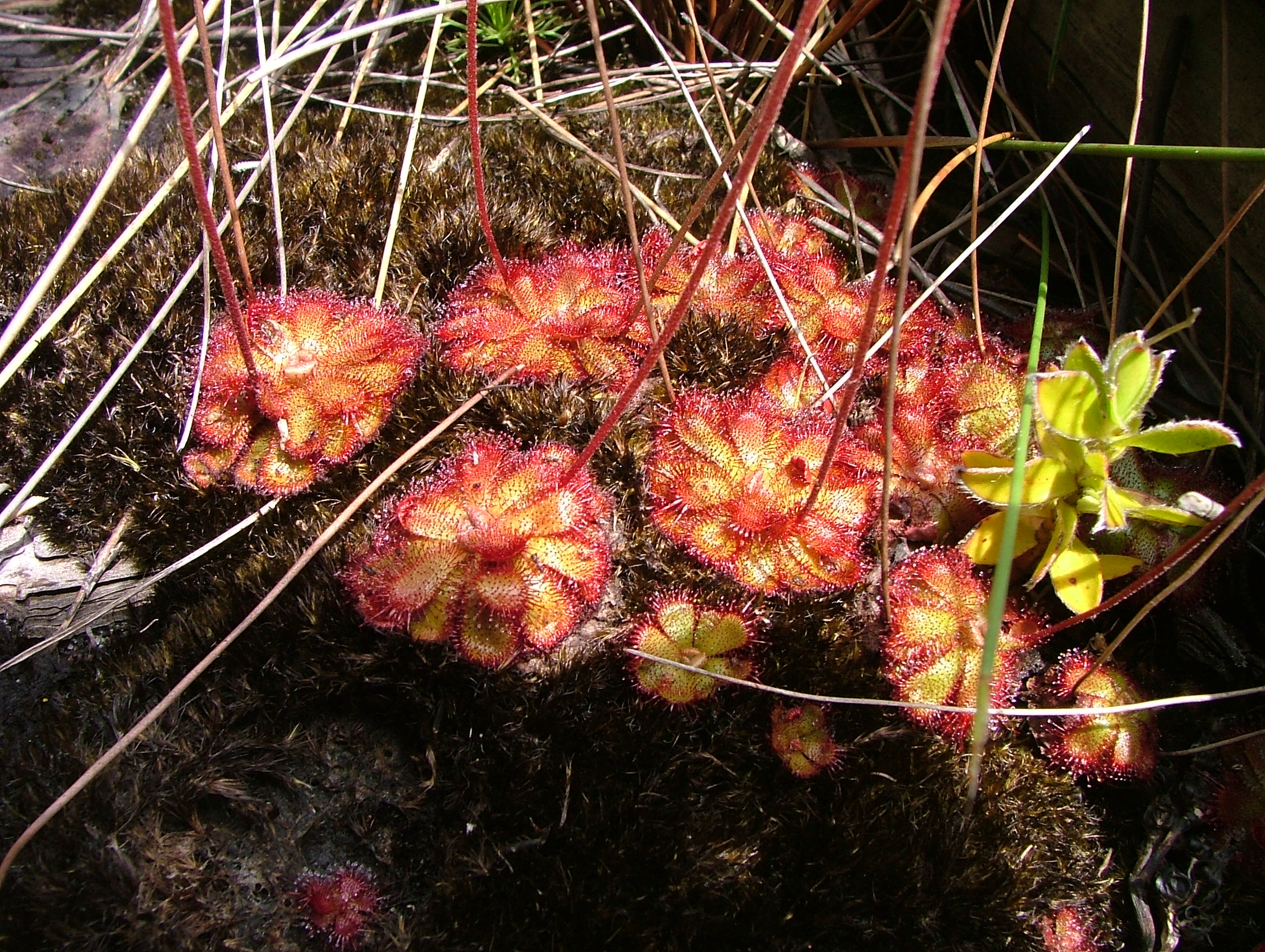
A medium-sized rosette about 4 cm across and some 3 cm tall. The leaves are wedge-shaped, 20 to 40 mm long and 10 to 15 mm wide, greenish to red, with three to five veins, widening towards the tip and truncate there. The tentacles cover the upper surface and margin. The leafless, erect scape is 10 to 20 cm tall, rarely branched, and carries several pink to mauve flowers with petals 10 to 15 mm long. The styles are spoon-shaped. Each flower opens in the morning, closes by mid-afternoon and lasts only one day.
Similar species
The truncate wedge shape of the leaf is the best character. Drosera aliciae has narrower spatulate leaves with a hairy underside; D. trinervia is smaller, usually white-flowered; D. slackii has a petiole widened in the middle and a larger rosette. On Table Mountain D. capensis and D. hilaris also grow, both with longer, upright leaves.
The trap and how it works
An active flypaper trap. The tentacles secrete a sticky mucilage which, according to PlantZAfrica, contains a weak acid and enzymes that digest the soft parts of the prey. After contact the surrounding tentacles bend towards the insect. The broad leaf tip gives the plant a relatively large trapping surface for a rosette of this size.
Habitat and ecology
Moist, peaty places in seep zones and open flat sandy ground among fynbos, and along streams and river banks, up to about 915 m (R1, W4, B5). The species grows in winter and usually goes dormant in the dry summer.
Distribution and elevation
Endemic to South Africa and confined to the Table Mountain complex on the Cape Peninsula in the Western Cape. As no lower limit is given for the altitudinal range, the elevation field is left empty; the upper limit lies around 915 m.
- Recorded (quarter-degree cells)
Forms and variation
Linnaeus the Younger described the species in 1781, making it one of the earliest-described Cape sundews. No varieties are recognised. Locality-labelled strains circulate in cultivation, but they have no taxonomic standing and are not used here.
Where and when to see it
Table Mountain and the Peninsula mountains are crossed by trails; after the winter rain look in wet places where water seeps over sandstone. The flowers appear in early summer and are open only in the morning and around midday. The whole area is a national park; picking and collecting are prohibited.
Conservation status
Not assessed for the global IUCN Red List and not listed in CITES. According to PlantZAfrica the species is listed as Least Concern on the national Red List. Its entire range lies within Table Mountain National Park, which gives protection; at the same time the very small range makes it vulnerable to changes in hydrology, invasive alien plants and overly frequent fires on the urban edge.
Scientific name
Drosera cuneifolia | Linnaeus filius, 1781
Described by Carl Linnaeus the Younger in 1782, in "Supplementum Plantarum Systematis Vegetabilium", p. 188. Cape region, South Africa, near Table Mountain/Cape Town ("Capensis"); no more precise locality or collector known. From the Latin cuneus ("wedge") and folium ("leaf") — "wedge-shaped leaf", referring to the spatula-shaped leaf form.
World Checklist of Vascular Plants (WCVP), via Plants of the World Online (POWO), Royal Botanic Gardens, Kew.