All species › Caryophyllales › Sundew family › Drosera natalensis
Drosera natalensis
A rosetted sundew of the wet sand flats along the Indian Ocean. Drosera natalensis was described in 1906 by Ludwig Diels, named after the then colony of Natal, and occurs in eastern South Africa, Mozambique and Madagascar. In cultivation it is sometimes confused with D. aliciae, but in the wild the two grow far apart.

Identification
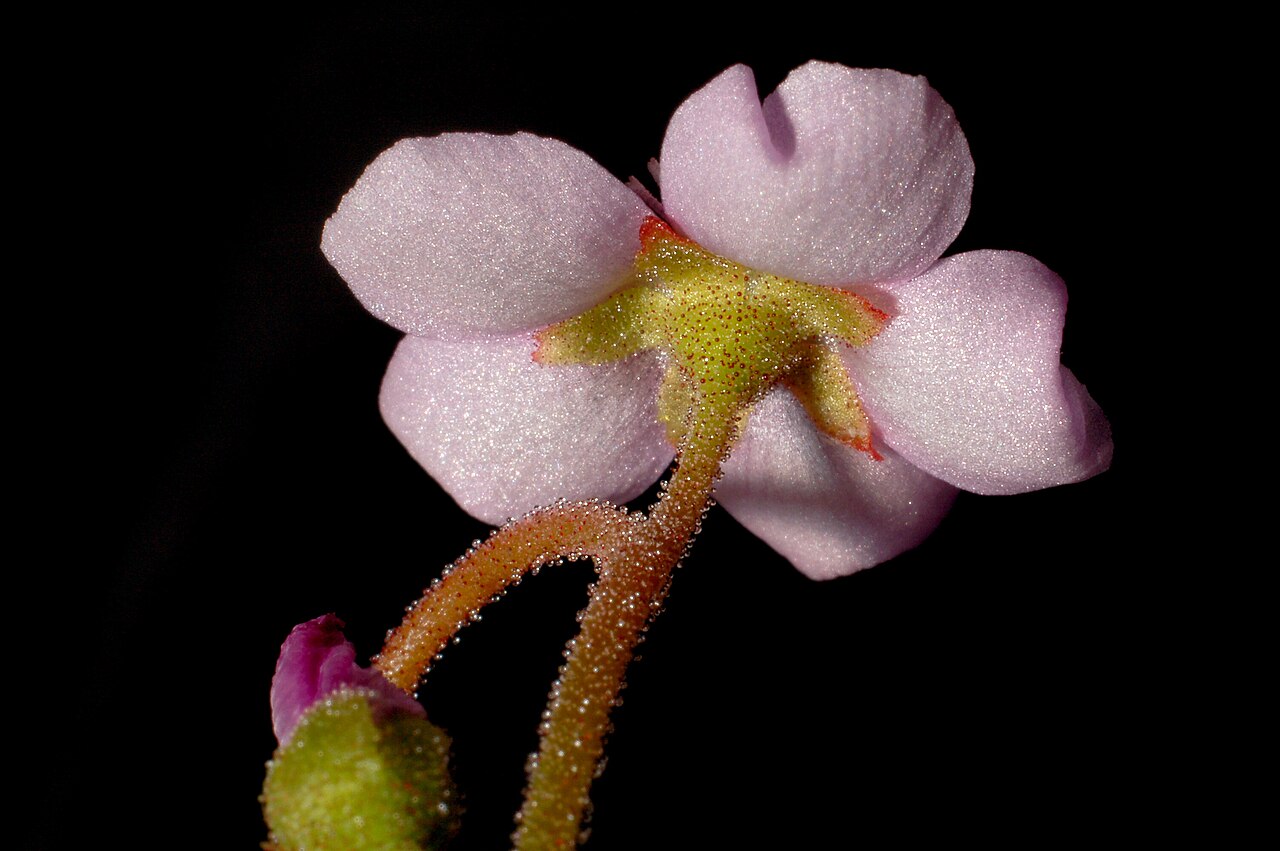
A flat to semi-erect rosette of spatulate leaves tapering gradually into the petiole, with red tentacles on the upper surface and along the margin. Characteristic are the strongly hairy stipules at the leaf base and a fairly large gap between the leaf base and the first tentacles. The scape carries pink flowers. Published measurements from a flora were not available for this text; the measurement fields are left empty.
Similar species
Drosera aliciae from the Cape is very similar but has less hairy stipules and its tentacles begin closer to the leaf base. Within its own range D. natalensis can grow with D. burkeana and D. madagascariensis; the latter forms a stem, the former has shorter, broader blades. Drosera dielsiana is smaller and grows further inland in grassland.
The trap and how it works
An active flypaper trap. Insects landing on the sticky droplets are caught; the surrounding tentacles then bend towards the prey and the glands secrete digestive enzymes. On the wet sand flats the plant catches mainly gnats and small flies.
Habitat and ecology
Wet, acid and nutrient-poor sandy soils near the coast: seasonally wet hollows, marsh margins and open, waterlogged grassland on sand (W4, W7, D1). The plant needs open, sunny ground; tall vegetation or encroaching scrub crowds it out.
Distribution and elevation
Eastern South Africa (KwaZulu-Natal), Mozambique and Madagascar. This departs from the label 'Cape mountains' in this guide's working list: the species is not a Cape mountain plant but a lowland species of the eastern coastal plain. Altitudinal limits were not found.
- Recorded (quarter-degree cells)
Forms and variation
No varieties are recognised. The relationship to the Cape D. aliciae group and to D. nidiformis has been discussed in the literature; in Kew's current lists D. natalensis is accepted as a distinct species.
Where and when to see it
In KwaZulu-Natal the plant grows in the wet summer. Search the marshy sand flats behind the coastal dunes, often in protected areas. In the sun the rosettes are red and stand out well against the white sand.
Conservation status
Not assessed for the global IUCN Red List and not listed in CITES. The range is fairly large and spread over three countries. Locally sites are lost to eucalyptus and pine plantations, drainage and coastal development.
Scientific name
Drosera natalensis | Diels, 1906
Drosera natalensis was described in 1906 by the German botanist Ludwig Diels, in H.G.A. Engler (ed.), Das Pflanzenreich, IV.112 (Heft 26), p. 93. The species occurs in Madagascar, Mozambique and South Africa (notably KwaZulu-Natal). The name points to an origin in the historic region of Natal, but the precise type locality, collector and collection date could not be established with certainty. The name is a toponym: the Latin suffix "-ensis" ("from, belonging to") combined with "Natal" yields "of Natal", referring to the former South African colony/province of Natal (now largely the province of KwaZulu-Natal), where the species was apparently first found or is most characteristic.
World Checklist of Vascular Plants (WCVP), via Plants of the World Online (POWO), Royal Botanic Gardens, Kew.