All species › Caryophyllales › Sundew family › Drosera menziesii
Drosera menziesii
The Pink Rainbow of Western Australia, one of the most widespread and variable tuberous sundews of the south-west. The name honours Archibald Menzies, the ship's surgeon and naturalist who visited King George Sound in 1791 with George Vancouver's expedition. Robert Brown gave the plant its name, but the formal description came in 1824 from Augustin Pyramus de Candolle. One of the type collections was made by Georgiana Molloy, the settler who at the Vasse River became one of the first women in Western Australia to collect plants for European botanists.
Identification
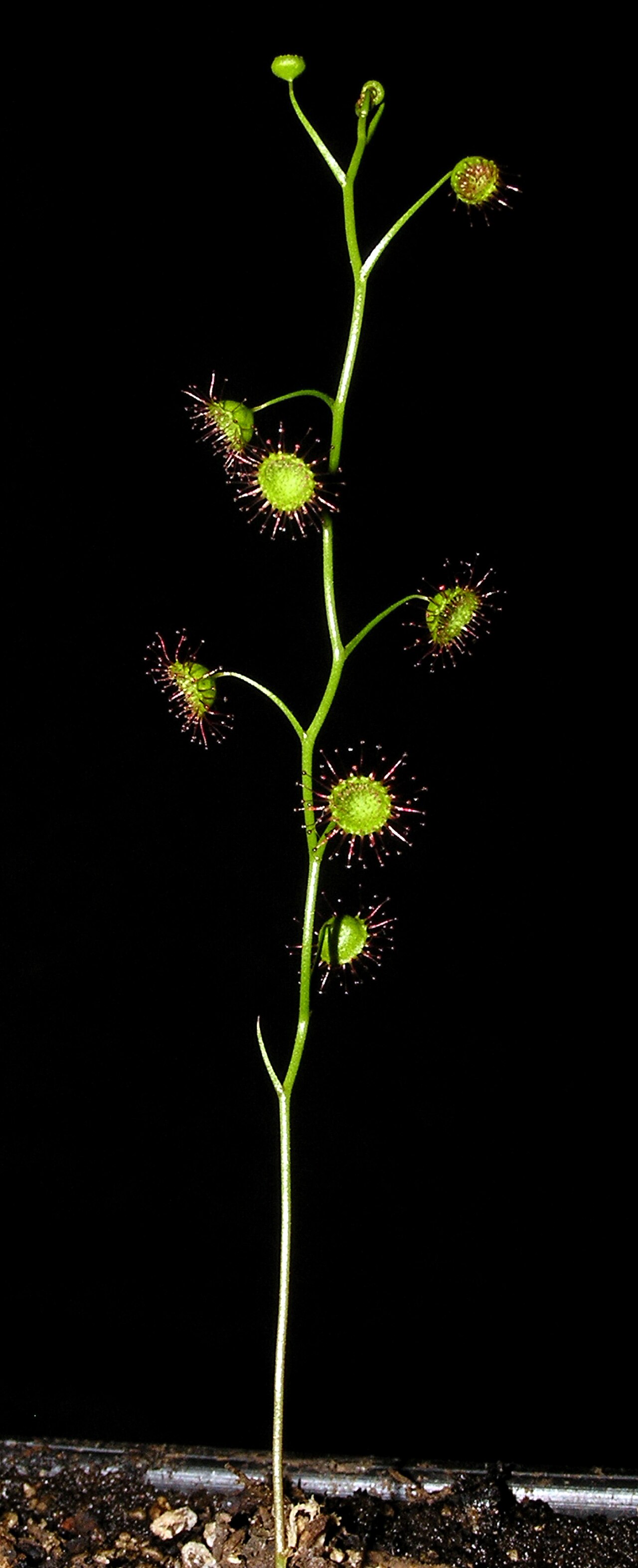
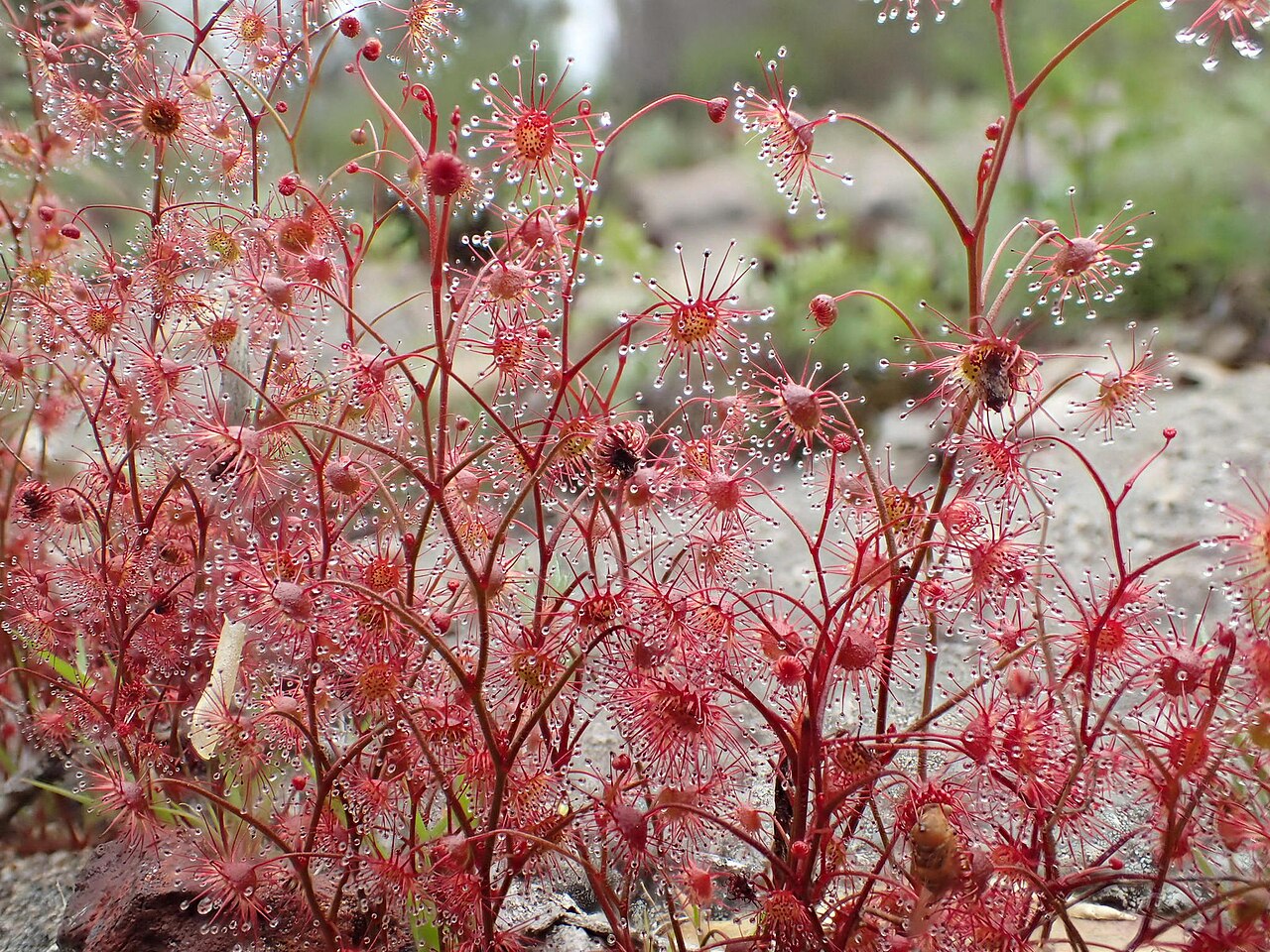
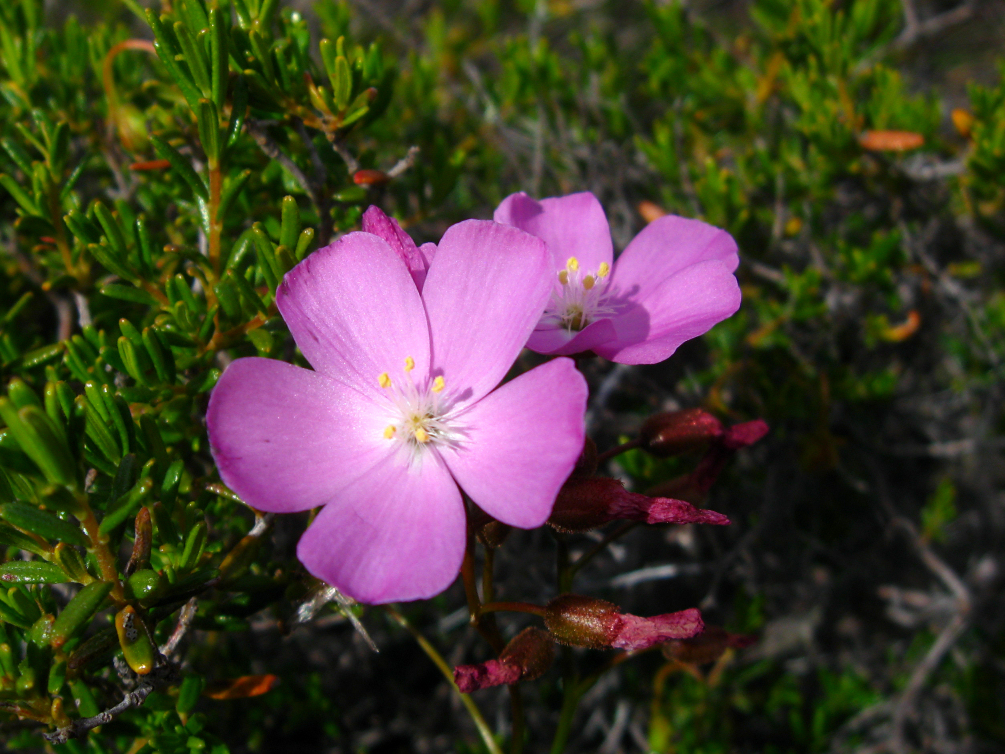
A perennial that each year sends up from an underground tuber an erect or scrambling, often wavy stem, from a few centimetres to over a metre. Along the stem sit small, circular trapping leaves on stalks. The flowers are usually pink, but white, purple and red forms also occur; they appear from July to November. The combination of a wavy stem, round leaves and pink flowers is the best field character. We did not find precise leaf and flower measurements in any source consulted.
Similar species
Other climbing tuberous sundews look similar. Drosera macrantha has larger, usually white flowers and cup-shaped leaves. D. neesii also has pink flowers but cup-shaped leaves in groups of three. D. modesta flowers white and has shield-shaped leaves with long tentacles. Within D. menziesii itself the four subspecies intergrade, which makes identification to subspecies difficult.
The trap and how it works
An active flypaper trap. The round leaf blades carry tentacles with sticky droplets that mainly catch small flying insects. After a catch the tentacles bend to the centre of the leaf and digestive enzymes are secreted. In scrambling plants the trapping leaves hang scattered through the surrounding shrubs; the sticky tentacles at the same time help the stem hold on.
Habitat and ecology
Clay, peaty sand or loam in places that are wet in winter: seasonal swamps, wet hollows and the margins of granite outcrops (W7, W4, R3, D1). The species grows with the autumn rains, flowers from late winter into spring and survives the dry summer as a tuber.
Distribution and elevation
Endemic to south-west Australia, over a large area. FloraBase lists the Avon Wheatbelt, Esperance Plains, Geraldton Sandplains, Jarrah Forest, Mallee, Swan Coastal Plain and Warren bioregions, from north of Perth to the south coast and the Esperance district.
- Recorded (quarter-degree cells)
Forms and variation
Four subspecies are recognised. Besides the typical subsp. menziesii these are subsp. penicillaris, described by Ludwig Diels in 1906 as a variety and raised to subspecies by Marchant and Lowrie in 1992; subsp. thysanosepala, described by Diels in 1906 as a species and reduced to subspecies by Marchant in 1982; and subsp. basifolia, described in 1992 and recognisable by a dense cluster of alternate stem leaves at the base of the stem. Of the three varieties George Bentham described in 1864, one is now a synonym of D. macrantha.
Where and when to see it
Go in August or September, when the species is in flower over most of its range. Search the edges of seasonal swamps and granite outcrops, and the coastal plain south of Perth. The pink flowers on wavy stems can be seen from a distance. Look closely at the base of the stem and the sepals if you want to determine the subspecies.
Conservation status
On the global IUCN Red List the species is listed as Least Concern (LC); in Western Australia it is regarded as not threatened. It is not listed in CITES. Thanks to its large range and broad habitat choice the species as a whole is secure, although populations on the coastal plain and in the Wheatbelt are heavily fragmented by drainage, building and clearing.
Scientific name
Drosera menziesii | R. Brown ex de Candolle, 1824
Drosera menziesii was named by Robert Brown and formally published by Augustin Pyramus de Candolle (cited as "R.Br. ex DC.") in the Prodromus Systematis Naturalis Regni Vegetabilis, volume 1, p. 319 (1824). The type material (B 100294474, Herbarium Berolinense, Berlin) was collected by Georgiana Molloy at the Vasse River in Western Australia; the exact collection date could not be established with certainty. The "-ii" ending indicates an honorific naming after a person called Menzies. This most likely refers to Archibald Menzies (1754–1842), the Scottish naval surgeon and botanist who visited the south coast of Australia (King George Sound) during the Vancouver expedition of 1791, and after whom several Australian and North American plants are named (e.g. Pseudotsuga menziesii, Arbutus menziesii). This specific attribution for D. menziesii, however, could not be confirmed with certainty.
World Checklist of Vascular Plants (WCVP), via Plants of the World Online (POWO), Royal Botanic Gardens, Kew.