All species › Caryophyllales › Sundew family › Drosera enodes
Drosera enodes
Drosera enodes is a pygmy sundew of the wet side: where many relatives grow on dry sand or gravel, this species grows in black, peaty soil at the edges of swamps. Neville Marchant and Allen Lowrie described it in 1992. The name means 'without nodes'. Opinions differ on the rank of this taxon.
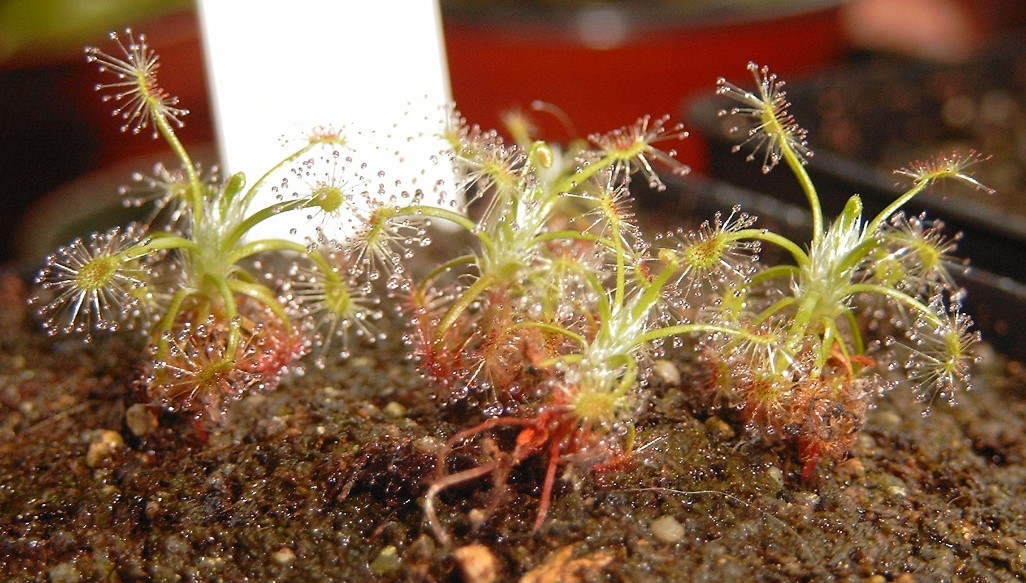
Identification
A perennial, fibrous-rooted pygmy sundew reaching 8 cm with its flowering stem. At its heart stands the cone of silvery stipules. The flowers are white and appear from September to November. Leaf and flower measurements were not available in the accessible sources.
Similar species
The closest relative is Drosera dichrosepala, of which Schlauer treated D. enodes as a subspecies. The difference in habitat is clearest in the field: D. dichrosepala grows on drier sand and laterite, D. enodes on wet, peaty soil. D. dichrosepala also has two-coloured sepals and white to pink flowers. Other pygmy sundews of wet places, such as Drosera closterostigma, are told by their stigmas.
The trap and how it works
An active flypaper trap. The leaves bear stalked glands with droplets of glue. In the wet environment of swamp margins small gnats, midges and springtails are abundant, and they make up most of the catch. After capture the tentacles bend towards the prey and the glands secrete digestive enzymes.
Habitat and ecology
Black peaty soil or grey to brown sand on seasonally wet flats and at the margins of swamps (FloraBase) (W4, W7). It is one of the wettest habitats among pygmy sundews. When the swamp margins dry in summer, the plant rests as a bud of stipules.
Distribution and elevation
Endemic to the south-west of Western Australia. FloraBase lists the Jarrah Forest, Swan Coastal Plain and Warren bioregions: from the coastal plain near Perth to the cool, wet far south-west.
- Recorded (one-degree cells)
Forms and variation
The rank of this taxon is disputed. Marchant and Lowrie described it in 1992 as a species; Schlauer placed it as Drosera dichrosepala subsp. enodes. FloraBase carries both names, and this guide follows the base list in treating D. enodes as a species. Like all pygmy sundews the plant also reproduces by gemmae.
Where and when to see it
Search from September to November at the margins of swamps and on wet flats with black, peaty soil. Wear waterproof footwear and keep off the wettest parts: swamp margins are fragile and many of these sites lie in protected areas. Small white flowers a few centimetres above the peat are the first thing to catch the eye.
Conservation status
Assessed as Least Concern (LC) on the IUCN Red List and listed as not threatened in Western Australia. Not in CITES. Wetlands on the Swan Coastal Plain have declined sharply through drainage, urbanisation and falling groundwater; the species, however, also has sites in the less affected south-west. Note the taxonomic uncertainty: data filed under D. dichrosepala may include this species.
Scientific name
Drosera enodes | Marchant & Lowrie, 1996
Described by N.G. Marchant & Lowrie in 1992, in Kew Bulletin, volume 47, no. 2, p. 323 — the same publication as the previous two species. In 1996 reduced by Schlauer to D. dichrosepala subsp. enodes, though species status is maintained elsewhere. Scott River region and Busselton area, south-western Western Australia, on peaty sand/laterite soils at swamp margins. Latin for "without nodes" — refers to the short, nodeless stems characteristic of this species.
World Checklist of Vascular Plants (WCVP), via Plants of the World Online (POWO), Royal Botanic Gardens, Kew.