All species › Caryophyllales › Sundew family › Drosera omissa
Drosera omissa
A pygmy sundew from the extreme south-west corner of Australia, between Busselton and Augusta. The name omissa means 'overlooked', and for a long time that was literally the case: the species, described by Ludwig Diels, was treated for part of the twentieth century as a subspecies of Drosera nitidula before regaining its own rank. Little has been published on the species itself that we could consult.
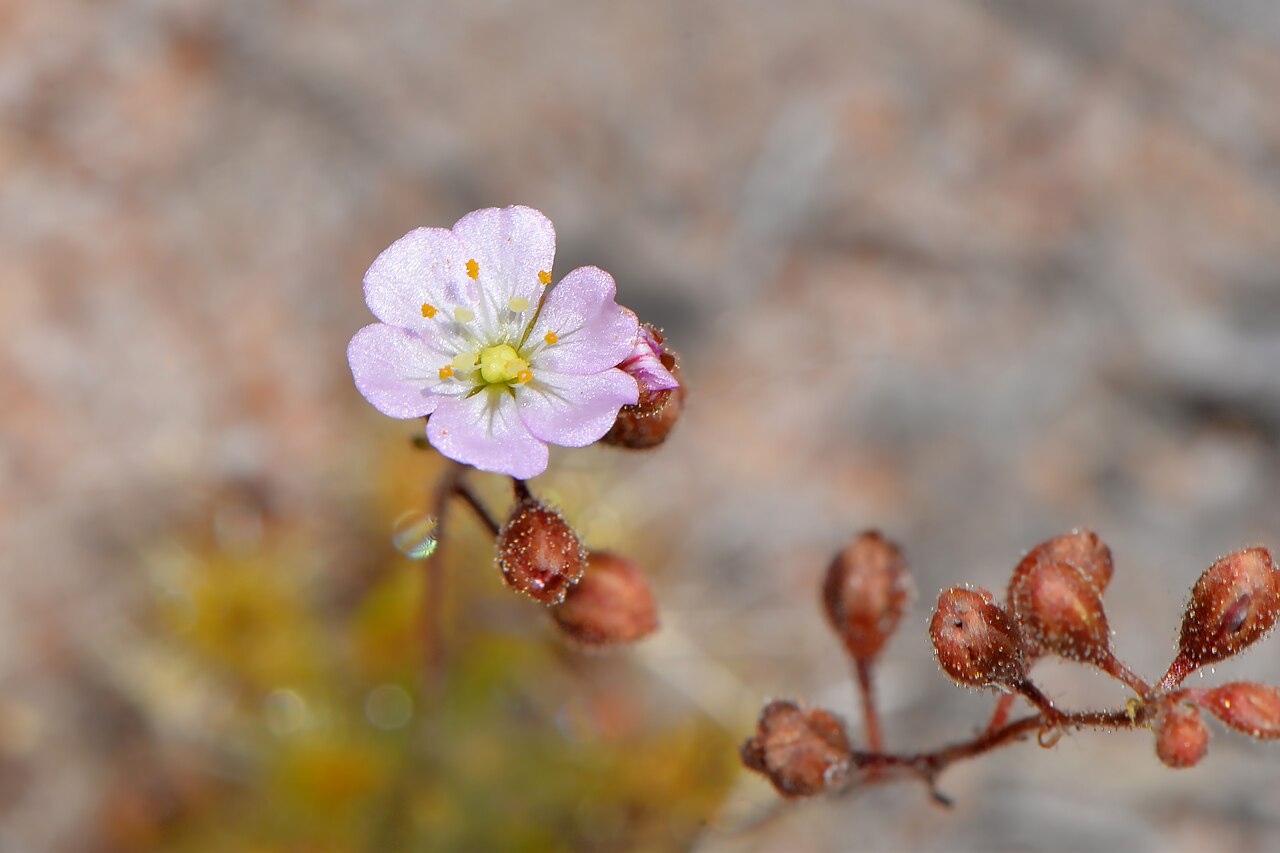
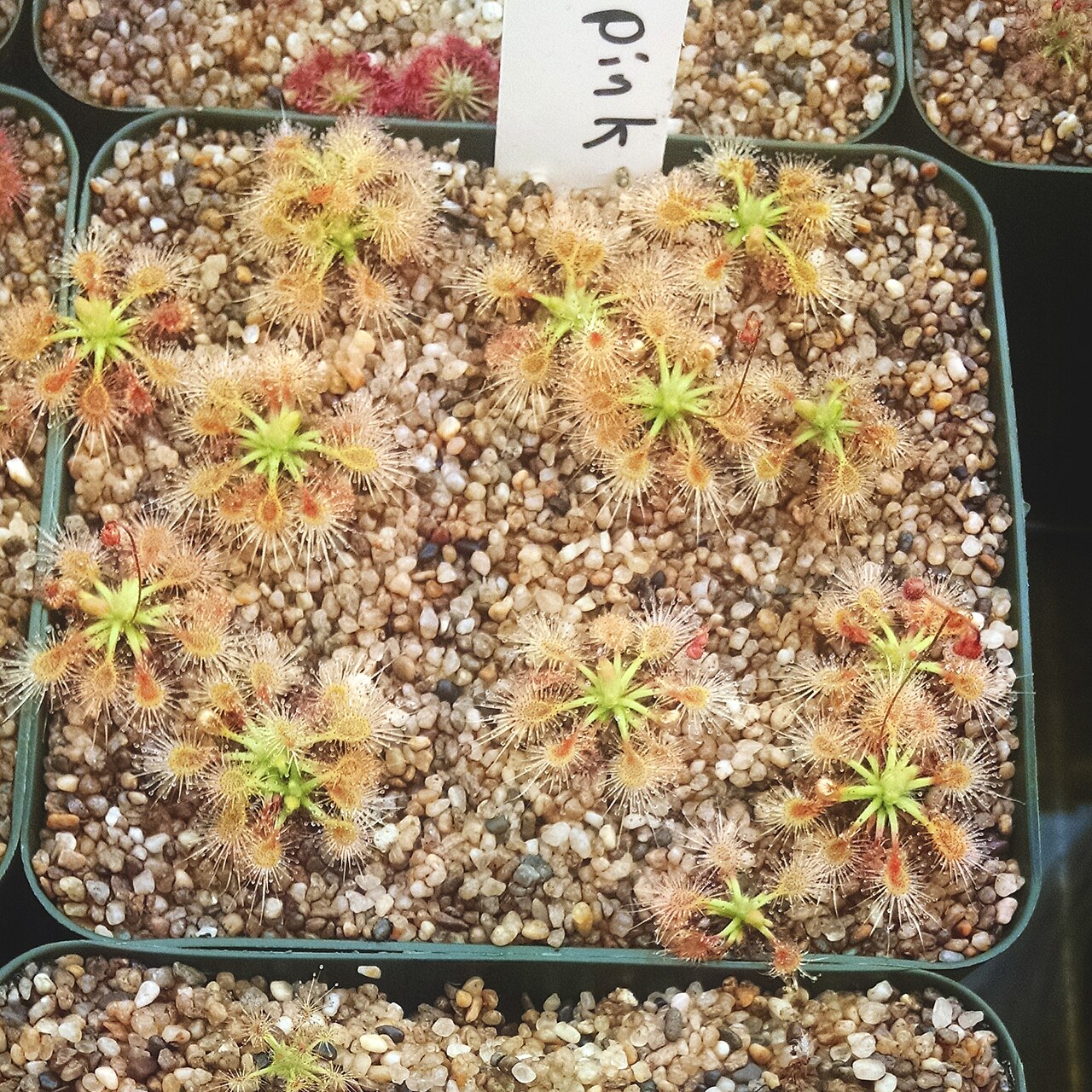
Identification
A small, fibrous-rooted, perennial rosette with the tuft of stipules at its heart that marks all pygmy sundews, and gemmae at the end of the growing season. We could not check measurements, flower colour or flowering time in any accessible source; those fields are left empty.
Similar species
The closest relative and the obvious confusion is Drosera nitidula, of which D. omissa was long a subspecies; D. leucostigma and D. allantostigma also belong to this alliance. The differences lie mainly in the shape and colour of the stigmas and can only be seen with a hand lens in flowering plants.
The trap and how it works
An active flypaper trap in miniature. The leaf blades carry stalked glands with a sticky droplet; the long marginal tentacles catch the prey and bend it to the centre of the leaf, where shorter glands take over digestion. The prey consists of springtails, mites and the smallest flies.
Habitat and ecology
We were unable to consult a published habitat description. The codes follow the picture of related pygmy sundews on sandy soils in and around seasonally wet hollows and in open heath (W7, D1, B5), and are provisional. The south-west corner between Busselton and Augusta is cooler and wetter than the interior, with a longer growing season.
Distribution and elevation
Endemic to south-west Australia, in the south-west corner between Busselton and Augusta, the area known as the Margaret River district and the Leeuwin-Naturaliste ridge.
- Recorded (one-degree cells)
Forms and variation
No subspecies or varieties are recognised. Like most pygmy sundews the plant reproduces by gemmae, which are flung away by raindrops.
Where and when to see it
Pygmy sundews flower in the south-west Australian spring and open their flowers only in sunshine. In the south-west corner, which is often overcast, it pays to wait for a sunny day. A hand lens is needed to examine the stigmas, the only character that reliably separates this species from D. nitidula.
Conservation status
On the global IUCN Red List the species is listed as Least Concern (LC). It is not listed in CITES. The south-west corner is much in demand for tourism, viticulture and housing, which puts the remaining bushland under pressure. Uncertainty: apart from name, author, section, status and general area we could verify little in a source; the former status as a subspecies of D. nitidula is based on current classification, not on the original literature.
Scientific name
Drosera omissa | Diels, 1992
Drosera omissa was described in 1906 by the German botanist Ludwig Diels, in Das Pflanzenreich (IV.112, Heft 26), page 73, edited by H.G.A. Engler. Diels was working through material gathered during his 1900–1902 expedition with Ernst Pritzel across south-western Australia. The type material comes from south-western Western Australia, the region where Diels and Pritzel collected intensively at the time. However, the precise locality, collector and collection date of the original type material could not be established with certainty; a sheet linked to this name from 1987 (A. Lowrie) likely relates to later taxonomic revisions of the Drosera nitidula complex rather than to Diels' original type material. The epithet omissa is Latin for "omitted" or "overlooked" (from the verb omittere). It likely refers to the fact that this species had been overlooked, or not distinguished from closely related species, in earlier classifications within the Drosera nitidula complex. It is thus a descriptive name, not a toponym or eponym.
World Checklist of Vascular Plants (WCVP), via Plants of the World Online (POWO), Royal Botanic Gardens, Kew.