All species › Caryophyllales › Sundew family › Drosera gigantea
Drosera gigantea
The giant among tuberous sundews: Drosera gigantea can reach a metre and branches like a small tree, with hundreds of glistening, shield-shaped trapping leaves along its side branches. John Lindley described it in 1839. Every year the whole above-ground plant is rebuilt from a red tuber that may lie up to a metre deep in the sand.

Identification
An erect, robust, perennial tuberous plant 0.2 to 1 m tall, with a flexuous main stem and side branches that give it a tree-like silhouette. Small, peltate trapping leaves with tentacles line the side branches. The flowers are white and appear from August to November. The tuber is red, up to 3.8 cm across, and may lie up to a metre below ground. The stems contain brown glucosides that can give the plant a coppery tint. Precise leaf measurements were not available in the sources consulted.
Similar species
Other erect tuberous sundews of section Ergaleium, such as Drosera stricticaulis, Drosera peltata and Drosera andersoniana, stay much smaller and are little or not branched. The tree-like branching and height of up to a metre make D. gigantea unmistakable in the field. Subspecies geniculata stays smaller, to about 45 cm.
The trap and how it works
An active flypaper trap on several storeys. The peltate leaves along the branches form a three-dimensional net in the open heath, into which flying insects blunder and stick. The tentacles bend around the prey and the glands secrete digestive enzymes. The shoots contain naphthoquinones such as plumbagin and droserone, substances common in sundews that probably help defend against grazing and fungi.
Habitat and ecology
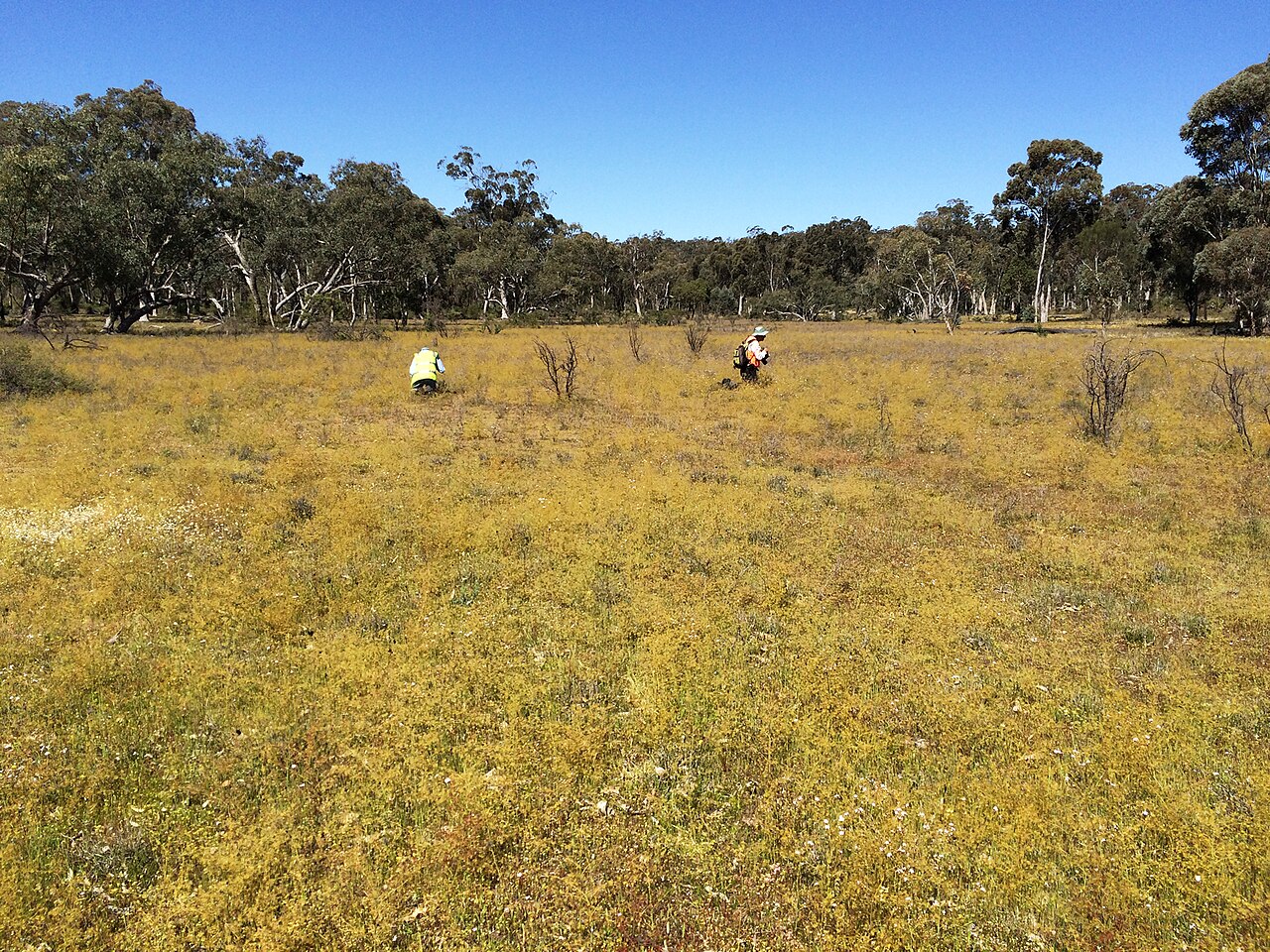
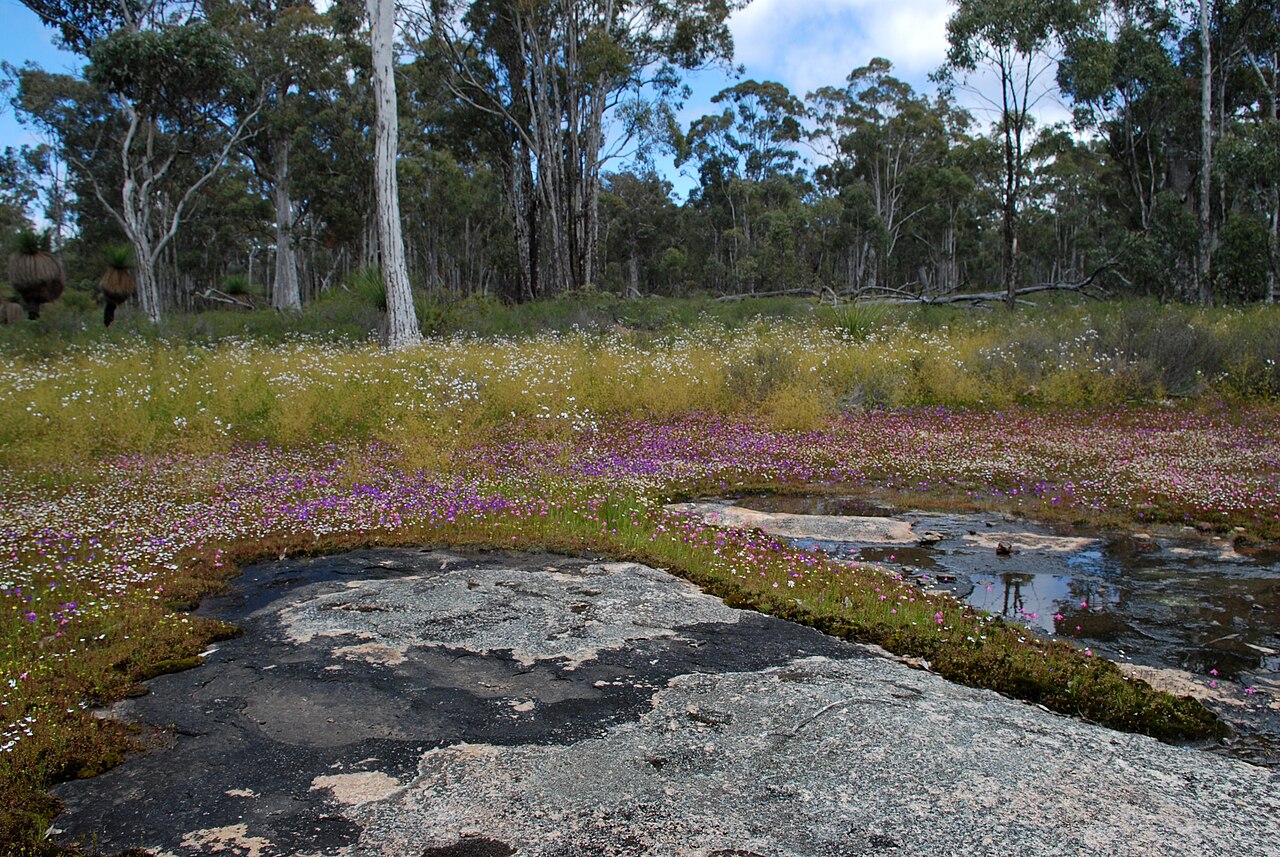
Sandy soil at the margins of swamps and near granite outcrops (FloraBase) (W4, D1, R3). The deep tuber lets the plant survive the dry summer even in the sand at swamp edges, far below the drying surface layer. In winter and spring the ground is moist or waterlogged.
Distribution and elevation
Endemic to the south-west of Western Australia, along the coast from Albany north to just south of Geraldton. FloraBase lists the Avon Wheatbelt, Geraldton Sandplains, Jarrah Forest and Swan Coastal Plain bioregions. Subspecies geniculata grows on black sand near Perth and further south.
- Recorded (quarter-degree cells)
Forms and variation
Two subspecies are recognised: subsp. gigantea and subsp. geniculata, described by Marchant and Lowrie in 1992. In 1996 Jan Schlauer proposed treating geniculata as a variety, disagreeing with Marchant and Lowrie's reasoning about whether the forms occur together or apart. FloraBase treats the variety as a synonym of the subspecies.
Where and when to see it
A species you see from afar: walk along swamp margins on the coastal plain in September or October and look for coppery 'little trees' half a metre to a metre tall among the low heath. Against the light the hundreds of droplets sparkle. One of the easiest sundews to find in the south-west.
Conservation status
Assessed as Least Concern (LC) on the IUCN Red List and listed as not threatened in Western Australia. Not in CITES. The species has a large range along the west coast. On the coastal plain around Perth many swamp margins have disappeared through urbanisation and drainage, but the species also occurs in many reserves.
Scientific name
Drosera gigantea | Lindley, 1839
Described by John Lindley in 1839, in "A Sketch of the Vegetation of the Swan River Colony", p. 20, no. 86. In 1992 Marchant & Lowrie (the same publication mentioned earlier in the guide) described a subspecies, D. gigantea subsp. geniculata. The precise type locality could not be established. Given the publication title, a site near the Swan River (Perth region) seems likely. The species today occurs along the Western Australian coast, from Albany to just south of Geraldton. From the Latin giganteus ("gigantic") — this species is one of the largest Drosera species in the world, with a tree-like, branching growth form up to 1 m tall.
World Checklist of Vascular Plants (WCVP), via Plants of the World Online (POWO), Royal Botanic Gardens, Kew.