All species › Caryophyllales › Sundew family › Drosera pauciflora
Drosera pauciflora
A sundew that seems almost all flower: a flat rosette on the sand, and above it on a bare stalk one to three large, cup-shaped pink flowers with a dark centre. Drosera pauciflora — 'few-flowered' — belongs to the same species complex as D. cistiflora and is one of the spring surprises of the lowlands north and east of Cape Town.
Identification
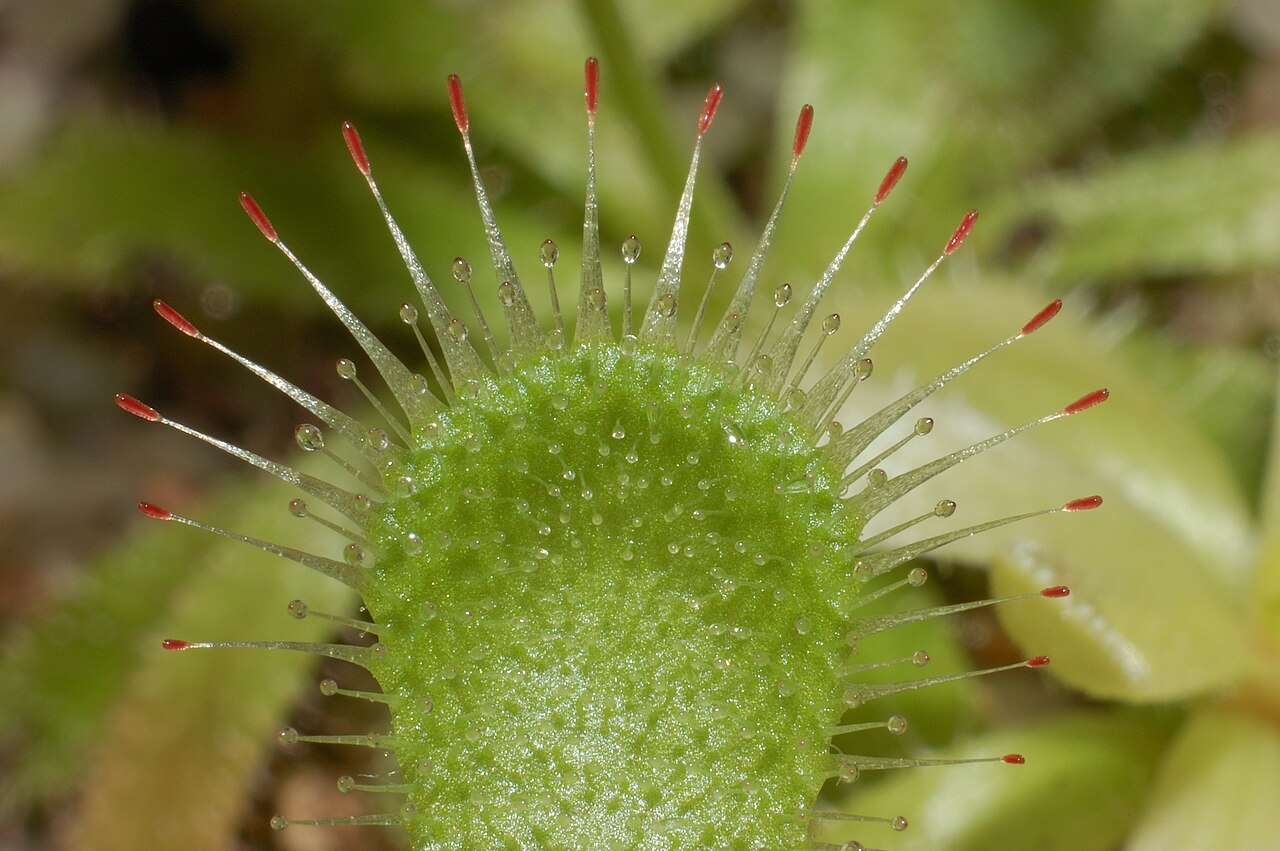
A compact basal rosette about 5 cm across, with semi-erect, narrowly ovate leaves up to 25 mm long and 8 mm wide. The leaves are sessile: there is no distinct petiole and there are no stipules. They carry both tentacles with a knob-shaped gland and straight tentacles. From the centre of the rosette rises an erect, leafless scape up to 20 cm tall with one to three large pink to mauve flowers, often with a dark blotch in the centre. The styles are fringed. The flowers open only in good sunshine, and then only for a few hours.
Similar species
The key distinction is from Drosera cistiflora, which has equally large flowers but later in the season forms an erect, leafy stem. In D. pauciflora the plant remains a rosette and the scape is bare. Other Cape rosetted sundews, such as D. trinervia, D. aliciae and D. cuneifolia, have much smaller flowers, several per stalk.
The trap and how it works
An active flypaper trap. Besides the usual knob-headed tentacles the leaf carries straight tentacles; together they form a sticky carpet in which small insects are caught. After capture the tentacles bend towards the prey and digestive enzymes are secreted. The large flowers stand high enough above the rosette not to endanger pollinators, although the species is usually self-pollinating.
Habitat and ecology
Open sandy ground that is moist to waterlogged in winter: seeps, flat sandy areas in fynbos and seasonally wet patches in alluvial renosterveld (W7, D1, B5). The plant grows in the wet winter, flowers in spring and survives the summer underground. After fire it flowers profusely.
Distribution and elevation
Endemic to the Western Cape of South Africa, in the lowlands and foothills around Darling, Paarl and Stellenbosch, with a record near Piketberg, between 61 and 1050 m altitude.
- Recorded (quarter-degree cells)
Forms and variation
The species belongs to the D. cistiflora complex; short-stemmed, large-flowered forms have in the past been shifted between the two species, and D. pauciflora var. minor is now a synonym of D. cistiflora. English Wikipedia lists D. acaulis and D. grandiflora as synonyms; that D. acaulis is presumably a homonym and not the species described by Linnaeus the Younger that is treated elsewhere in this guide.
Where and when to see it
Go in August or September to the reserves around Darling, famous for their spring flowers, and search wet sandy hollows on sunny mornings. A year after fire the chance of mass flowering is greatest. Check beforehand whether the reserves are open; many are on private land.
Conservation status
Not assessed for the global IUCN Red List and not listed in CITES; on the South African Red List it is listed as not threatened. Still, the range is small and lies largely in farmland where renosterveld and lowland fynbos are heavily fragmented. Keeping the remaining wet hollows and a natural fire regime is vital for the species.
Scientific name
Drosera pauciflora | Banks ex de Candolle, 1824
Drosera pauciflora was validly published by Augustin Pyramus de Candolle in 1824, in volume 1 (page 317) of his Prodromus Systematis Naturalis Regni Vegetabilis, based on an earlier unpublished manuscript name by Joseph Banks (hence the author citation "Banks ex DC."). The species is endemic to the southwestern Cape region of South Africa, occurring frequently around Darling, Paarl and Stellenbosch in fynbos vegetation; exactly who collected the type material, and when, could not be established with certainty. The epithet pauciflora is descriptive, combining the Latin paucus ("few") and flos/flora ("flower"), referring to the relatively small number of flowers the plant produces per stem.
World Checklist of Vascular Plants (WCVP), via Plants of the World Online (POWO), Royal Botanic Gardens, Kew.