All species › Caryophyllales › Sundew family › Drosera trinervia
Drosera trinervia
One of the most widespread and least conspicuous sundews of the Cape: a small red rosette that appears in winter in every wet spot of the fynbos and in spring sends up a little stalk of white flowers. The name refers to the three veins running the length of the leaf, though these are often hard to see beneath the glands on the upper surface.
Identification
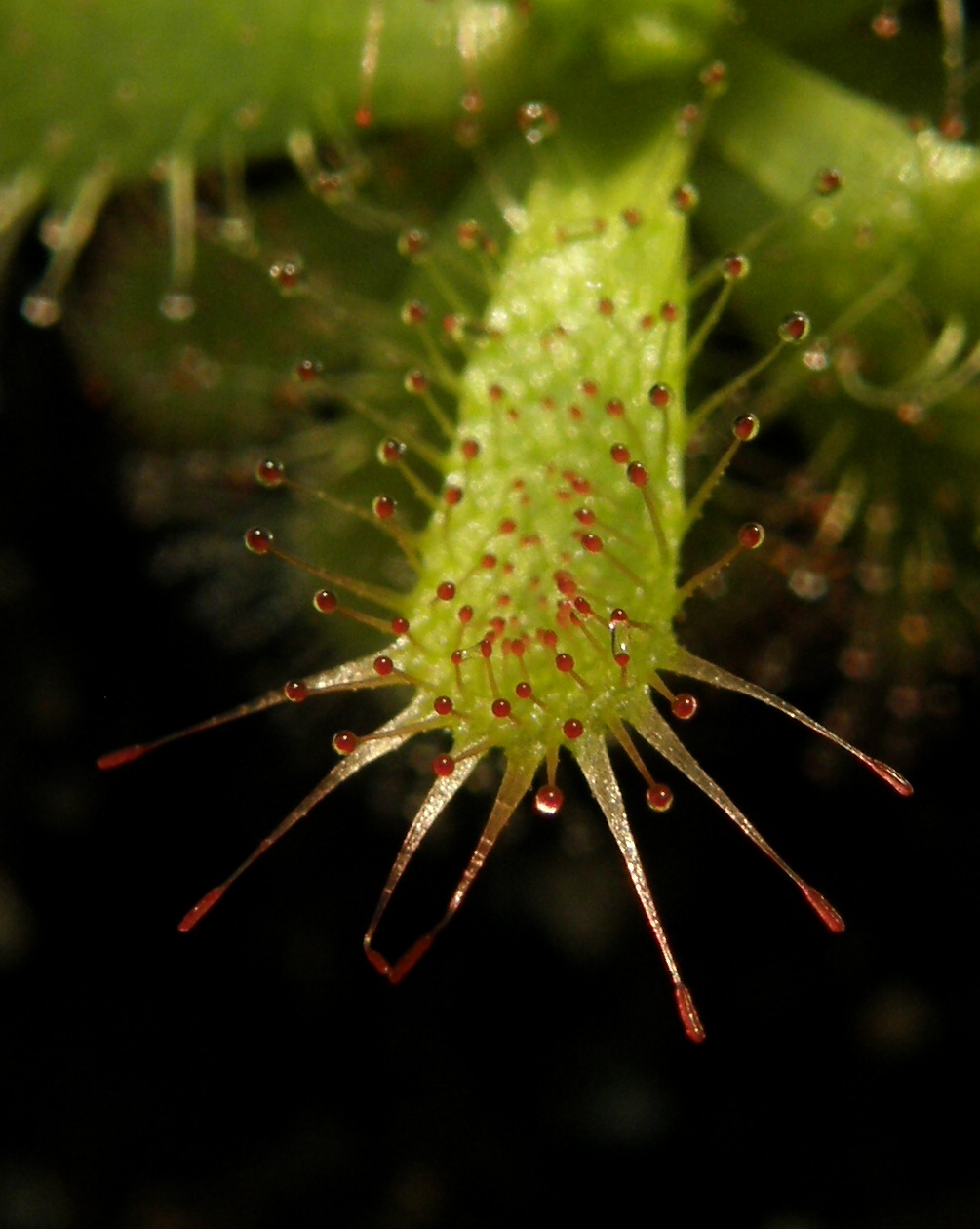
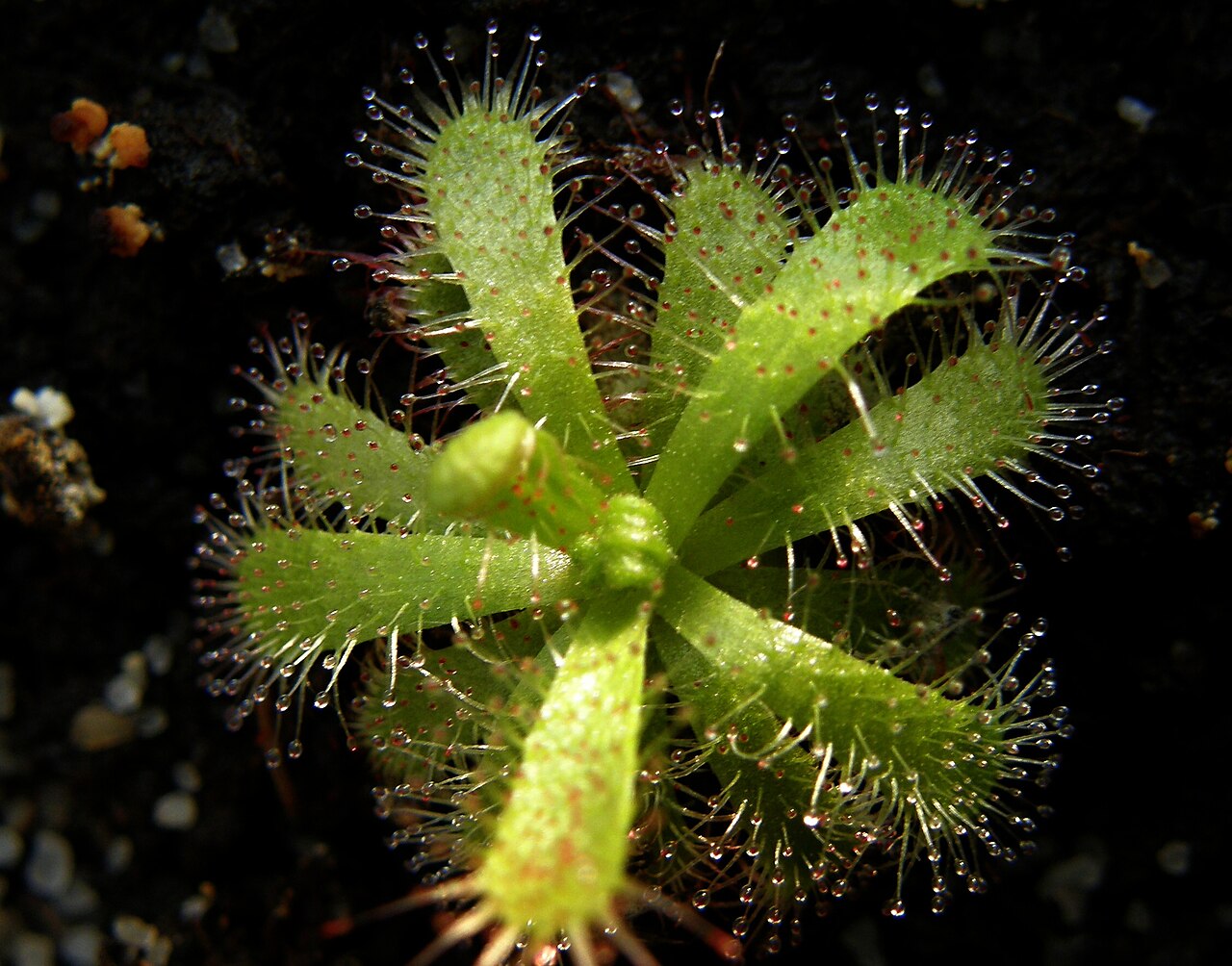
A small basal rosette 2 to 3 cm across, usually bright red in sun and greener in shade. The blade is wedge-shaped, 10 to 20 mm long and 4 to 7 mm wide, with three longitudinal veins. Both the leaves and the flowering stalk are covered with small glands. Conspicuous stipules are absent. The inflorescence is up to 10 cm tall and carries 2 to 10 flowers, usually white, sometimes mauve to red. Underground are one or two long, slightly thickened roots that carry the plant through the dry summer. The seed is blackish brown, ovoid and only 0.3 mm long.
Similar species
Drosera aliciae is somewhat larger, has distinct stipules at the leaf base and deep pink flowers. Drosera cuneifolia is larger, with broad truncate leaves, and grows only around Table Mountain. The plants described as D. afra are larger with pink flowers; whether that is a separate species is disputed (see Forms). From D. cistiflora and D. pauciflora, D. trinervia differs in its much smaller flowers.
The trap and how it works
An active flypaper trap on a small scale. The red tentacles secrete a sticky droplet in which small insects — springtails, midges, aphids crossing wet ground — are caught. Surrounding tentacles then bend towards the prey and the glands digest the soft parts. Because the rosette is so small the prey is very small; the flowering stalk is glandular too, but no digestive function is known there.
Habitat and ecology
Seasonally wet places in fynbos and adjacent vegetation: seeps, banks of streams and rivers, moist fields and open peaty ground on sandstone (W7, R1, B5). The plant grows in the wet winter and retreats into its roots in summer. It is a generalist found on the lowlands and high in the mountains alike, from 15 to 2200 m.
Distribution and elevation
South Africa: mainly in the Western and Northern Cape, from Namaqualand south to Cape Agulhas. PlantZAfrica also lists it from KwaZulu-Natal and Lesotho; that record departs from the picture of a purely Cape species and may reflect earlier, broader concepts of the species.
- Recorded (quarter-degree cells)
Forms and variation
The species was described by Sprengel in 1820. Kew and Wikipedia include D. afra Debbert and D. albiflora among the synonyms, but some authors keep D. afra as a separate species. Colour forms with mauve or red flowers occur here and there. The wide altitudinal range and distribution suggest that undescribed variation may remain within the species.
Where and when to see it
Search from August to October in wet, open patches in the fynbos, often along paths where water stands. The rosettes are small, but in large numbers they form red patches on the sand. For the flowers go on a sunny day; they open only in sufficient light.
Conservation status
Not assessed for the global IUCN Red List and not listed in CITES. On the national Red List of South Africa it is listed as not threatened. Its large range and broad habitat choice make it far less vulnerable than most Cape sundews; locally sites are lost to urban expansion, agriculture and drying out.
Scientific name
Drosera trinervia | Sprengel, 1820
Drosera trinervia was first formally described by the German botanist Kurt Polycarp Joachim Sprengel in 1820, in his work Neue Entdeckungen im ganzen Umfang der Pflanzenkunde, volume 1, page 298. The species is endemic to the Cape Provinces of South Africa; a precise type locality with collector and collection date could not be established with certainty. The epithet trinervia is a descriptive Latin term composed of "tri-" (three) and "nervus" (nerve/vein), likely referring to three distinct veins on the leaves or petals; however, this could not be confirmed against the original description.
World Checklist of Vascular Plants (WCVP), via Plants of the World Online (POWO), Royal Botanic Gardens, Kew.