All species › Caryophyllales › Sundew family › Drosera schizandra
Drosera schizandra
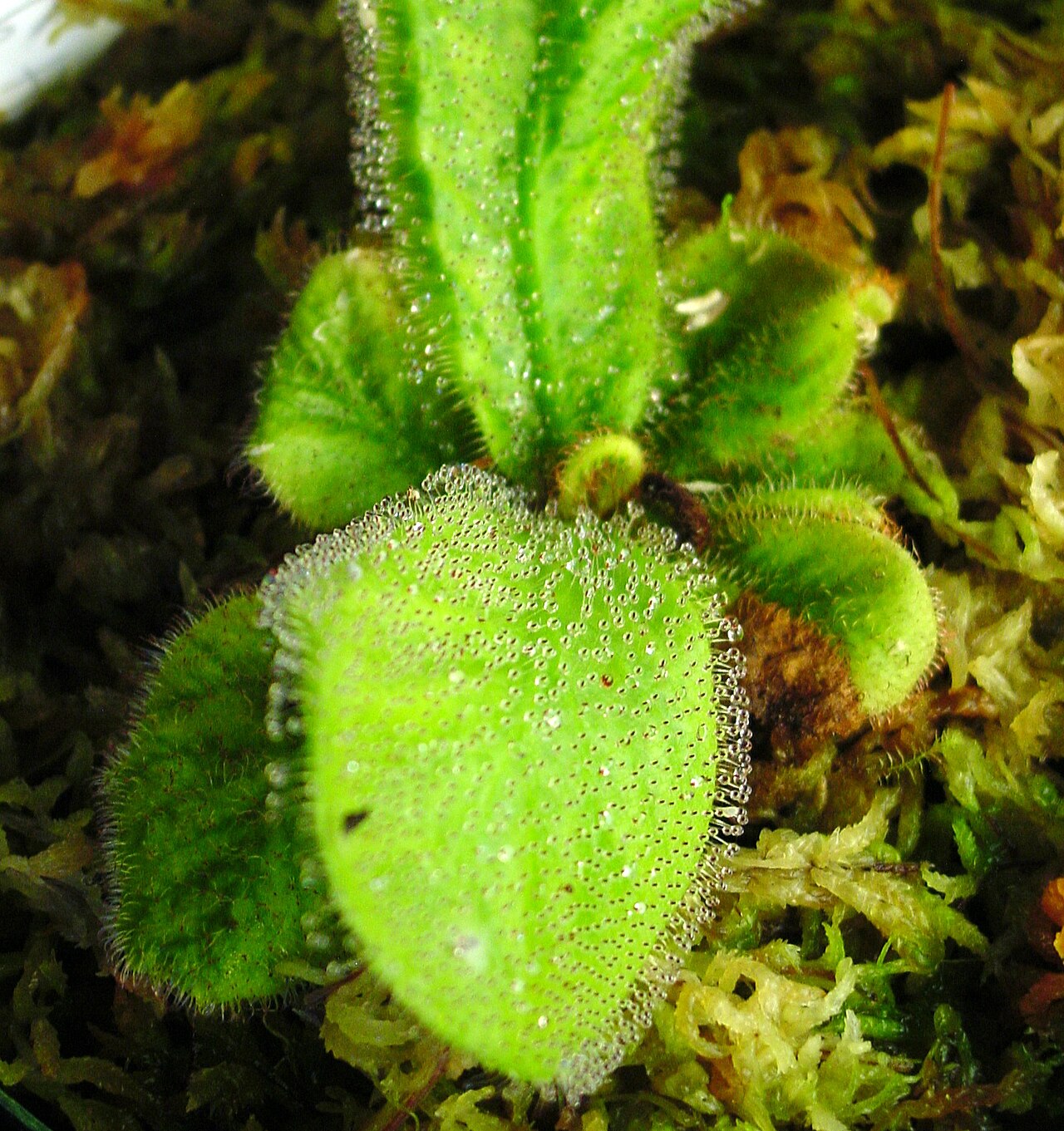
The heart-leaf or notched sundew is the most shade-loving and moisture-dependent of the three 'sisters of Queensland'. Drosera schizandra grows in the deep understorey of the tropical rainforest of north-eastern Queensland, in places that direct sunlight almost never reaches. Its broad, flat leaves look more like those of a woodland herb than the usual image of a sundew, and in the wild it flowers only rarely.
Identification
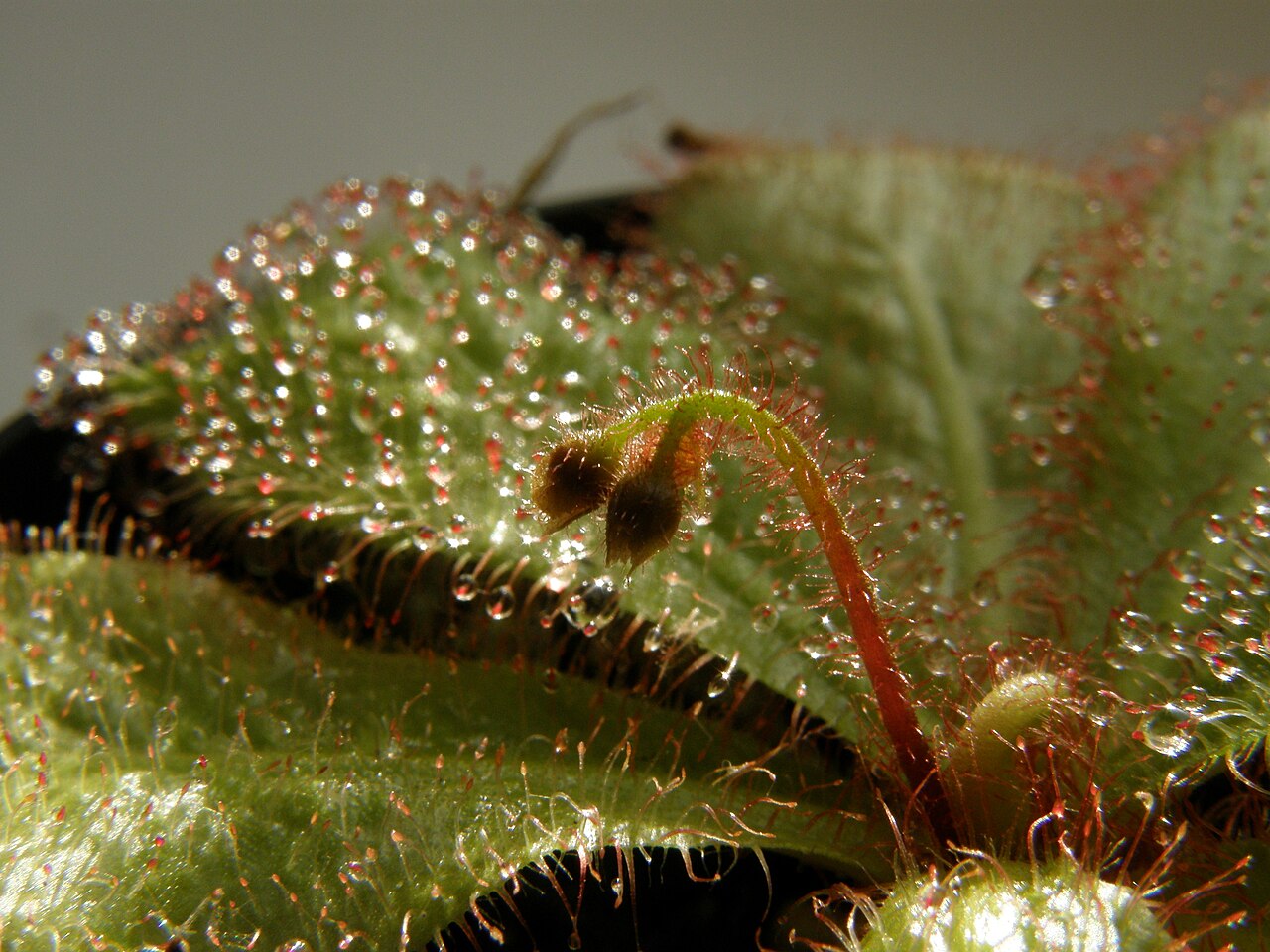
A flat rosette of strikingly broad, round to oval leaves lying against the ground or the moss. As they age many leaves develop a notched tip, so that they look heart-shaped — the source of both its common name and its scientific one (schizandra refers to the split leaf). The leaf is thin, light green to yellow-green, with short tentacles scattered over the surface and longer ones at the margin. The plant multiplies mainly vegetatively, by shoots from the roots. Reliable measurements from the original description were not available for this guide; the measurement fields are therefore left empty.
Similar species
Of its relatives in section Prolifera it is the easiest to recognise. Drosera adelae has long, narrow lanceolate leaves; Drosera prolifera has small round blades on long stalks and flowering stems that form plantlets; Drosera buubugujin from Cape York resembles it most but has longer, slimmer leaves and white rather than yellowish pollen. No other Australian sundew has such broad, thin, notched leaves.
The trap and how it works
An active flypaper trap, but a weak one. The tentacles are short and the movement slow; the broad leaf mainly acts as a large sticky surface on which small gnats, springtails and other forest-floor insects get stuck. The large leaf area is probably above all an adaptation to low light: it catches as much light as possible, while the prey supplements the supply of nitrogen and phosphorus.
Habitat and ecology
The deeply shaded, permanently humid understorey of tropical rainforest (B3), especially in the higher, cloud-prone parts of the mountains where the forest grades into mossy forest (B4). The plant grows on wet humus, mossy ground and along small streams, always in high humidity. It tolerates neither direct sunlight nor drying out.
Distribution and elevation
Endemic to the Wet Tropics of north-eastern Queensland, where it has a small range in the mountain rainforest. Precise sites are not given here. Altitudinal limits are not published in the sources consulted; the elevation field is left empty.
- Recorded (one-degree cells)
Forms and variation
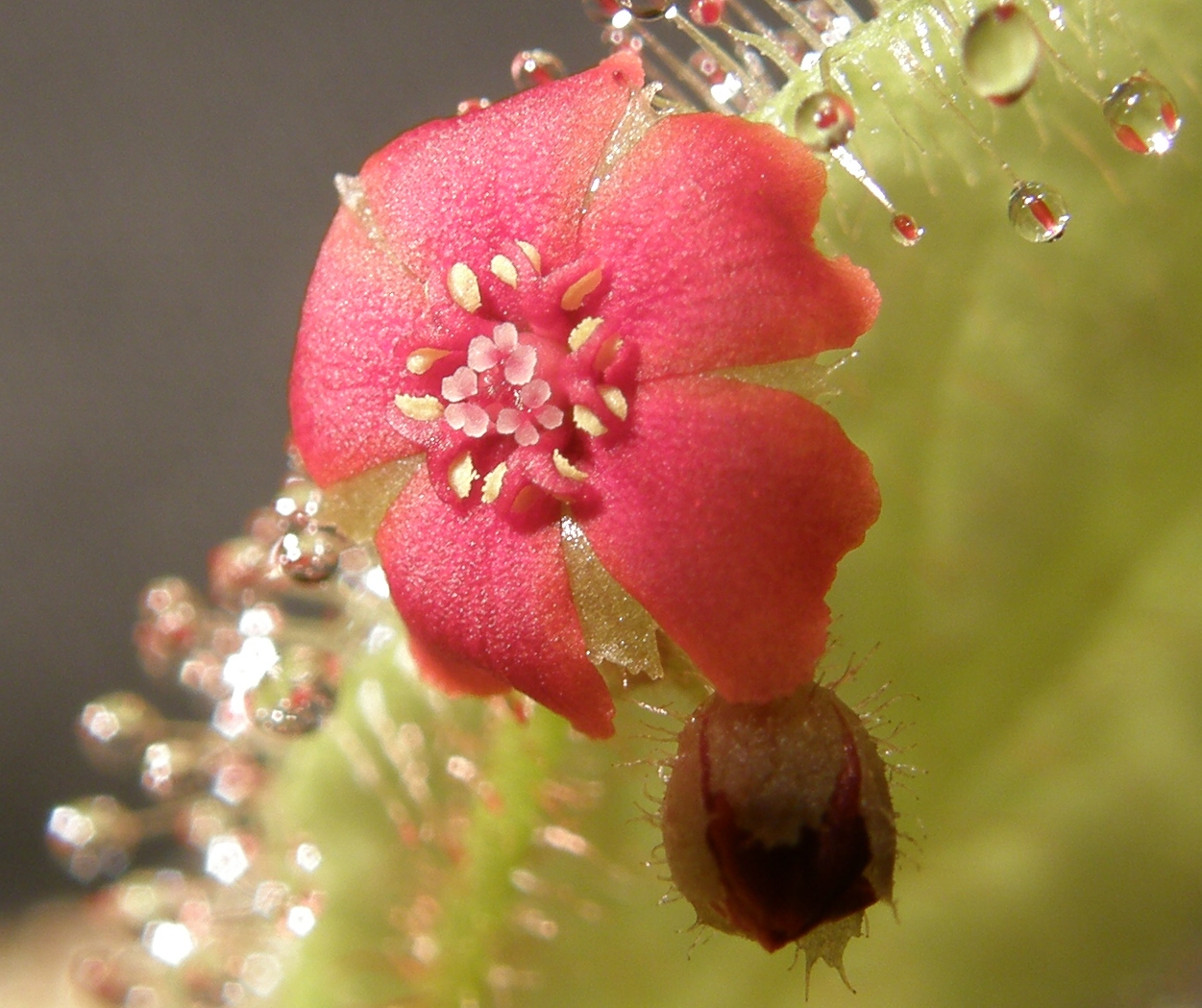
No varieties are recognised. The species was described in 1906 by Ludwig Diels in his monograph of the Droseraceae. Within section Prolifera it is morphologically closest to D. buubugujin, described in 2020. Because it rarely flowers in the wild, its seed is little known and its spread rests mainly on vegetative reproduction, which probably limits genetic variation within populations.
Where and when to see it
This is one of the hardest sundews to find in Australia: it grows in remote, steep, wet mountain rainforest. Anyone wanting to see it must search the dampest, darkest places along tracks through mountain forest, on the ground and among moss by small streams. The area is World Heritage and the species protected: stay on the track, do not walk on wet ground and take nothing away.
Conservation status
The species has not been assessed for the global IUCN Red List and is not listed in CITES. Under Queensland's Nature Conservation Act it is listed as Vulnerable. Its range is small and confined to a specific climatic zone in the mountains, which makes it sensitive to climate change: rising temperatures and decreasing cloud cover could shrink the suitable zone. Illegal collecting is an additional threat.
Scientific name
Drosera schizandra | Diels, 1906
Drosera schizandra was described in 1906 by the German botanist Ludwig Diels, published in Engler's Das Pflanzenreich, IV.112 (Droseraceae), page 80 (page 109 is also cited elsewhere). The species is endemic to the rainforests on the lower slopes of Mount Bartle Frere, in northeastern Queensland, Australia, at elevations of 300–600 m. It was first found in 1891 by a certain St. Johnson; the precise type locality and collection date of the material used by Diels in 1906 could not be established with certainty. The epithet schizandra is composed of the Greek schistos ("split") and andros/aner ("male/stamen"), and refers to this species' split stamens (anthers) — a descriptive name.
World Checklist of Vascular Plants (WCVP), via Plants of the World Online (POWO), Royal Botanic Gardens, Kew.