All species › Caryophyllales › Sundew family › Drosera prolifera
Drosera prolifera
This sundew owes its scientific name to an unusual habit: after flowering its flowering stems bend to the ground and form new plantlets at the tip. Drosera prolifera is the second of the three 'sisters of Queensland', the sundews of the tropical rainforest of north-eastern Queensland. It is endemic there and grows in shade on wet, mossy rocks and banks along mountain streams.


Identification
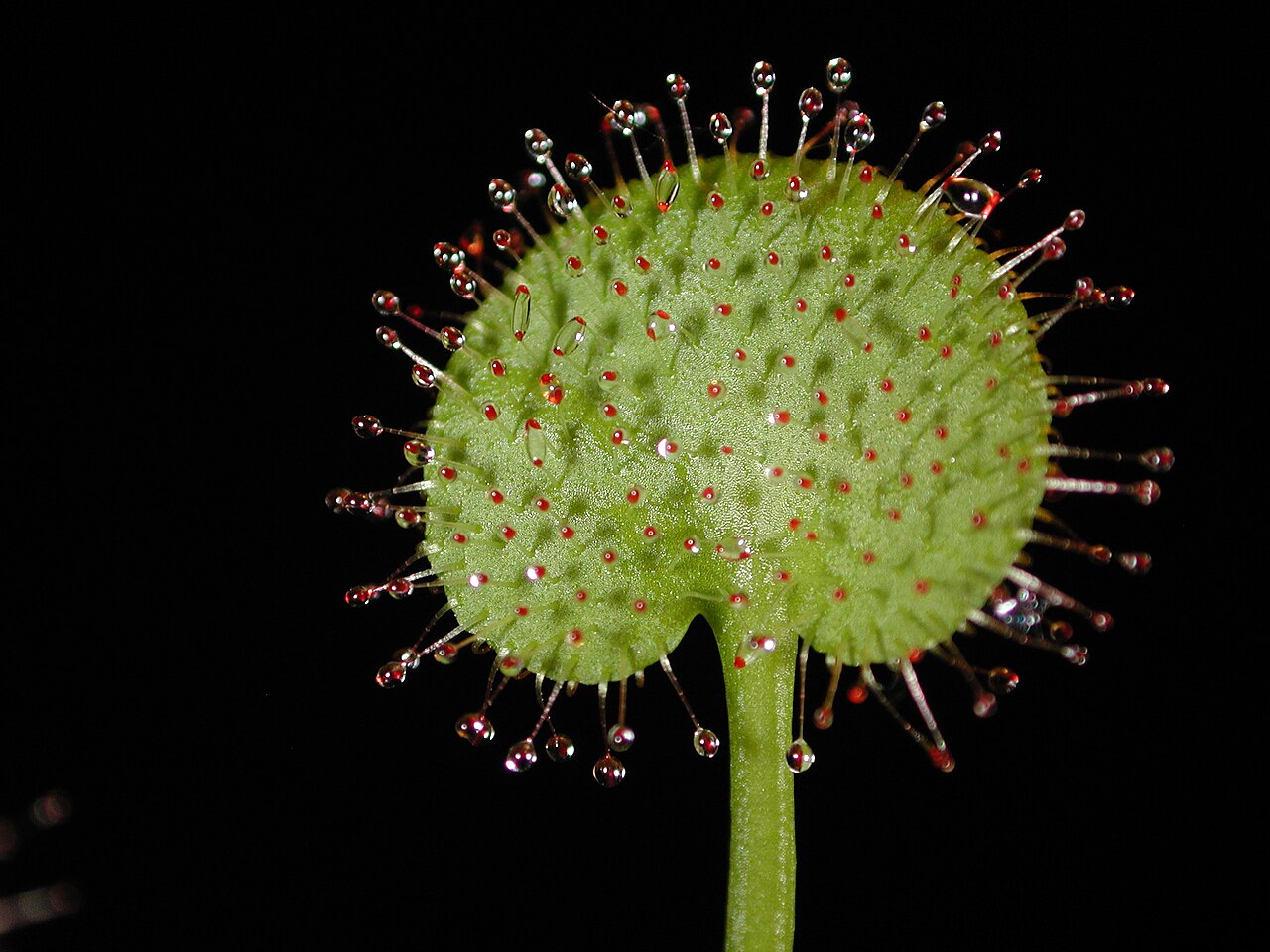
A small, flat rosette of leaves with relatively long, thin petioles and a round to kidney-shaped blade that stays green in shade and flushes red in more light. The tentacles cover the whole blade. The most striking feature is the flowering stems: they carry small red flowers, but after flowering they bend down, and where the tip touches the ground young rosettes form and take root. Over time a single plant thus forms a small carpet of rosettes. Reliable measurements from the original description were not available for this guide; the measurement fields are therefore left empty.
Similar species
Within section Prolifera the differences are clear. Drosera adelae has long, narrow lanceolate leaves; Drosera schizandra has large, broad, ovate leaves often with a notched tip and forms no plantlets on its flowering stem; Drosera buubugujin from Cape York has elongate, short-stalked leaves but can likewise form a plantlet at the tip of its flowering stem. It differs from the rosette sundews of open ground, such as D. spatulata, in its round blade on a long stalk and its shaded habitat.
The trap and how it works
An active flypaper trap. In the humid rainforest air the tentacles secrete a sticky mucilage in which small gnats, springtails and other insects of the forest floor get stuck. The tentacles bend slowly towards the prey and the glands digest it. Because the understorey is dim and photosynthesis limited, the catch provides a significant share of nitrogen and phosphorus.
Habitat and ecology
Permanently humid, shaded places in tropical lowland and upland rainforest (B3): wet, mossy rocks and boulders along mountain streams and in the spray zone of waterfalls (R1), and sandy, humus-rich banks. Humidity is high all year and direct sunlight is rare. The plant does not tolerate drying out.
Distribution and elevation
Endemic to the Wet Tropics of north-eastern Queensland, where it has a small range in the rainforest north of Cairns. Precise sites are not given here. Altitudinal limits are not published in the sources consulted; the elevation field is left empty.
- Recorded (one-degree cells)
Forms and variation
No varieties are recognised. With D. adelae, D. schizandra and D. buubugujin the species belongs to section Prolifera, established by C.T. White and named after this species. All four are rainforest plants that reproduce vegetatively, each in its own way; in D. prolifera it happens through the flowering stems.
Where and when to see it
Search from walking tracks along rainforest creeks, on wet, mossy rocks close to the water. The rosettes are small and green and only stand out once you see the glistening tentacles; a torch or the slanting light of a clearing helps. The plant grows in a protected World Heritage Area: stay on the track, do not climb over wet rocks and take nothing away.
Conservation status
On the IUCN Red List the species is Least Concern (LC); it is not listed in CITES. Under Queensland's Nature Conservation Act, however, it is listed as Vulnerable because of its small range. Most populations lie in protected rainforest; possible threats are altered drainage, trampling of banks and illegal collecting. The species propagates well in cultivation, so collecting from the wild is unnecessary.
Scientific name
Drosera prolifera | White, 1940
Drosera prolifera was first validly described by the Australian botanist Cyril Tenison White, in the journal "The Victorian Naturalist", volume 57, page 95, in 1940. The species occurs in the rainforests of Queensland, Australia. The exact collection site, collector and collection date of the type specimen could not be established with certainty. The epithet prolifera is Latin for "proliferous" or "self-multiplying" (from proles, "offspring", and ferre, "to bear"). It refers to the plant's striking habit of forming new rosettes on its flower stalks or old leaves, allowing the species to multiply vegetatively. It is therefore a descriptive name, not a toponym or a name honouring a person.
World Checklist of Vascular Plants (WCVP), via Plants of the World Online (POWO), Royal Botanic Gardens, Kew.