All species › Caryophyllales › Sundew family › Drosera capillaris
Drosera capillaris
The commonest sundew of the south-eastern United States, and the species most often found in large numbers in the wet pine savannas of the coastal plain — sometimes so dense that the ground turns red. Drosera capillaris reaches far beyond the US: through Mexico and Central America, across the Greater Antilles to northern South America. It is a plant of sunny, permanently moist, acid, nutrient-poor ground, and it closely follows the rhythm of fire that keeps those landscapes open.
Identification
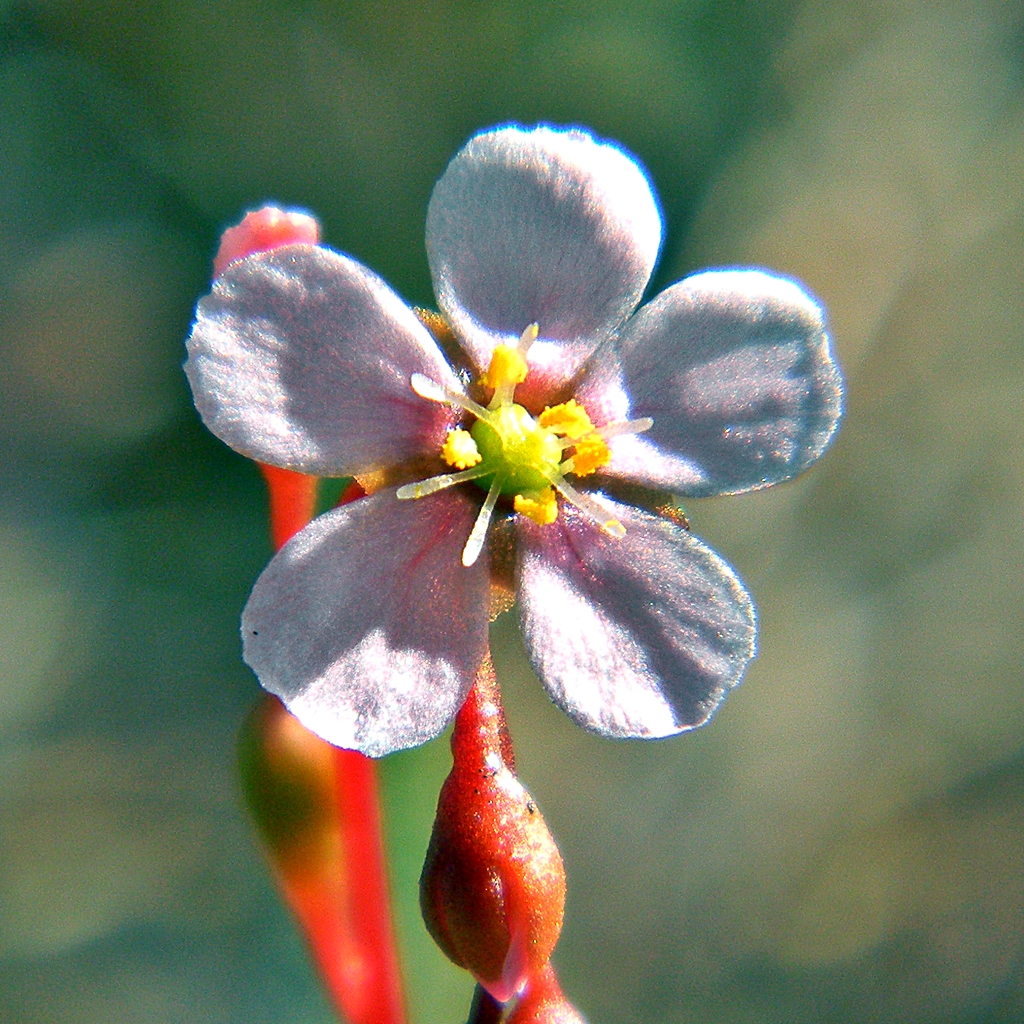
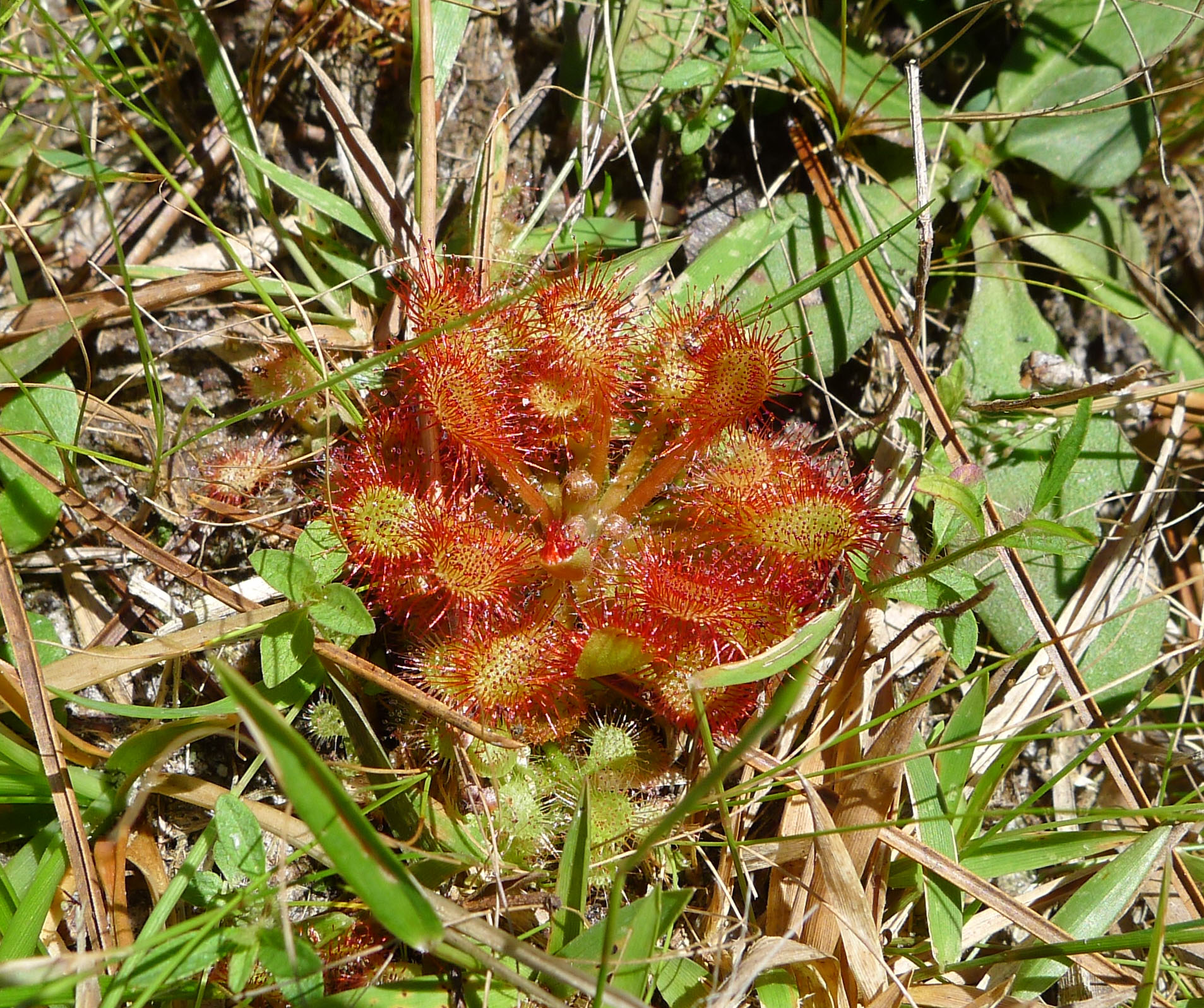
A perennial, fairly flat rosette up to about 7.5 cm across. Each leaf has a thin, sparsely hairy petiole ending in a round to spatulate blade; the leaf including petiole is about 1.2 to 2.5 cm long. Fringed stipules sit in the centre of the rosette. The tentacles are red, the blade itself green to red depending on the amount of sun. The scape is glabrous, 10 to 35 cm tall, and carries a one-sided raceme of one to six pink, rarely white flowers that open one at a time. Ovoid capsules with many very small seeds follow.
Similar species
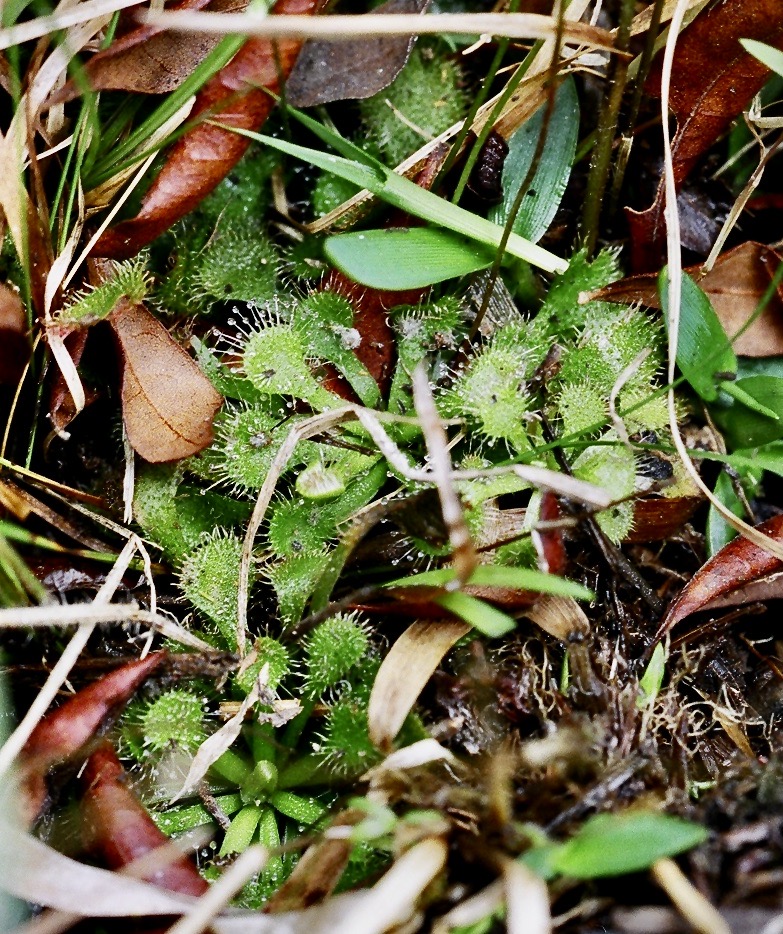
Drosera brevifolia often grows at the same sites but is smaller, has wedge-shaped leaves without a distinct thin petiole, no stipules and a glandular-hairy scape. Young D. intermedia looks very like D. capillaris; the difference is in the petiole — glabrous in D. intermedia, sparsely hairy in D. capillaris — and in the flowers, which are white in D. intermedia and usually pink in D. capillaris. D. intermedia also tends to stand upright and grow wetter, sometimes half submerged. In the Caribbean and South America D. communis and related species look similar; there, identification depends on flower and seed characters.
The trap and how it works
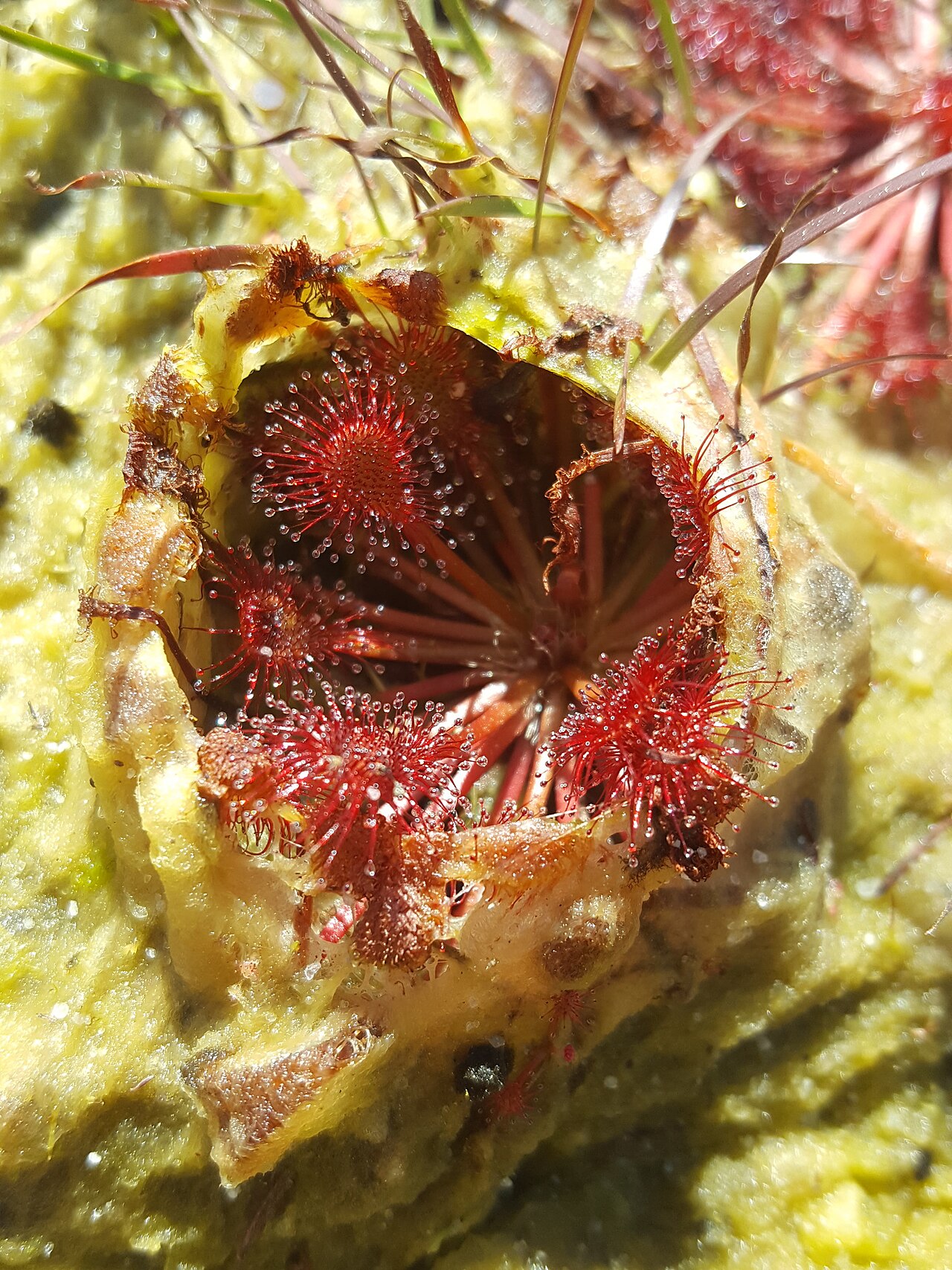
An active flypaper trap. The red tentacles on the blade each carry a droplet of sugary, sticky mucilage; an insect landing in it is held. The tentacles touched bend towards the prey, the surrounding ones follow, and with larger prey the blade itself curls inwards. The prey is then digested by enzymes from the glands and nitrogen and phosphorus are absorbed. The catch is mainly small flies, gnats, ants and springtails.
Habitat and ecology
Wet, acid, sandy to peaty soil in open pine savannas and flatwoods (B6), in seepage bogs and peaty hollows (W4), and in wet roadside ditches and drains (H1). An impermeable clay layer often lies beneath the sand, holding water and keeping trees out. The species is adapted to regular fire: after a burn new plants germinate en masse on the bare, sunny ground. Without fire or other management the sites close in and it disappears.
Distribution and elevation
The south-eastern United States, from Virginia, Maryland and Delaware south to Florida and west to Texas, Tennessee and Arkansas; further in Mexico, Central America (including Belize, Honduras, Nicaragua, Costa Rica and Panama), the Greater Antilles (Cuba, Jamaica, Hispaniola, Puerto Rico) and Trinidad, and in northern South America to Colombia, Venezuela, the Guianas and Brazil, with reports as far as Paraguay and Uruguay. A reliably published altitudinal range for the species as a whole is lacking.
- Recorded (quarter-degree cells)
Forms and variation
No varieties are accepted, although several names have been given over time to smaller or differently coloured forms that are now treated as synonyms. The species varies greatly in size and colour: in full sun plants are compact and deep red, in shade larger, greener and looser. White-flowered plants occur occasionally. Its relationship with the South American species of the same group is still under study.
Where and when to see it
May to August, preferably on a sunny morning when the flowers are open. The richest sites are savannas that have burned in the last year or two. Search low down, among the grasses and on bare patches; where the rosettes grow in thousands the ground looks dusted with red. Many fine sites lie in state forests and reserves on the Gulf coast and in the Carolinas; keep to the paths and never take plants.
Conservation status
The species has not been assessed for the global IUCN Red List and is not in CITES. Across its whole range it is abundant and not threatened, but at the edges of its US range it is rare, among others in Arkansas, Maryland and Tennessee. The main threats are the same as for all inhabitants of the pine savannas: loss of habitat to forestry, agriculture and development, drainage, and the suppression of natural fires.
Scientific name
Drosera capillaris | Poiret, 1804
Described by Jean Louis Marie Poiret in 1804, in "Encyclopédie méthodique. Botanique", volume 6, no. 1, p. 299. The precise type locality could not be established. The species occurs across the southern United States, the Greater Antilles, Mexico, Central America and northern South America. From the Latin capillaris ("hair-like") — probably refers to the fine, thread-like glandular hairs characteristic of the genus, or to the slender leaf shape.
World Checklist of Vascular Plants (WCVP), via Plants of the World Online (POWO), Royal Botanic Gardens, Kew.