All species › Caryophyllales › Sundew family › Drosera graniticola
Drosera graniticola
The name says it all: graniticola means 'dweller on granite'. Neville Marchant described this erect tuberous sundew in 1982 in volume 8 of the Flora of Australia. It is a species of the granite rocks of the eastern Wheatbelt, with a very small range around Hyden and Kulin.
Identification
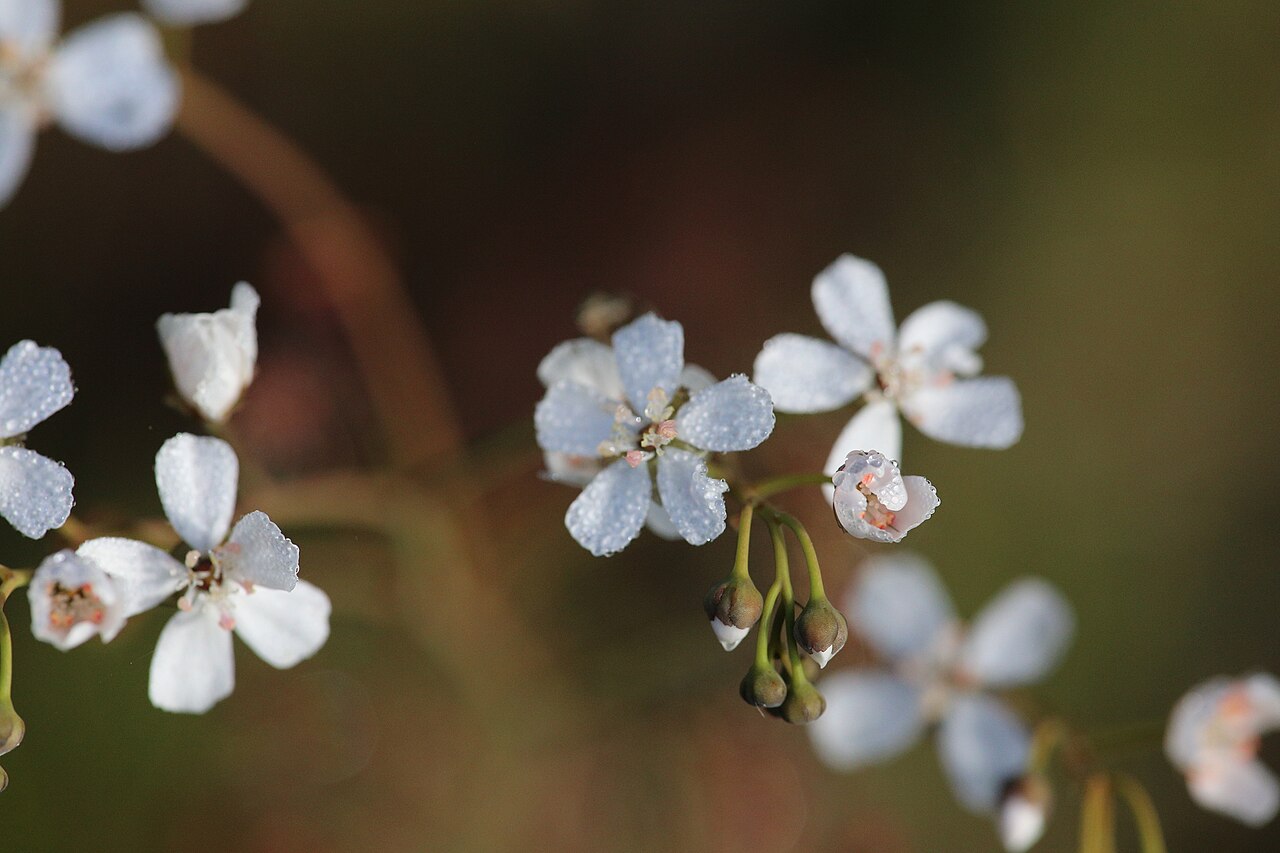
A perennial, erect tuberous plant 10 to 20 cm tall. Small, peltate trapping leaves with tentacles line the stem, as in other members of section Ergaleium. The flowers are white and appear in August and September. Precise leaf and flower measurements could not be found in the accessible sources; the original description in the Flora of Australia was not consulted for this guide.
Similar species
Drosera andersoniana grows in the same granite landscape; it is also erect but has a conspicuous basal leaf rosette and pinkish to red flowers. There are also several small, erect, white-flowered tuberous sundews in the Wheatbelt related to Drosera peltata and Drosera stricticaulis; a sure identification needs leaf shape, calyx and details of the inflorescence.
The trap and how it works
An active flypaper trap. The peltate leaves along the stem carry tentacles with droplets of glue and catch mainly small flying insects. After capture the tentacles bend around the prey and the glands secrete digestive enzymes. Most of the nutrients absorbed go to the tuber, which carries the plant through the long, hot summer of the interior.
Habitat and ecology
Granite outcrops (FloraBase) (R3): the shallow soil and moss mats on and around the Wheatbelt granite domes, where rainwater runs off the rock in winter. Beyond them the landscape is dry; the rocks form moist islands in a semi-arid region. The plant survives the summer as a tuber.
Distribution and elevation
Endemic to the south-west of Western Australia, in the Mallee bioregion, Western Mallee subregion. FloraBase knows the species from the Shire of Kulin; the base list gives the Hyden area, which lies right next to it. It is one of the sundews with the smallest known range.
- Recorded (one-degree cells)
Forms and variation
No subspecies or varieties have been described. The species is placed in subgenus and section Ergaleium, the erect and climbing tuberous sundews.
Where and when to see it
The granite rocks around Hyden, including the well-known Wave Rock, draw many visitors; August and September are also the time for this species. Search at the foot of the rocks and in moss mats where water runs off the dome, but do not step on the mats themselves. Report records through official channels.
Conservation status
The IUCN code in this guide is Vulnerable (VU); in Western Australia the species is listed as Priority Four. Not in CITES. A small range in a largely cleared farming district makes the species sensitive to disturbance. Granite rocks are also popular recreation sites, and trampling, weeds and salinisation of the surroundings pose a risk.
Scientific name
Drosera graniticola | Marchant, 1982
Described by Neil G. Marchant on 9 December 1982, in "Flora of Australia", volume 8, p. 383, fig. 31. The precise type locality could not be confirmed. The species occurs south-east of Hyden, south-western Western Australia, in wetland habitats on granite outcrops. From the Latin graniticus ("granitic") and -cola ("dweller") — "granite-dwelling", referring to its habitat on granite outcrops.
World Checklist of Vascular Plants (WCVP), via Plants of the World Online (POWO), Royal Botanic Gardens, Kew.