All species › Caryophyllales › Sundew family › Drosera grantsaui
Drosera grantsaui
A sundew of the Brazilian cerrado, the vast savanna of the interior, named after Rolf Grantsau, a German-Brazilian naturalist. Drosera grantsaui was described by Fernando Rivadavia in 2003, in the same paper in Carnivorous Plant Newsletter in which Drosera camporupestris, Drosera tentaculata and Drosera viridis were named. Unlike many of those species it is not confined to one mountain range but spread over several states.
Identification
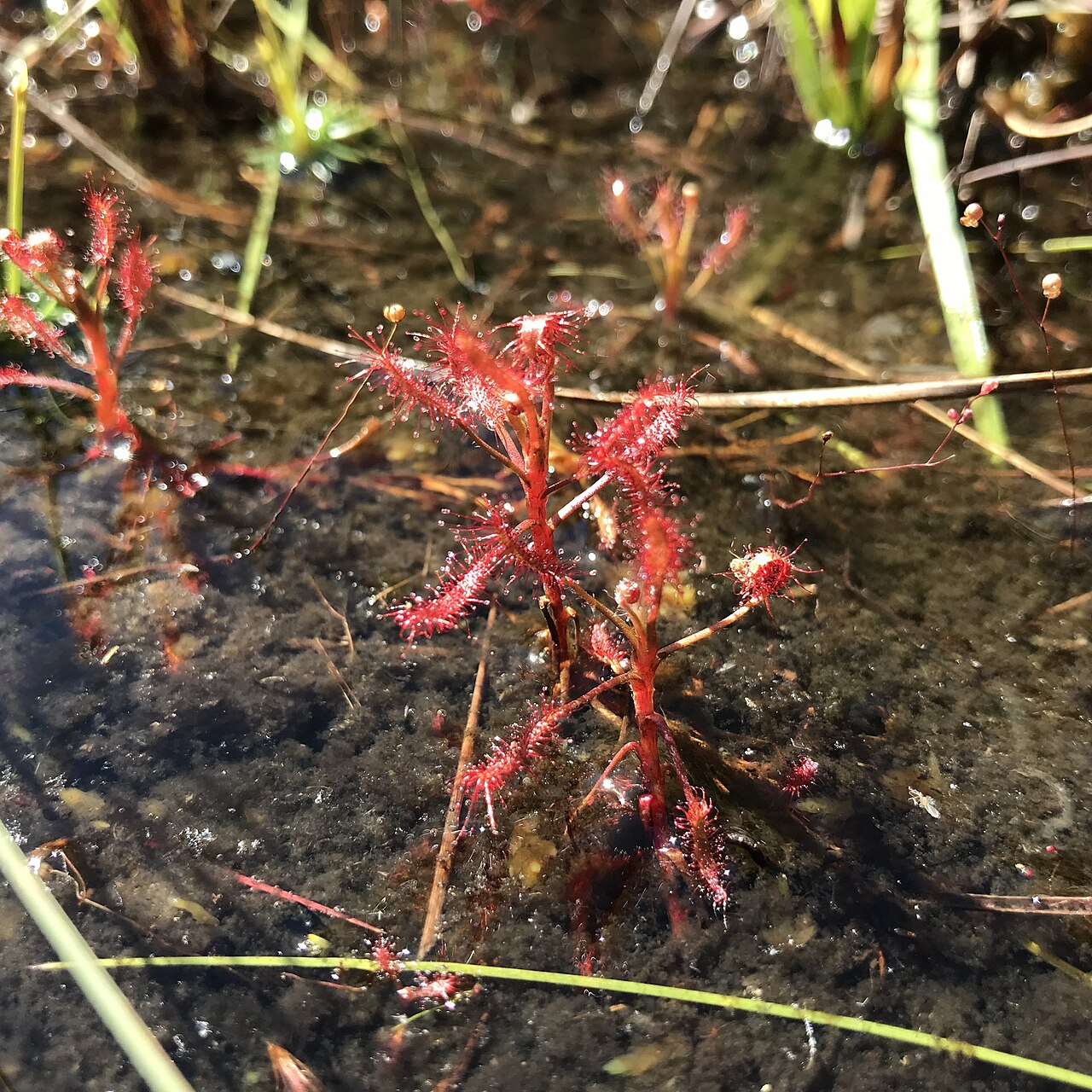
A perennial, flat to slightly raised rosette of spatulate leaves that turn red in sun and are densely set with tentacles, with one or more scapes carrying several flowers. In habit it resembles Drosera communis and its relatives; the distinguishing characters, including those of stipules, hairs and seed, are given in the original description. Measurements and a confirmed flower colour could not be checked here; the size fields are left empty.
Similar species
Drosera communis is the most obvious confusion species; both grow in wet, open parts of the cerrado and may occur side by side. Drosera sessilifolia, with sessile wedge-shaped leaves, and Drosera hirtella and Drosera lutescens, with conspicuous hairs, also grow in the cerrado. Without the original description or the key in the 2022 synopsis, field identification is uncertain.
The trap and how it works
An active flypaper trap. The tentacles catch small insects walking over the wet ground or flying low above it, such as ants, springtails and gnats; the surrounding tentacles then bend towards the prey. The rosette lies close to the ground, so mainly crawling prey is caught.
Habitat and ecology
Wet, open places in the cerrado: boggy grasslands and veredas, the characteristic wet hollows with swamp palms, stream edges and seepage zones, and seasonally wet sandy hollows (B6, W7, W4). The soils are acid and poor; in the long dry season the sites may largely dry out and they are regularly swept by fire.
Distribution and elevation
Central and eastern Brazil, spread over several states in the cerrado region, as the area column of this guide also indicates. As far as known endemic to Brazil. A precise list of states and an altitudinal range could not be checked here.
- Recorded (one-degree cells)
Forms and variation
No varieties are recognised. The species is part of the rich sundew flora of the Brazilian cerrado and campos rupestres, where dozens of species have been newly described or redefined in the last twenty years.
Where and when to see it
In the wet season, November to April, search the wet hollows and stream edges of open cerrado, for instance in the national parks of Goiás and Minas Gerais. Compare on the spot with D. communis if it grows nearby, and photograph scape, flower and stipules close up.
Conservation status
Not assessed for the global IUCN Red List and not listed in CITES. The range is fairly large, but the cerrado is one of the fastest-disappearing ecosystems in South America: large parts have been converted to soy and maize fields and pasture, and the wet hollows are drained or dammed. Many sites are being lost locally as a result.
Scientific name
Drosera grantsaui | Rivadavia, 2003
Described by Fernando Rivadavia in September 2003, in Carnivorous Plant Newsletter, volume 32, no. 3, p. 82-85. The name was briefly considered a synonym of D. communis (golf 40), but reinstated as a distinct species based on molecular and morphological research. Brazil, Minas Gerais, Grão Mogol, "Morro do Jambeiro", marshy spring at the base of the hill, about 7 km from town on the road to Montes Claros, at 700 m elevation. Collected by Rivadavia (no. 299) on 8 September 1994; holotype at herbarium SPF. Named after Rolf Grantsau (1928-2015), a German-Brazilian naturalist and scientific illustrator who emigrated to Brazil in 1962. Primarily known as an ornithologist (hummingbird specialist, co-describer of the parrot Amazona kawalli in 1989), but also active with mammals, reptiles, insects, orchids and carnivorous plants. Several species across different groups are named after him.
World Checklist of Vascular Plants (WCVP), via Plants of the World Online (POWO), Royal Botanic Gardens, Kew.