All species › Caryophyllales › Sundew family › Drosera lowriei
Drosera lowriei
A tuberous sundew that does not grow upwards but forms a rosette flat against the ground, like the well-known Drosera erythrorhiza. Neville Marchant described it in 1992 and named it after Allen Lowrie, the man who described more Australian sundews than anyone else. The type was collected in 1984 at a granite outcrop inland north-west of Esperance.
Identification
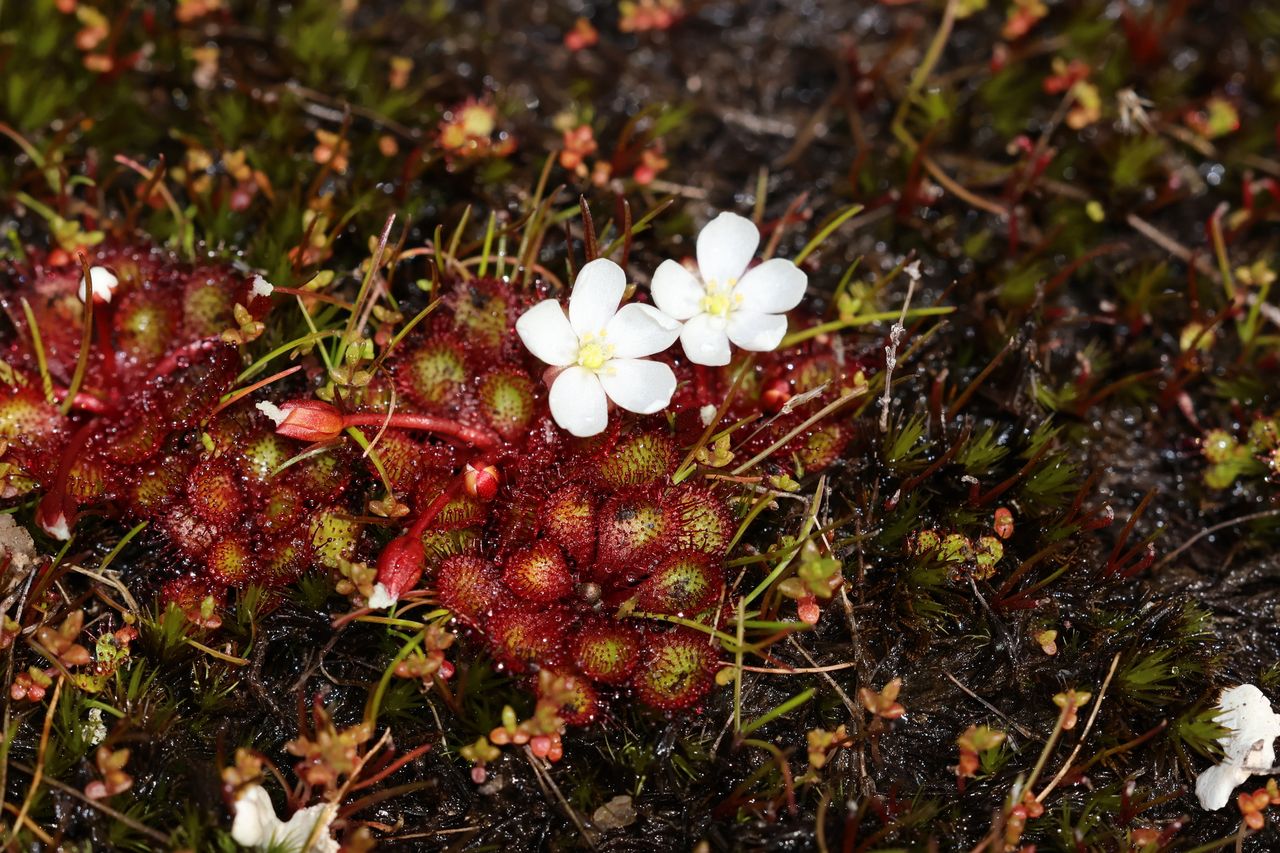
A perennial with an underground tuber and a flat rosette up to 4 cm across and 2 cm tall. The leaves overlap, are green to red, obovate to spatulate, and decrease in size towards the centre. From the middle rises a short scape of about 1.5 cm with a single white flower; the sepals are ovate, 3.5 mm long and 1.5 mm wide. After flowering the scapes lie down and the capsules with spherical seeds ripen against the ground. Flowering from June to September.
Similar species
The closest relative is Drosera zonaria, another rosette-forming tuberous sundew from the south. Other species of the same section, such as D. erythrorhiza and D. macrophylla, are larger and carry several flowers per inflorescence on a taller scape. The combination of a small flat rosette, a single white flower on a very short scape and prostrate fruiting scapes is characteristic of D. lowriei.
The trap and how it works
An active flypaper trap. The upper surface of the flat-lying leaves is covered with stalked glands bearing sticky droplets that catch crawling and low-flying insects: ants, springtails, small flies. After a catch the tentacles bend towards the prey and digestive enzymes are secreted. The reserves for the next year sit in the tuber, which is formed anew each season.
Habitat and ecology
Loam and coarse sand in the wetter zones by granite outcrops (R3, W7, D1), where rainwater runs off the rock and the soil stays moist for long in winter. In summer everything dries out and the plant survives as a tuber.
Distribution and elevation
Endemic to south-west Australia, inland north-west of Esperance. FloraBase lists the Avon Wheatbelt, Coolgardie, Esperance Plains and Mallee bioregions, including the Fitzgerald, Recherche, Southern Cross and Western Mallee subregions.
- Recorded (quarter-degree cells)
Forms and variation
There are no subspecies or varieties. In 2000 the Czech botanists Chrtek and Slavíková placed the species in a separate genus, Sondera, as Sondera lowriei; that treatment is not followed. The species belongs to section Erythrorhiza, the rosette-forming tuberous sundews.
Where and when to see it
Go in July or August to the margins of granite outcrops in the eastern Wheatbelt and the Mallee, and search where water runs off the rock and keeps a narrow strip of loam or coarse sand moist. The flat rosettes are red and stand out among the mosses and lichens; the white flowers sit so low that you have to kneel to see them.
Conservation status
On the global IUCN Red List the species is listed as Least Concern (LC); in Western Australia it is regarded as not threatened. It is not listed in CITES. In the Wheatbelt, granite outcrops are often the last patches of native vegetation in a landscape of fields, and are threatened by grazing, weeds and salinisation of their surroundings.
Scientific name
Drosera lowriei | Marchant, 1992
Described by N.G. Marchant (with A. Lowrie), in "New names and new combinations in 34 taxa of Western Australian tuberous and pygmy Drosera", Kew Bulletin, volume 47, no. 2, p. 315-328 (1992). Collected by A. Lowrie at "Purnta Rock", Western Australia, on 12 September 1984. "Purnta Rock", Western Australia. Named in honour of Allen Lowrie, the prominent Australian carnivorous-plant researcher and collector who recurs countless times in this guide as (co-)describer.
World Checklist of Vascular Plants (WCVP), via Plants of the World Online (POWO), Royal Botanic Gardens, Kew.