All species › Caryophyllales › Sundew family › Drosera lutescens
Drosera lutescens
One of the newest names in this guide, but based on an old description. Saint-Hilaire distinguished a variety lutescens of Drosera hirtella as early as the nineteenth century; in 2022 Paulo Gonella, Fernando Rivadavia and Andreas Fleischmann raised it to species rank as Drosera lutescens in their synopsis of the Brazilian sundews. The name means becoming yellowish and refers to a yellow tinge that separates the plant from its nearest relative.
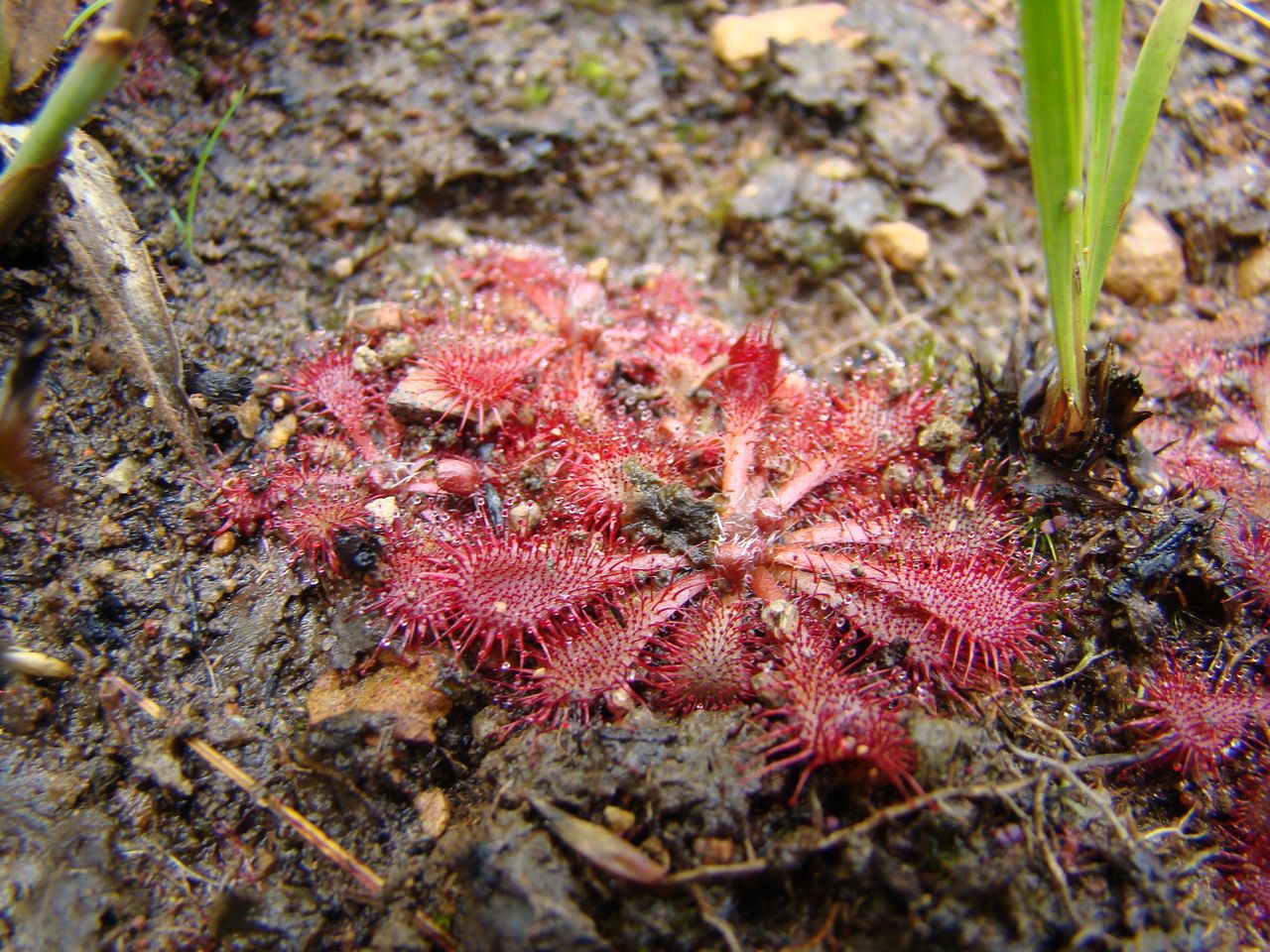
Identification
A perennial, hairy rosette plant of the D. hirtella alliance. The difference from that species lies mainly in the scape: in D. hirtella it is red with red non-glandular hairs, in D. lutescens that red colour is absent. Photographs in the synopsis show both species right next to each other, with the difference in colour and hairs clearly visible. Measurements and a confirmed flower colour could not be checked here; the size fields are left empty.
Similar species
The only serious confusion species is Drosera hirtella, of which it was a variety until 2022 and with which it can grow in the same places. Look at the colour of the scape and its hairs. Other cerrado species, such as Drosera communis and Drosera grantsaui, lack the conspicuous hairs; Drosera tomentosa is woolly-haired but grows in the mountains of eastern Brazil.
The trap and how it works
An active flypaper trap. The tentacles on the blade catch small insects, after which the surrounding tentacles bend towards the prey and digestive enzymes do their work. The hairs on scape and leaves have no trapping role.
Habitat and ecology
Wet and seasonally wet, open to lightly shaded places in the savannas of the interior: boggy grasslands, seepage zones along streams and wet hollows in the cerrado (B6, W4, W7). As the photographs in the synopsis show, the plant can also flower in shade.
Distribution and elevation
Central South America: Brazil and Bolivia, as the area column of this guide also indicates. The exact distribution within both countries, and the relationship to the western form of D. hirtella, could not be checked here. Since the species occurs in two countries, it is not endemic in the sense used by this guide.
- Recorded (one-degree cells)
Forms and variation
No varieties are recognised. The species illustrates the approach of the recent Brazilian revisions: old units distinguished by Saint-Hilaire are re-examined and, where the differences prove stable, recognised as species. Older literature and cultivated plants under the name D. hirtella var. lutescens belong to this species.
Where and when to see it
In the wet season search the wet hollows of the cerrado and the savannas of eastern Bolivia. Where a hairy sundew grows, check whether two types stand side by side: one with red scapes and one without. Photograph scape and hairs close up.
Conservation status
Not assessed for the global IUCN Red List and not listed in CITES. Because the species has been recognised as such only since 2022, its distribution and rarity are not yet well known. The cerrado and the savannas of eastern Bolivia are disappearing fast through the expansion of agriculture and cattle ranching, which also affects this species.
Scientific name
Drosera lutescens | (Saint-Hilaire) Gonella, Rivadavia & Fleischmann, 2022
Originally described as Drosera hirtella var. lutescens by Auguste de Saint-Hilaire in 1824, in "Histoire des Plantes les plus Remarquables du Brésil et du Paraguay", volume 1, p. 263. Raised to full species status in 2022 by Gonella, Rivadavia & A. Fleischmann, in Phytotaxa, volume 553, no. 1, p. 49 — one of the most recent name changes in the guide. The precise type locality could not be established. The basionym derives from Saint-Hilaire's work on the flora of Brazil and Paraguay. From the Latin lutescens ("becoming yellowish") — which plant part is specifically yellowish (flower, glands, stipules) could not be confirmed.
World Checklist of Vascular Plants (WCVP), via Plants of the World Online (POWO), Royal Botanic Gardens, Kew.