All species › Caryophyllales › Sundew family › Drosera macrantha
Drosera macrantha
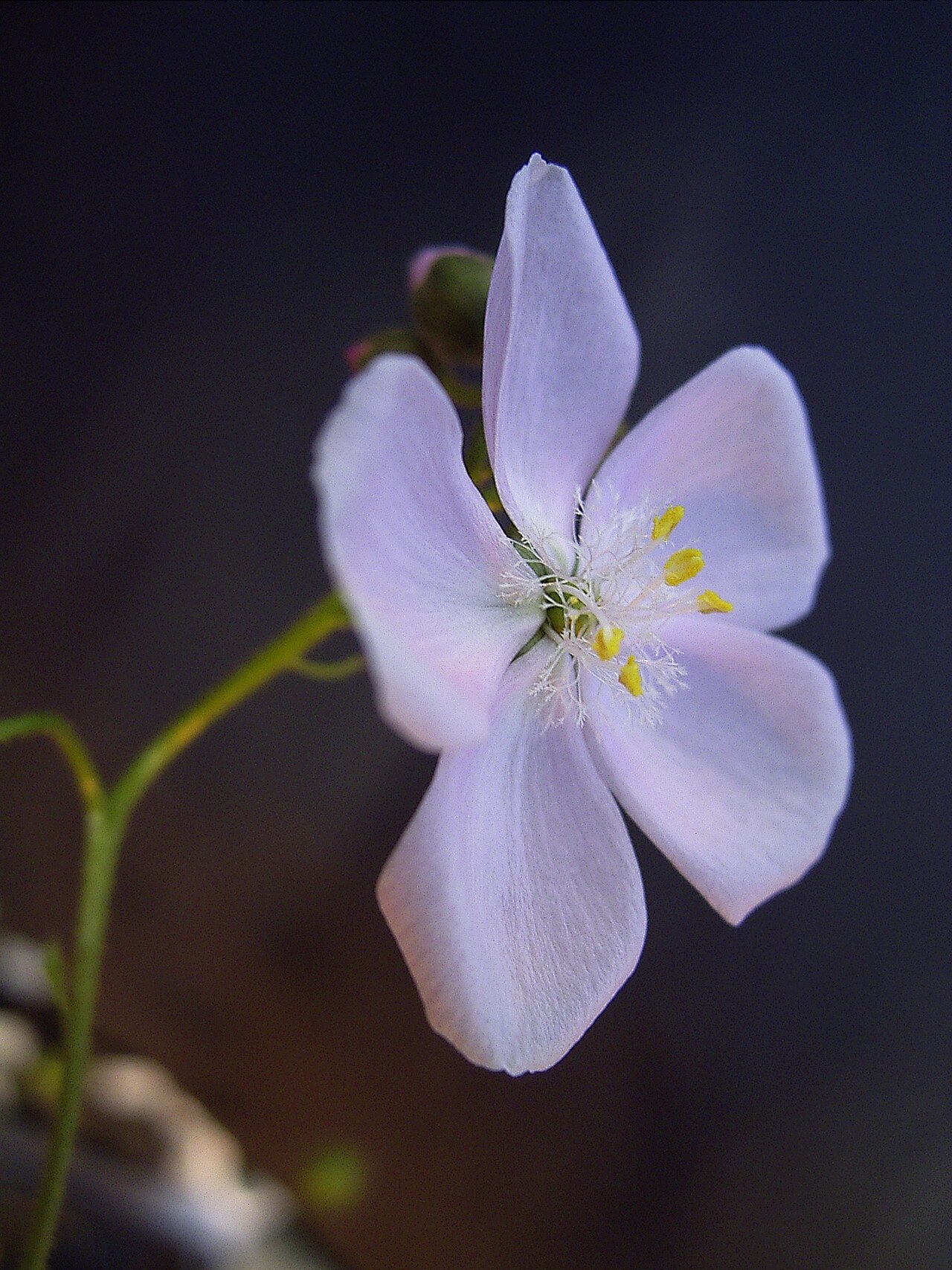
One of the large climbing tuberous sundews of Western Australia, with flowers unusually big for a sundew — the name macrantha means 'large-flowered'. In Western Australia the plant is called Bridal Rainbow. Stephan Endlicher described it in 1837. Because of its huge and varied range the species has collected a long list of synonyms over time.

Identification
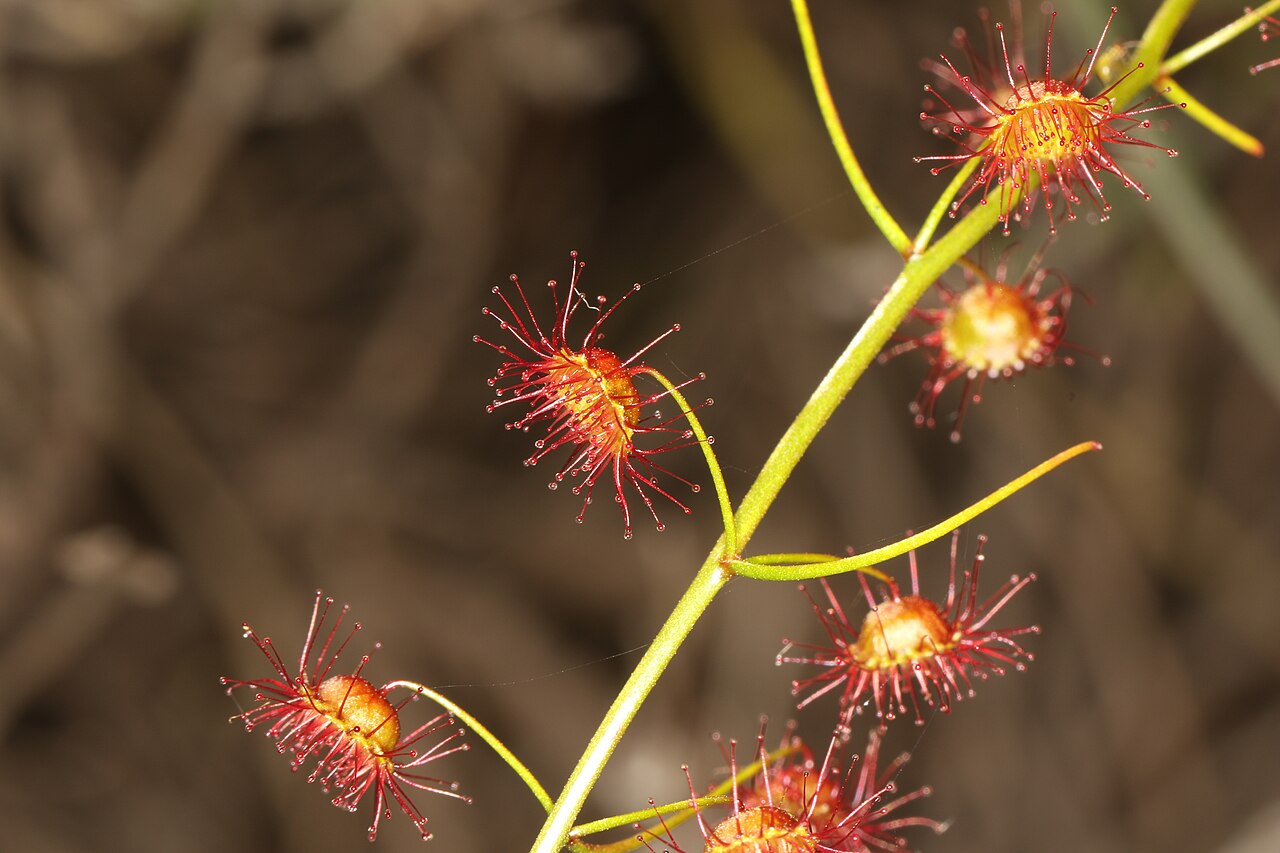
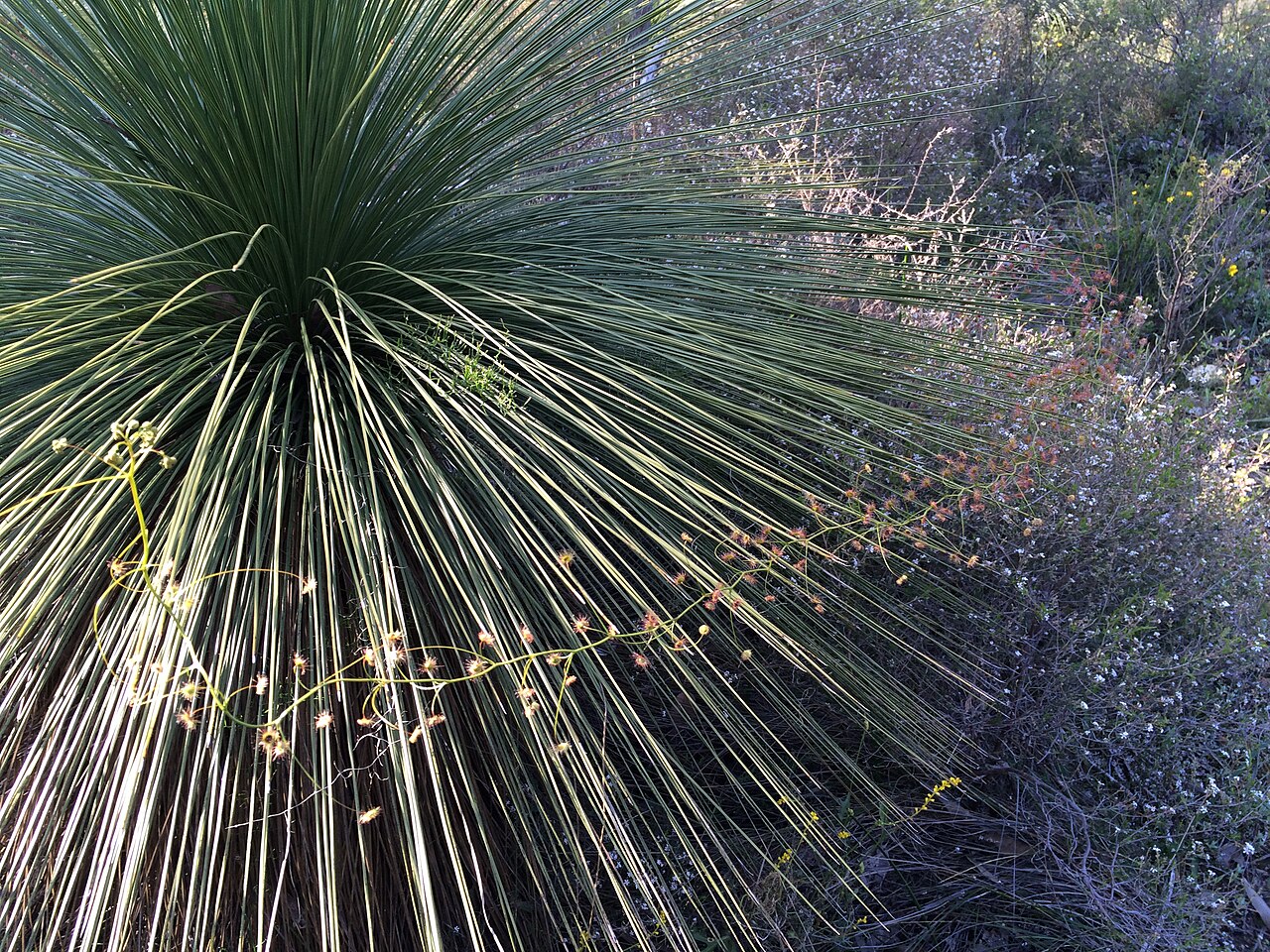
A perennial that each year sends up from an underground tuber a long, scrambling or climbing stem, from 16 cm up to a metre and a half. Along the stem sit small, cup-shaped trapping leaves on stalks, with which the plant hooks on to surrounding shrubs. The flowers are about 2.5 cm across, white, pink or occasionally red, and appear from June to November, earlier in the north of the range than in the south. We did not find precise leaf measurements in any source consulted.
Similar species
Other climbing tuberous sundews, such as Drosera menziesii, D. pallida and D. modesta, can look very similar. D. menziesii usually has pink flowers and more often grows in wet hollows; D. modesta has white flowers but shield-shaped leaves with conspicuously long tentacles. The large flower is the best character of D. macrantha. The boundary with D. stricticaulis is disputed (see forms).
The trap and how it works
An active flypaper trap. The cup-shaped leaf blades carry long marginal tentacles with a sticky droplet. Because the plant climbs high into shrubs it mainly catches flying insects. The leaves have a double function: the sticky tentacles also hook on to surrounding twigs and so serve as climbing organs.
Habitat and ecology
Hollows that are wet in winter, in deep sand, loam, laterite or quartzite soils, often along seasonal creeks and in heath and scrub (W7, D1, D3, B5). The species occurs in a wide range of habitats, from the wet coastal plain to the dry interior. Like all tuberous sundews it survives the summer as a tuber.
Distribution and elevation
Western Australia, over a large area. FloraBase lists the Avon Wheatbelt, Coolgardie, Esperance Plains, Geraldton Sandplains, Jarrah Forest, Mallee, Swan Coastal Plain, Warren and Yalgoo bioregions — from the south coast far into the north and east of the south-west floristic region. Plants from south-eastern Australia formerly included under this name are now usually treated as a separate species.
- Recorded (quarter-degree cells)
Forms and variation
Two subspecies are recognised: the typical D. macrantha subsp. macrantha and D. macrantha subsp. eremaea, described in 1992 for plants from the drier interior. The latter is disputed: some authors place it in D. stricticaulis. The species belongs to section Ergaleium.
Where and when to see it
In August or September walk along the edges of seasonal creeks and wet hollows in heath and look up into the shrubs: the large white or pink flowers sometimes hang at chest height. Follow the stem down to inspect the plant, but do not pull; the thin stem breaks easily from the tuber.
Conservation status
On the global IUCN Red List the species is listed as Least Concern (LC); in Western Australia it is regarded as not threatened. It is not listed in CITES. The large range and broad habitat choice make the species robust as a whole, although local populations in the Wheatbelt are confined to remnants of native vegetation. Uncertainty: the delimitation of the subspecies and the relationship to D. stricticaulis and the eastern plants are not settled.
Scientific name
Drosera macrantha | Endlicher, 1837
Described by Stephan Endlicher in 1837, in "Enumeratio Plantarum" (based on Baron Carl von Hügel's collected material from the south-west coast of New Holland), p. 6. The precise type locality could not be established, but the publication is tied to Von Hügel's collections from the south-west coast of New Holland (Western Australia) — the same source as D. huegelii (golf 44). From the Greek makros ("large") and anthos ("flower") — "large-flowered".
World Checklist of Vascular Plants (WCVP), via Plants of the World Online (POWO), Royal Botanic Gardens, Kew.