All species › Caryophyllales › Sundew family › Drosera erythrorhiza
Drosera erythrorhiza
The red ink sundew owes its English name to its tuber: dig one up and your fingers turn red as if from ink. John Lindley described Drosera erythrorhiza, 'the red-rooted one', as early as 1839 in his sketch of the vegetation of the Swan River colony. It is the species that gives its name to section Erythrorhiza, the tuberous sundews with a flat rosette, and one of the most widespread sundews of the south-west.


Identification
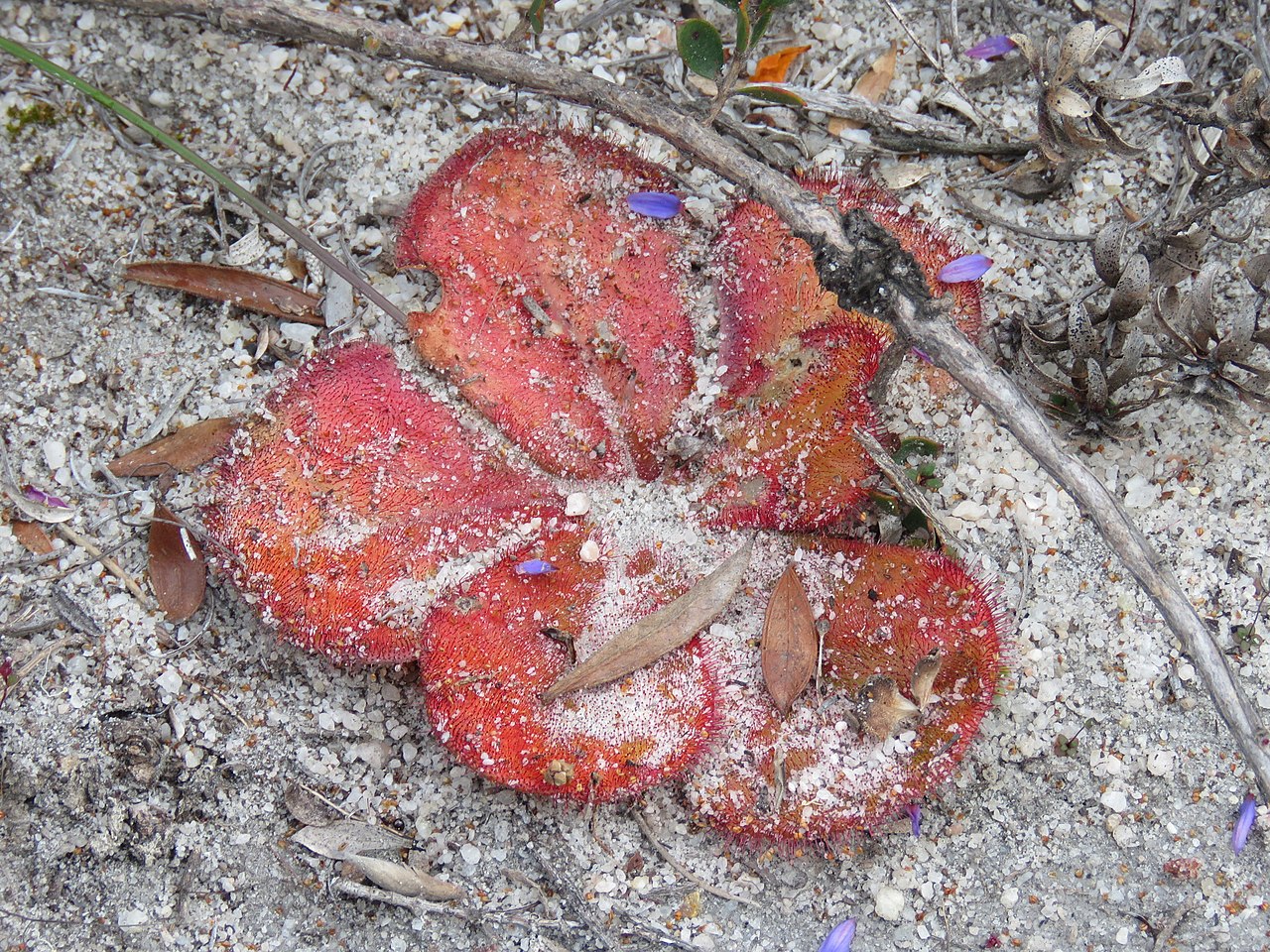
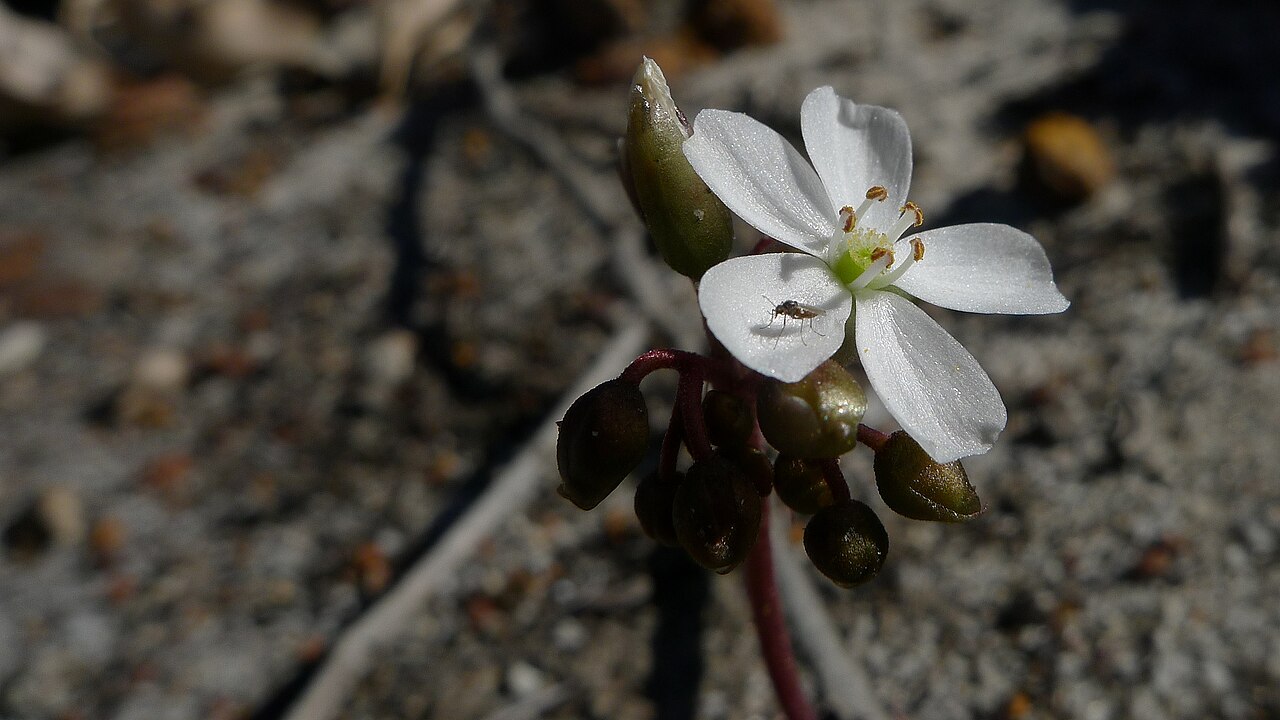
A perennial tuberous plant with a flat rosette of broad leaves lying against the ground; with its inflorescence the plant reaches 12 cm. The leaves bear stalked glands on their upper surface. What sets the species apart within its section is the inflorescence: a branched, cymose cluster with many flowers, up to about fifty. The flowers are white and appear early in the season, from April to June. Leaf shape, leaf width and the number of leaves per rosette vary strongly between subspecies. The underground tuber is deep red.
Similar species
Drosera bulbosa and relatives also form flat rosettes from a tuber, but carry a few flowers close to the rosette rather than a branched, many-flowered inflorescence. Drosera zonaria has a conspicuous red leaf margin. Drosera browniana flowers later and pinkish white. The many-flowered inflorescence above a flat rosette is the best character of D. erythrorhiza; outside flowering, the leaves of subspecies squamosa can be recognised by their red margins, caused by densely packed red tentacles.
The trap and how it works
An active flypaper trap at ground level. The broad, flat leaves act as sticky mats for ants, springtails, small beetles and low-flying insects. Tentacles bend over the prey, after which digestive enzymes are secreted. Most of the nutrients absorbed go into the new tuber the plant forms each year.
Habitat and ecology
Very varied: yellow-grey sand, red-brown sandy loam, laterite and granite, on coastal plains, swamp margins and ridges (FloraBase) (D1, D3, R3, W7). The plant grows in heath and open woodland. It comes up with the first autumn rains and withdraws in late winter into its tuber, which survives the dry summer deep in the ground.
Distribution and elevation
Endemic to the south-west of Western Australia. FloraBase lists seven bioregions, from the Geraldton Sandplains in the north through the Swan Coastal Plain and Jarrah Forest to the Warren and Esperance Plains in the south and the Avon Wheatbelt and Mallee inland.
- Recorded (quarter-degree cells)
Forms and variation
In 1992 Marchant and Lowrie recognised four subspecies, based mainly on leaf form and distribution: subsp. erythrorhiza (fewer, broader leaves), subsp. collina (of hills, variable leaf shape), subsp. magna (larger, broader and more numerous leaves) and subsp. squamosa (red leaf margins). Diels had earlier recognised a variety imbecilla. In 1999 Chrtek and Slavíková proposed placing the group in a genus of its own, Sondera, but this is little followed. More recent treatments regard some subspecies as separate species; this guide treats the species in the broad sense.
Where and when to see it
Come in May or June after good autumn rain. The flat, green to reddish rosettes then lie among the litter of heath and open woodland, sometimes in dense carpets. Flowering rosettes are often most numerous in the year after a fire. Never dig up a tuber to see the red colour: the plant depends entirely on it for the next season.
Conservation status
Assessed as Least Concern (LC) on the IUCN Red List and listed as not threatened in Western Australia. Not in CITES. Its large range and broad habitat tolerance make the species as a whole of little concern. Locally, populations have disappeared through clearing and urbanisation, especially on the coastal plain around Perth.
Scientific name
Drosera erythrorhiza | Lindley, 1839
Described by John Lindley in 1839, in "A Sketch of the Vegetation of the Swan River Colony". The same 1992 publication (Marchant & Lowrie, Kew Bulletin) that appeared repeatedly earlier in this golf later placed three subspecies (collina, erythrorhiza, magna) and a subspecies squamosa (originally Bentham) under this species. The precise type locality could not be established; the material was collected during Lindley's work on the flora of the Swan River Colony, Western Australia. From the Greek erythros ("red") and rhiza ("root") — refers to the plant's red-coloured root/tuber system, hence also the English common name "red ink sundew".
World Checklist of Vascular Plants (WCVP), via Plants of the World Online (POWO), Royal Botanic Gardens, Kew.