All species › Caryophyllales › Sundew family › Drosera pygmaea
Drosera pygmaea
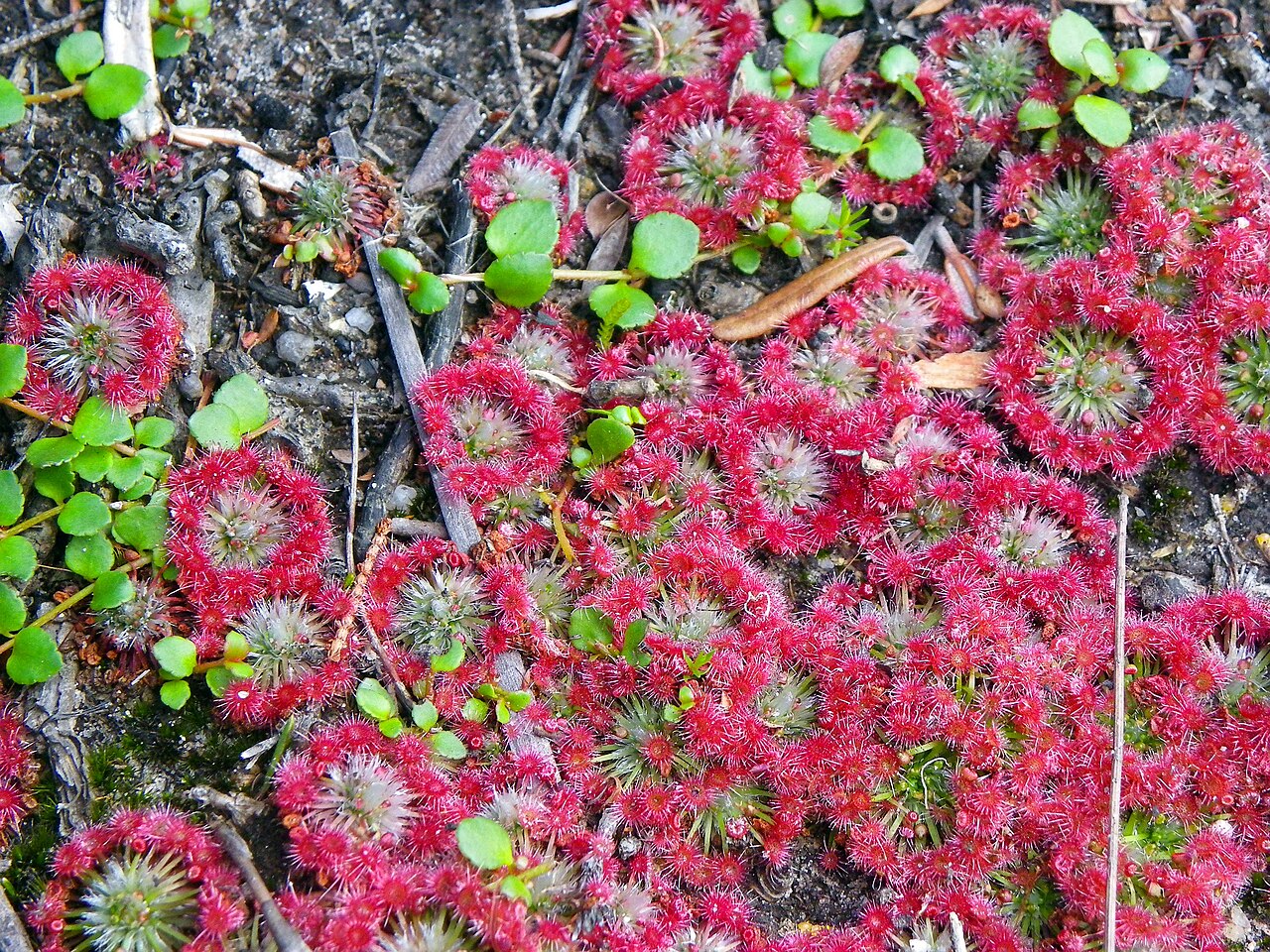
Of the forty-odd pygmy sundews this is the only one to have crossed to New Zealand and the only one common in south-eastern Australia. Drosera pygmaea is truly minute: a rosette the size of a fingernail, easily taken for a red moss. It also has a feature that sets it apart from almost every other sundew: flowers with four rather than five petals.

Identification
A flat rosette 5 to 20 mm across on an extremely short stem, dark red, bright green or yellow-green. The leaves consist of a stalk at most 6 mm long and an almost round, subpeltate blade only 1.5 to 2 mm across, set with stalked glands. At the centre of the rosette silvery, papery stipules form a small upright cone. Each peduncle carries one white, four-parted flower about 3 mm across with petals up to 2.5 mm. The fruit is a four-valved, elliptic capsule. At the end of the season the plant forms small gemmae at its centre.
Similar species
Australia has more pygmy sundews, especially in the south-west, but they have five-parted flowers, so a flowering plant is recognised at once. Without flowers, the combination of very small round blades and the silvery cone of stipules helps. Drosera spatulata may grow alongside but is larger, with elongate spoon-shaped leaves and scapes carrying several flowers. Young rosettes of Drosera auriculata or D. gunniana have crescent-shaped leaves.
The trap and how it works
An active flypaper trap on a small scale. The marginal tentacles of the blade are relatively long and can bend quickly towards stuck prey; the short central tentacles digest. The prey is the smallest life crawling over the ground: springtails, mites and tiny gnats. For a plant of this size even such a small catch is a significant source of nitrogen and phosphorus.
Habitat and ecology
Open, wet to damp and very nutrient-poor ground with plenty of light: sandy and peaty patches in heath and scrub (B5), the edges of peat swamps (W4) and ground that is wet in winter and may dry out in summer (W7). In New Zealand it is characteristic of gumland and pakihi scrub and adjacent bogs, from the coast into the subalpine zone. It needs open ground; once taller plants advance, it disappears.
Distribution and elevation
Australia (in the south-west and south-east, including Tasmania) and New Zealand. On the North Island it occurs from Te Paki south to around Dargaville and near Waiouru; on the South Island only near Bluff Hill. It has probably disappeared from the Auckland area. Reliable altitudinal limits for the whole range are lacking; the elevation field is left empty.
- Recorded (quarter-degree cells)
Forms and variation
No varieties are recognised. The species belongs to the pygmy sundews (section Bryastrum), a group centred on south-western Australia, and is the only one in it with four-parted flowers. Its life cycle varies: it can be annual or biennial and survives unfavourable periods as seed or through gemmae. Colour differences between red and green follow the light level.
Where and when to see it
Search in late spring, when the rosettes are full grown and the first flowers open; flowers open only in sunshine and often close again in the afternoon. Kneel on open, wet sand along paths through heath and gumland and look from close by: the rosettes are too small to see standing up. In New Zealand the far north, from Kaitaia, is the best area. Watch where you put knees and feet; a good site often holds hundreds of rosettes in a few square metres.
Conservation status
Globally the species is Least Concern (LC) on the IUCN Red List; it is not listed in CITES. In New Zealand it is rated 'At Risk – Naturally Uncommon' (2023); earlier assessments said 'Nationally Vulnerable'. The threats there are wetland drainage, road maintenance and the advance of invasive shrubs and grasses. In Australia it is locally common, although much wet heath has been lost there too.
Scientific name
Drosera pygmaea | de Candolle, 1824
Drosera pygmaea was described by the Swiss botanist Augustin Pyramus de Candolle, in "Prodromus Systematis Naturalis Regni Vegetabilis", volume 1, page 317, in 1824. The species occurs in Australia and New Zealand, from coastal areas to subalpine zones. The exact collection site, collector and collection date of the type specimen could not be established with certainty. The epithet pygmaea is Latin for "dwarf" and refers to the very small size of this plant, which typically measures only 8 to 18 mm in diameter — making it one of the smallest species in the genus Drosera. It is a descriptive name.
World Checklist of Vascular Plants (WCVP), via Plants of the World Online (POWO), Royal Botanic Gardens, Kew.