All species › Caryophyllales › Sundew family › Drosera madagascariensis
Drosera madagascariensis
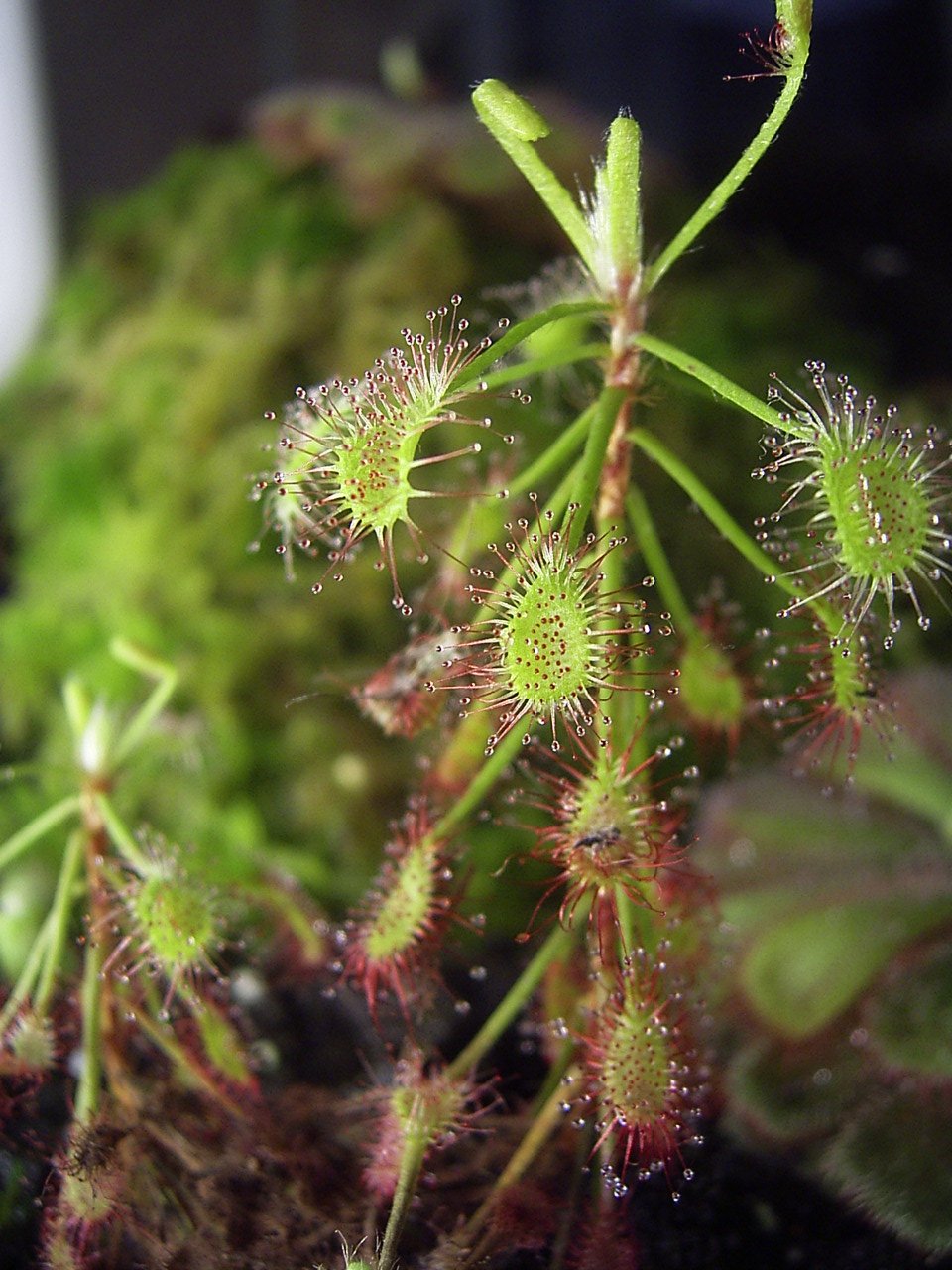
The most widespread sundew of tropical Africa. Drosera madagascariensis was described by De Candolle in 1824 from Madagascan material but occurs across much of Africa south of the Sahara. It is not a flat rosette like the Cape species but a plant that over time forms an erect or sprawling stem, with the leaves spaced along it.

Identification
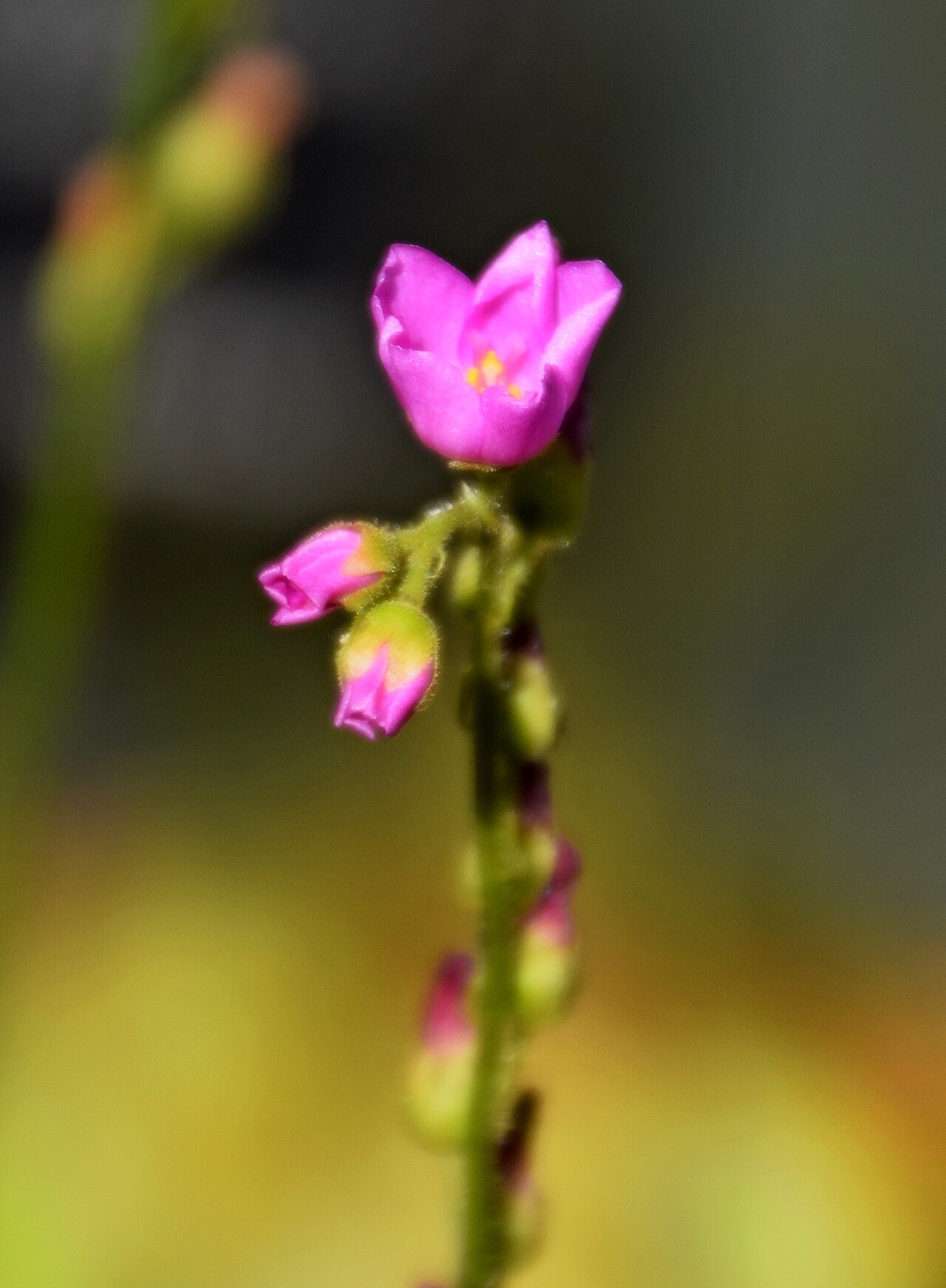
The plant starts as a small rosette but develops an ascending, often unbranched stem with the leaves scattered along it; older dead leaves remain hanging downward on the stem. Each leaf consists of a long, narrow petiole and a small obovate to spatulate trapping blade with red tentacles. The flowering stalk arises laterally and carries pink to purple flowers. Reliable measurements from a flora were not available for this text; the measurement fields are therefore left empty.
Similar species
Tropical Africa has a few related species with a similar stem habit, such as D. affinis and D. elongata; these are separated on details of leaf and flower and are sometimes confused with D. madagascariensis in the literature. Drosera ramentacea from the Cape also has a stem but bears scale-like hairs (ramenta). The rosette species D. burkeana, D. dielsiana and D. natalensis form no stem.
The trap and how it works
An active flypaper trap. The trapping blades are scattered along the stem, so the plant catches insects at different heights in the vegetation. After contact the tentacles bend towards the prey and the glands secrete digestive enzymes. The stem growth is an adaptation to sites with grasses and sedges: the plant grows upwards with them and keeps its traps in the light.
Habitat and ecology
Wet, nutrient-poor, open places: marshy grassland, stream banks, seeps and seasonally wet hollows in savanna and open woodland (W4, W7, B6). The plant often grows among grasses and sedges that become as tall or taller.
Distribution and elevation
Tropical and southern Africa, from West to East Africa and south into South Africa, and Madagascar. Precise altitudinal limits were not found in the sources consulted.
- Recorded (quarter-degree cells)
Forms and variation
Across so large an area the species varies in size, hairiness and flower colour. Some of these forms have been described in the past as separate species or varieties; the relationship to D. affinis and D. elongata is not clear in every respect.
Where and when to see it
In southern Africa the species flowers in the wet summer. Search marshy grassland and stream banks; the plant is less conspicuous than the rosette species because it grows up among the grass. Look for the red trapping blades on long stalks.
Conservation status
Assessed on the IUCN Red List as Least Concern; not in CITES. The large range and broad habitat choice make the species little vulnerable. Locally sites are lost to wetland drainage for agriculture and to urban expansion.
Scientific name
Drosera madagascariensis | de Candolle, 1824
Described by Augustin Pyramus de Candolle in January 1824, in "Prodromus Systematis Naturalis Regni Vegetabilis", volume 1, p. 318. Not explicitly stated, but given the name and range Madagascar seems likely; the species actually occurs more broadly across Africa and Madagascar, not exclusively on the island. Named after Madagascar, one of the countries where the species occurs.
World Checklist of Vascular Plants (WCVP), via Plants of the World Online (POWO), Royal Botanic Gardens, Kew.