All species › Caryophyllales › Sundew family › Drosera slackii
Drosera slackii
A robust, flat rosetted sundew from the coastal mountains of the south-western Cape, described as a species only in 1987. Drosera slackii is named after the British grower and author Adrian Slack (1933–2018), whose books shaped a whole generation of carnivorous-plant enthusiasts. In the wild it is a plant of permanently wet seeps along small mountain streams.

Identification
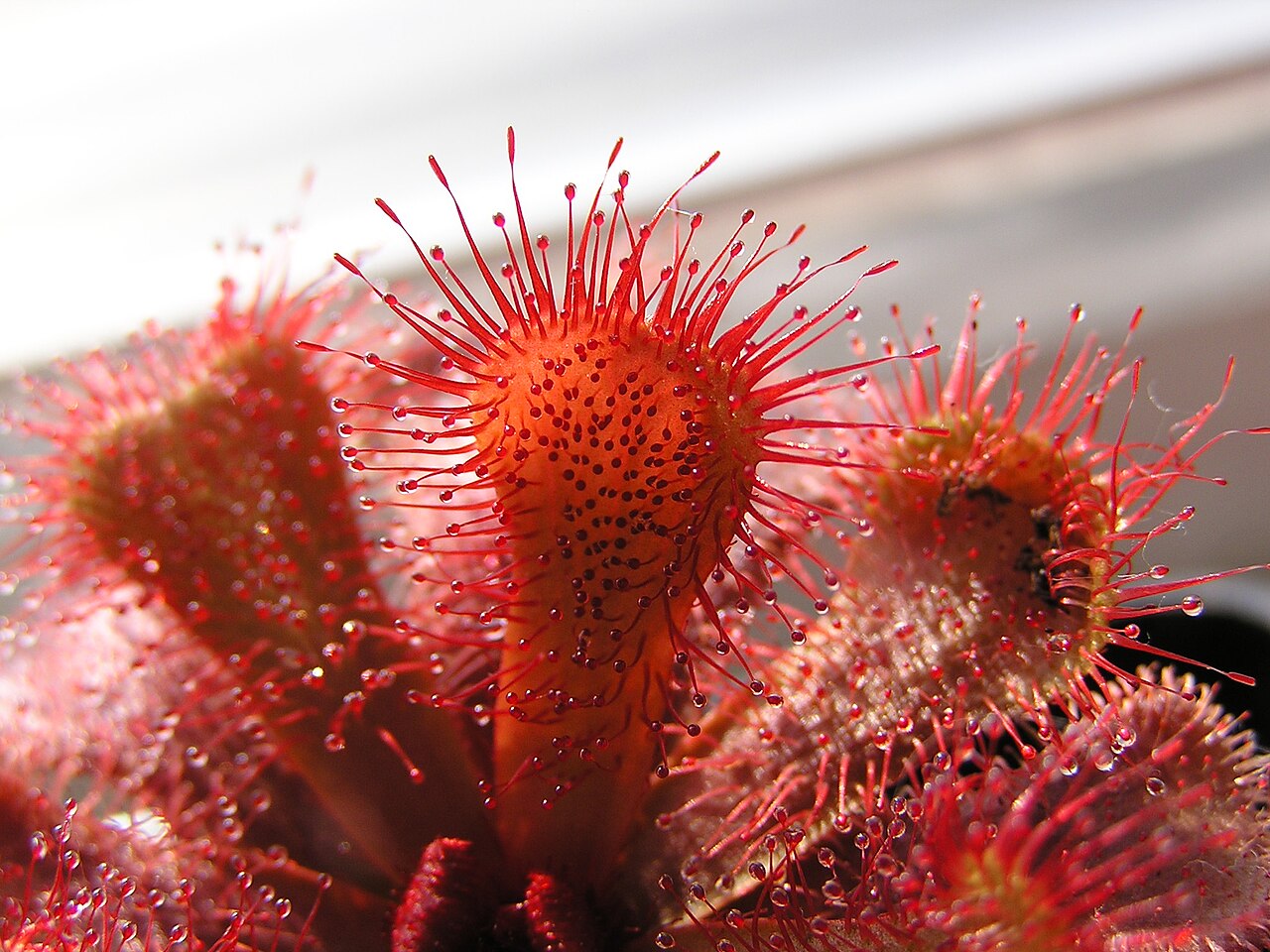
A broad, semi-erect to flat rosette 5 to 10 cm across, green at the base and copper to deep red in the sun. The leaves reach about 4 cm long and have a characteristic guitar shape: the petiole is flat and widened in the middle, passing into a broad, rounded trapping blade. The young, unrolling leaves bear scattered short fleshy projections on the underside; this is the best character. In the centre of the rosette the tentacles are bright red. The scape carries deep pink flowers in spring.
Similar species
Drosera rubrifolia has a similar leaf shape but lacks the fleshy projections on the underside of the young leaves, and is smaller and deeper red. Drosera aliciae is smaller, with narrower spatulate leaves lacking a clearly widened petiole. Drosera cuneifolia has wedge-shaped leaves truncate at the tip and is confined to the Table Mountain massif. In older literature D. slackii was sometimes included in D. aliciae, so older records should be read with care.
The trap and how it works
An active flypaper trap. The broad blade is densely set with stalked glands, each holding a sticky droplet; small insects landing on it are caught, after which the surrounding tentacles bend towards the prey. The glands then secrete digestive enzymes and absorb the nutrients. The large flat rosette acts as a wide trapping plate on wet ground where gnats and small flies are plentiful.
Habitat and ecology
Permanent seeps along small mountain streams, on nutrient-poor peaty sand over sandstone, in open fynbos (R1, W4, B5). The plant needs water all year, though it grows mainly in the cool, wet winter. It tolerates shading by tall shrubs or alien trees poorly.
Distribution and elevation
Endemic to the south-western Cape of South Africa, in the coastal mountains: the Kogelberg, the Hottentots-Holland Mountains and the Kleinrivier Mountains. Reliable altitudinal limits from scientific sources are lacking; the elevation field is left empty.
- Recorded (one-degree cells)
Forms and variation
No varieties are recognised. The species was described in 1987 by Martin Cheek in the Kew Bulletin, from material previously included in D. aliciae. The Cape rosetted sundews have since been thoroughly revised, by Debbert and later by Fleischmann and colleagues, and D. slackii stands in those revisions as a well-defined species. Natural hybrids with other species may occur locally; they are not treated separately here.
Where and when to see it
In the wet months follow the trails through the Kogelberg or the Kleinrivier Mountains and watch for places where a stream seeps over rock or path. The rosettes are large enough to spot from the path. Stay on it: the seep zones are narrow, and the sites lie mostly in protected areas.
Conservation status
Not assessed for the global IUCN Red List and not listed in CITES. The range is small but lies largely within protected mountain areas such as the Kogelberg Biosphere Reserve. Possible threats are the drying of seeps, invasion by alien trees and collecting for trade; the species is, however, common in cultivation and widely raised from seed, which reduces pressure on wild plants.
Scientific name
Drosera slackii | Cheek, 1987
Drosera slackii was described in 1987 by Matthew Cheek, published in Kew Bulletin, volume 42(3): 738. The species occurs in the Overberg region of the Western Cape, South Africa, with known localities around Hermanus (including the Fernkloof and Vogelgat nature reserves, Rotary Way). The exact type locality and the collector/date of the holotype could not be established with certainty. This is an eponym: the species is named after the British plantsman and author Adrian Slack (1933–2018), a well-known authority on carnivorous plants.
World Checklist of Vascular Plants (WCVP), via Plants of the World Online (POWO), Royal Botanic Gardens, Kew.