All species › Caryophyllales › Sundew family › Drosera hamiltonii
Drosera hamiltonii
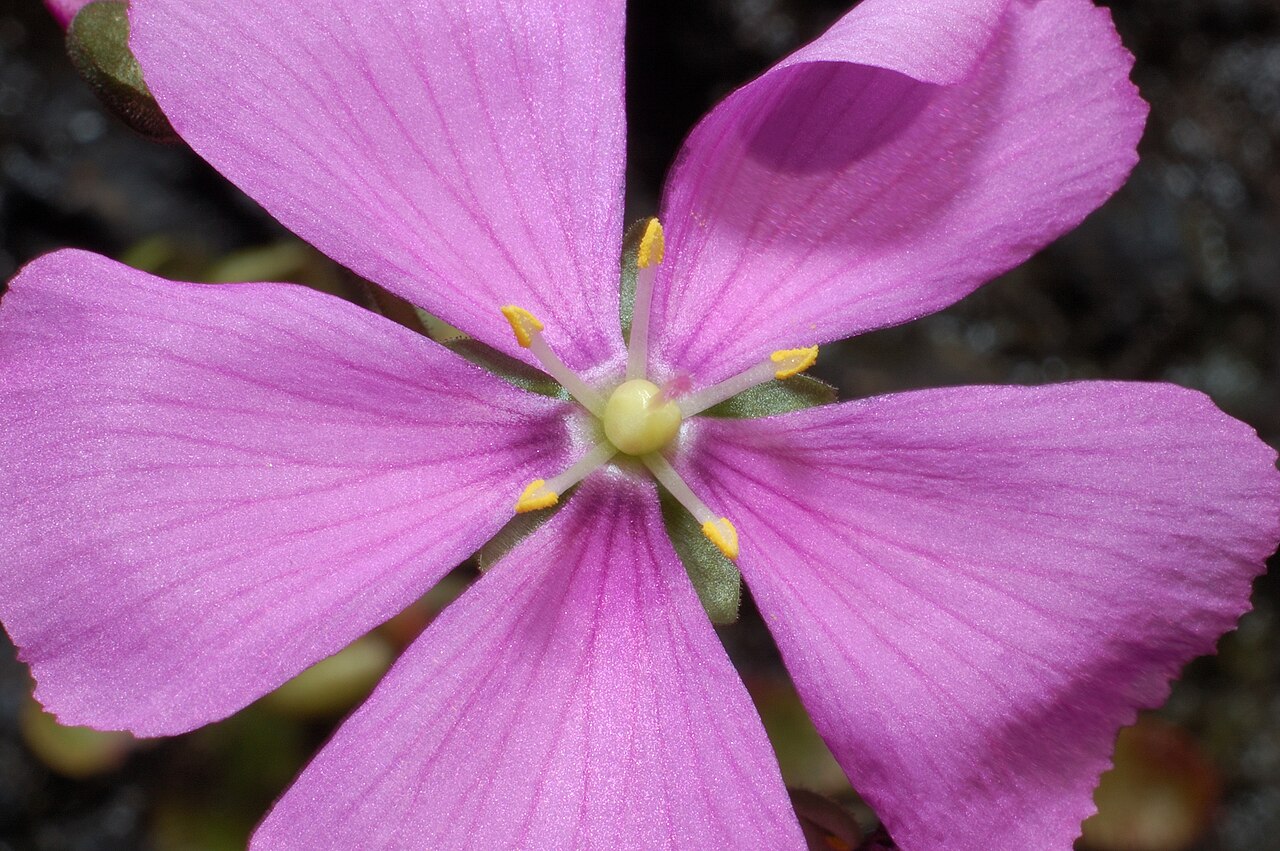
A sundew so different from the rest that it has been given its own subgenus. Drosera hamiltonii, the rosy sundew, is the only species of subgenus Stelogyne, because of a detail in the flower: the styles are fused together, something found nowhere else in the genus. Cecil Andrews described it in 1903. It is a plant of the peaty swamps of the cool, wet far south-west.

Identification
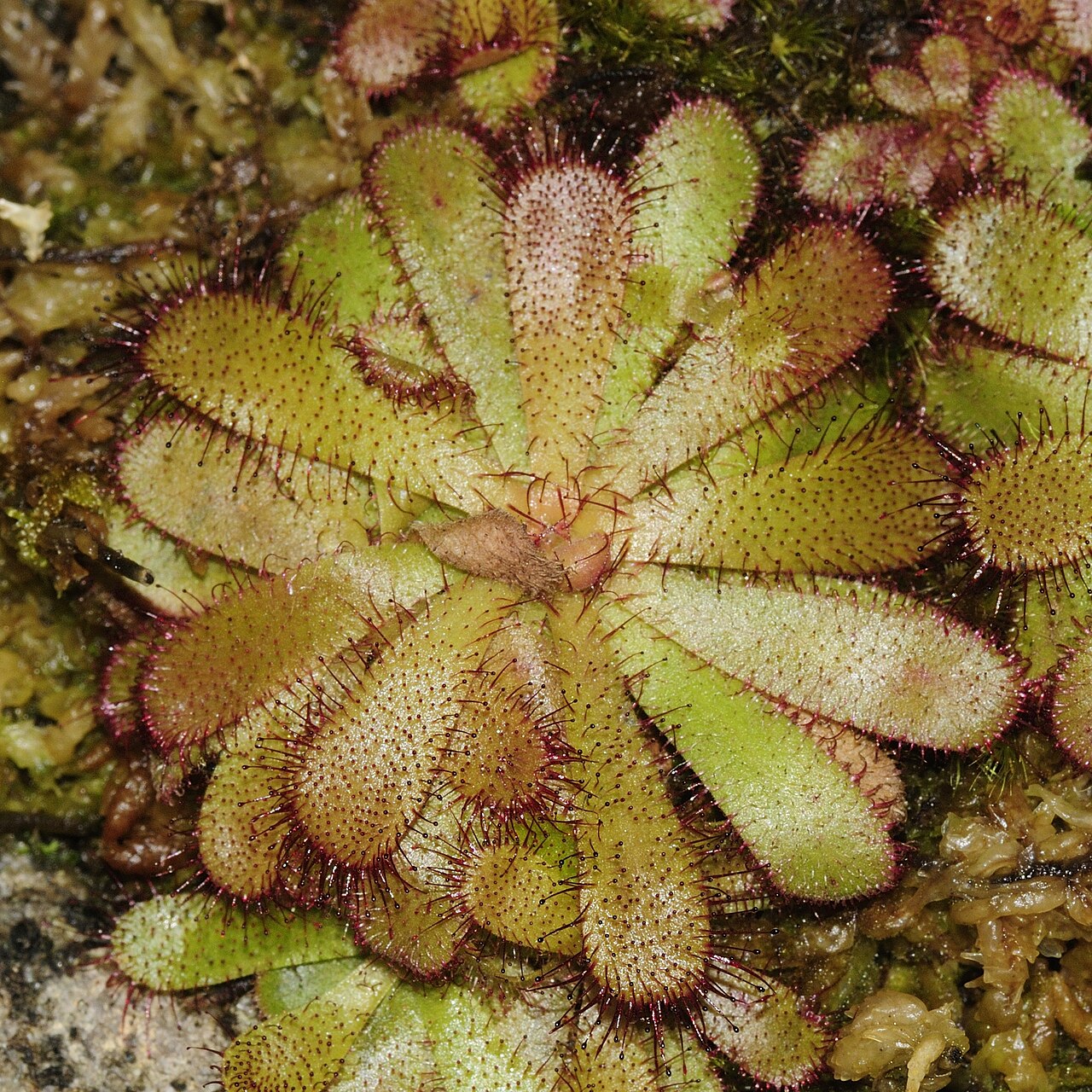
A perennial, fibrous-rooted rosette plant without a tuber. The leaves are about 2 cm long, densely covered in stalked glands, and form a rosette on the ground. From it rises a long flowering stem about 30 cm tall, up to 40 cm according to FloraBase, with pink to purplish red flowers. Flowering falls in late spring and early summer, in November and December. The decisive feature, the fused styles at the heart of the flower, can be seen with a hand lens.
Similar species
Other rosette-forming sundews may grow in the same south-western swamps, such as tuberous sundews of section Erythrorhiza and various pygmy sundews, but these are much smaller in build or flower white and much earlier in the year. The combination of a rosette of leaves a few centimetres long, a flowering stem of 30 cm or more and pink flowers in November and December is characteristic; the fused styles make identification certain.
The trap and how it works
An active flypaper trap. The rosette leaves are densely covered with stalked glands secreting sticky droplets. In the damp swamp environment they mainly catch gnats, midges and other small flying insects. After contact the tentacles bend towards the prey and the glands secrete digestive enzymes. In sundews a long flowering stem is often interpreted as a way of keeping pollinators away from the traps.
Habitat and ecology
Peaty soils in swamps (FloraBase) (W4, W7), in the near-coastal swamps of the south-west. Unlike the tuberous sundews, which spend the summer underground, this species grows in places that stay wet for a long time, which makes its late flowering in early summer possible.
Distribution and elevation
Endemic to the south-west of Western Australia, in the coastal swamps of the cool, wet far south-west. FloraBase lists the Jarrah Forest and Warren bioregions, with records in the shires of Albany, Augusta-Margaret River, Denmark, Manjimup and Nannup.
- Recorded (one-degree cells)
Forms and variation
No subspecies or varieties have been described. Its taxonomic position is all the more interesting. Ludwig Diels placed the species in 1906 in a section of its own, Stelogyne; Seine and Barthlott proposed in 1994 to include it in section Drosera; Jan Schlauer raised Stelogyne to subgenus in 1996, arguing that the unique fused styles justify separation above sectional rank.
Where and when to see it
Come late in the season, in November or December, when most other south-western sundews have finished flowering or gone underground. Search the wet, peaty swamps between Augusta and Albany. The pink flowers on long stems rise above the swamp vegetation and can be seen from some distance. Wear boots and keep to paths; many swamps lie in national parks.
Conservation status
Assessed as Least Concern (LC) on the IUCN Red List and listed as not threatened in Western Australia. Not in CITES. The range lies largely in the wettest and best-protected corner of the south-west. Swamps nonetheless remain sensitive to drainage, falling groundwater under a drying climate, and changes in fire regime.
Scientific name
Drosera hamiltonii | Andrews, 1903
Described by Cecil Rollo Payton Andrews in 1903, in Journal of the Mueller Botanic Society of Western Australia, volume 1, no. 11, p. 81. The precise type locality could not be established. The species is endemic to coastal swamps in south-western Western Australia. Named after a person surnamed Hamilton, but the identity of this person could not be established.
World Checklist of Vascular Plants (WCVP), via Plants of the World Online (POWO), Royal Botanic Gardens, Kew.