All species › Caryophyllales › Sundew family › Drosera brevifolia
Drosera brevifolia
One of the smallest sundews of North America: a flat, deep red rosette a few centimetres across, above which strikingly large white or pink flowers rise in spring. Drosera brevifolia has a surprisingly large and broken range — the south-eastern United States, Mexico, Cuba, and then only again the southern part of South America. It is a plant of places that are wet for only part of the year, and it is often short-lived: many plants flower after one or two years and then die.


Identification
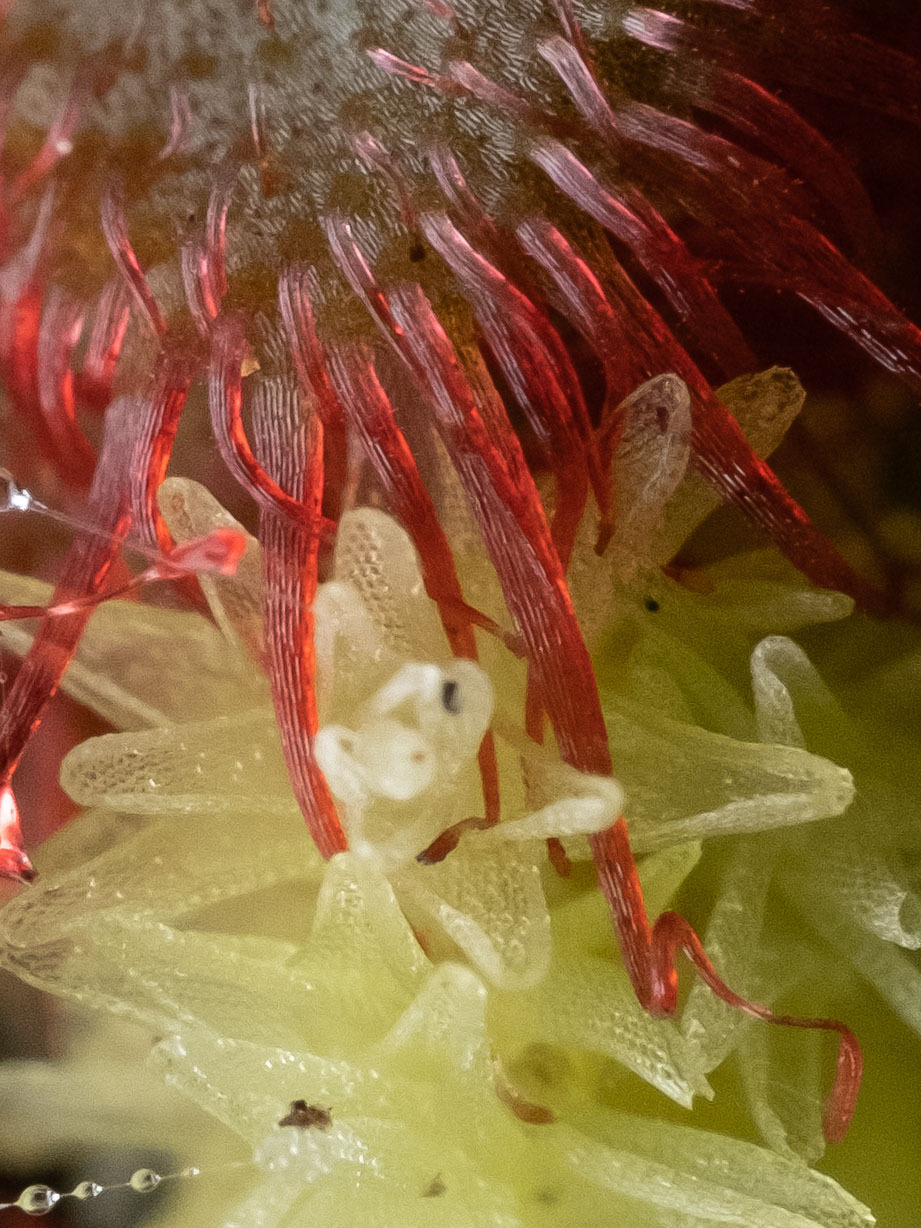
A rosette lying flat on the ground, usually about 3 cm across and rarely to 5 cm. The leaves are wedge-shaped, obovate to spatulate and 7 to 16 mm long, the blade tapering gradually into a short, broad stalk; in sun the colour is deep red to reddish purple. Stipules are absent. The scape is up to about 15 cm tall and — an important character — covered in small glandular hairs. It carries one or a few flowers that are large for the size of the plant, with white to pink petals. Flowering is in spring.
Similar species
The main confusion is with Drosera capillaris, which often grows at the same sites. It is larger, has a distinct thin petiole with a round to spatulate blade, carries fringed stipules in the centre of the rosette and has a glabrous scape; it also flowers later, in summer. Small plants of D. intermedia also have a long, glabrous petiole and an upright rather than flat rosette. A flat red rosette of wedge-shaped leaves with a glandular-hairy scape therefore points to D. brevifolia.
The trap and how it works
An active flypaper trap. The glands on the upper surface and margin of the leaf each carry a sticky droplet; a small insect that lands in it is held, after which the tentacles bend towards the prey and the leaf curls slightly round it. The glands then secrete enzymes and absorb the released nutrients. Because of the small size, the catch is mainly springtails, ants, small midges and other minute animals that walk on the ground or fly low.
Habitat and ecology
Moist to wet, acid, sandy or clayey soil that may dry out in summer: open patches in pine savannas and flatwoods (B6), the edges of marshes, ponds and temporary pools (W7), and disturbed bare ground such as roadsides, tracks and scraped land (H2). The species often grows in drier places than most other carnivorous plants in the region and benefits greatly from open, bare soil after fire or disturbance. Its short-lived, prolifically seeding habit fits with that.
Distribution and elevation
In the United States from Virginia and Kentucky south to Florida and west to Texas, Oklahoma and Kansas, including Tennessee, Arkansas, Missouri, Mississippi, Alabama, Georgia and the Carolinas. Further in eastern Mexico, Belize and Cuba, and after a large gap in southern Brazil, Paraguay, Uruguay and north-eastern Argentina. How that leap to South America came about is not clear. A reliably published altitudinal range is lacking; the elevation field is left empty.
- Recorded (quarter-degree cells)
Forms and variation
No varieties are recognised. Over time, however, several names have been given to this plant, mostly from South America, that are now treated as synonyms — among them Drosera ferruginea from Uruguay, which has its own cross-reference page in this guide. Colour forms occur: plants in full sun are deep red, those in partial shade greener, and flower colour ranges from pure white to clearly pink.
Where and when to see it
Go in spring — early in the southern US — and search bare, damp patches in open pine woods, sandy tracks and roadsides. The rosettes are so small they are easily overlooked; the flowers give them away. Come on a sunny morning, because the flowers open only in sun. As the plant often dies after flowering, numbers at a site can vary greatly from year to year.
Conservation status
The species has not been assessed for the global IUCN Red List and is not in CITES. Overall it is not rare, but it is at the northern edge of its range: in Kentucky it is considered endangered and in Tennessee threatened. The main threats are the loss of open pine savannas to forestry and development, the absence of fire, and the closing-in of the bare patches on which the seedlings depend.
Scientific name
Drosera brevifolia | Pursh, 1814
Described by Frederick Pursh, described December 1813, title page 1814, in "Flora Americae Septentrionalis", volume 1, p. 211. "Sandy swamps, Georgia" — sandy swamps in Georgia, south-eastern United States. Lectotype at herbarium PH (Philadelphia). The species occurs from eastern Texas to Florida, north to Virginia. In 1834, a variety, D. brevifolia var. major Hook., was additionally described from Louisiana. From the Latin brevis ("short") and folium ("leaf") — "short-leaved", consistent with the English common names "dwarf sundew"/"small sundew".
World Checklist of Vascular Plants (WCVP), via Plants of the World Online (POWO), Royal Botanic Gardens, Kew.