All species › Caryophyllales › Sundew family › Drosera miniata
Drosera miniata
A pygmy sundew from south-west Australia, described by the German botanist Ludwig Diels, who wrote the first major monograph of the sundew family at the beginning of the twentieth century and collected in Western Australia himself. Drosera miniata belongs to the section of the pygmy sundews. For this species we could verify only the name, author and classification; the text is therefore short.

Identification
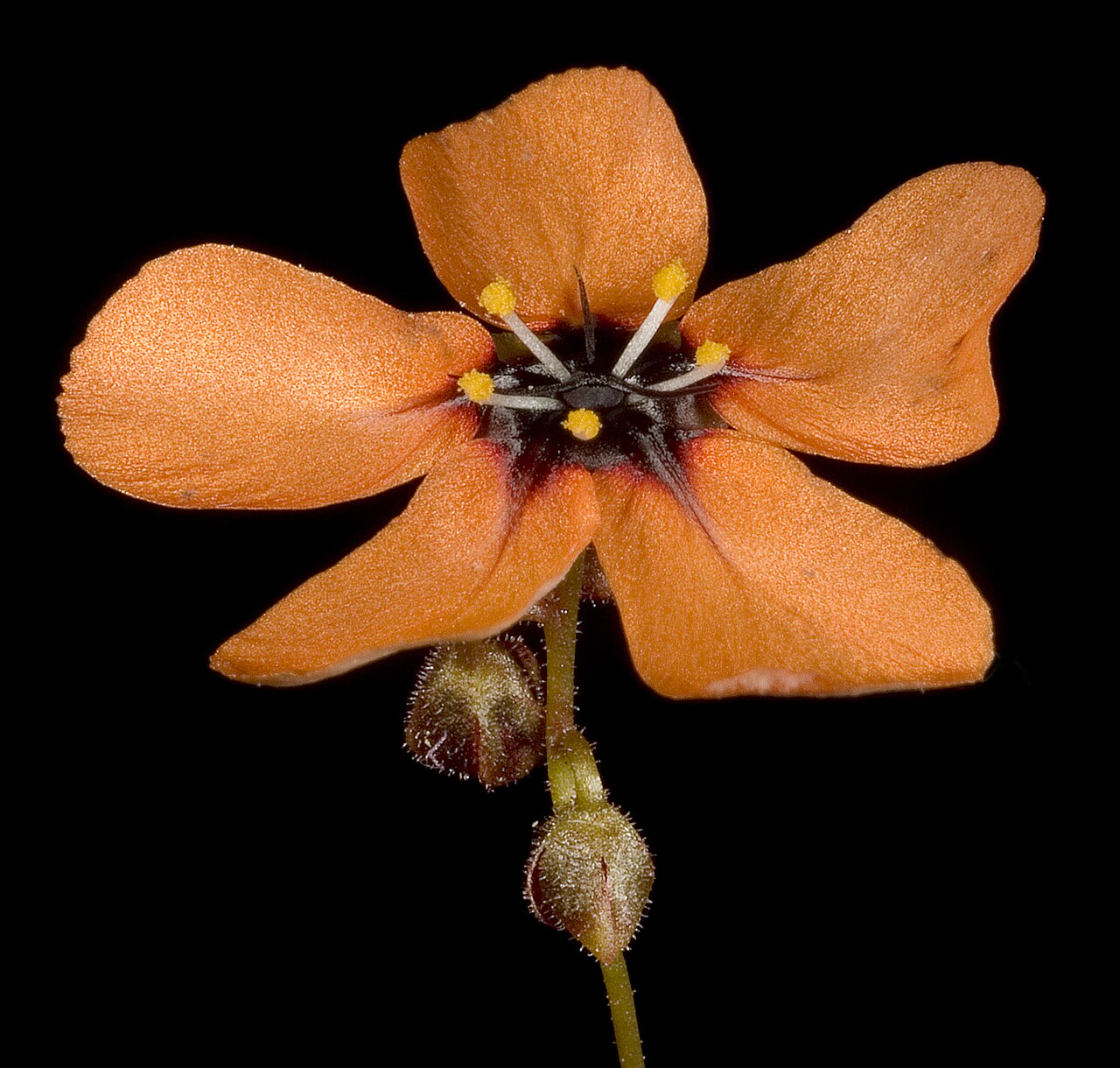
The epithet miniata means 'vermilion', after the red pigment minium; in a sundew such a name usually refers to flower colour, but we could not confirm that in a source. As a pygmy sundew the plant forms a small rosette with a tuft of white or silvery stipules at its heart, and gemmae at the end of the growing season. Measurements, flower colour and flowering time are left empty.
Similar species
The south-west holds dozens of pygmy sundews, and the orange- and red-flowered species among them, such as Drosera leucoblasta and D. hyperostigma, differ mainly in the shape of petals and stigmas and the colour of filaments and styles. Without flowers and without the key in Lowrie (2013) a reliable identification cannot be expected.
The trap and how it works
An active flypaper trap in miniature. The leaf blades carry stalked glands with a sticky droplet; long marginal tentacles catch the prey and bend it to the centre of the leaf, where shorter glands take over digestion. The prey consists of springtails, mites and the smallest flies.
Habitat and ecology
We were unable to consult a published habitat description. The codes follow the general picture of south-west Australian pygmy sundews, on open laterite and sand among low heath (D3, B5, D1), and are provisional. Like all pygmy sundews the plant grows in the wet winter and rests in the dry summer.
Distribution and elevation
Endemic to south-west Australia. We could not verify a more precise description of the range.
- Recorded (one-degree cells)
Forms and variation
As far as we could establish, no subspecies or varieties have been described. Asexual reproduction by gemmae, flung away by raindrops, often results in dense groups of genetically identical plants in pygmy sundews.
Where and when to see it
Pygmy sundews flower in the south-west Australian spring, and their flowers open only in sunshine. Go on a bright day around midday, kneel by open patches in the heath and take a hand lens for the details of styles and stigmas.
Conservation status
On the global IUCN Red List the species is listed as Least Concern (LC). It is not listed in CITES. Uncertainty: apart from name, author, section and status we could verify nothing in a source; morphology, flower colour, habitat and distribution remain open until the original description or FloraBase has been consulted.
Scientific name
Drosera miniata | Diels, 1904
Drosera miniata was described in 1904 by Ludwig Diels, in Botanische Jahrbücher für Systematik, volume 35, p. 206. No reliable type-specimen record with collection details (locality, collector, date) could be found; the species is endemic to Western Australia, but a precise type locality could not be established with certainty. The name derives from Latin miniatus, "coloured with minium/cinnabar", i.e. vermilion to orange-red — a descriptive name, consistent with the common English name "orange sundew".
World Checklist of Vascular Plants (WCVP), via Plants of the World Online (POWO), Royal Botanic Gardens, Kew.