All species › Caryophyllales › Sundew family › Drosera monticola
Drosera monticola
A tuberous sundew of the mountain tops: monticola means 'mountain-dweller'. The species grows only on the highest summits of the Stirling Range, the mountain chain that rises above the plains of southern Western Australia, in the zone where the clouds touch the peaks. It is one of the most isolated sundews of the south-west.
Identification
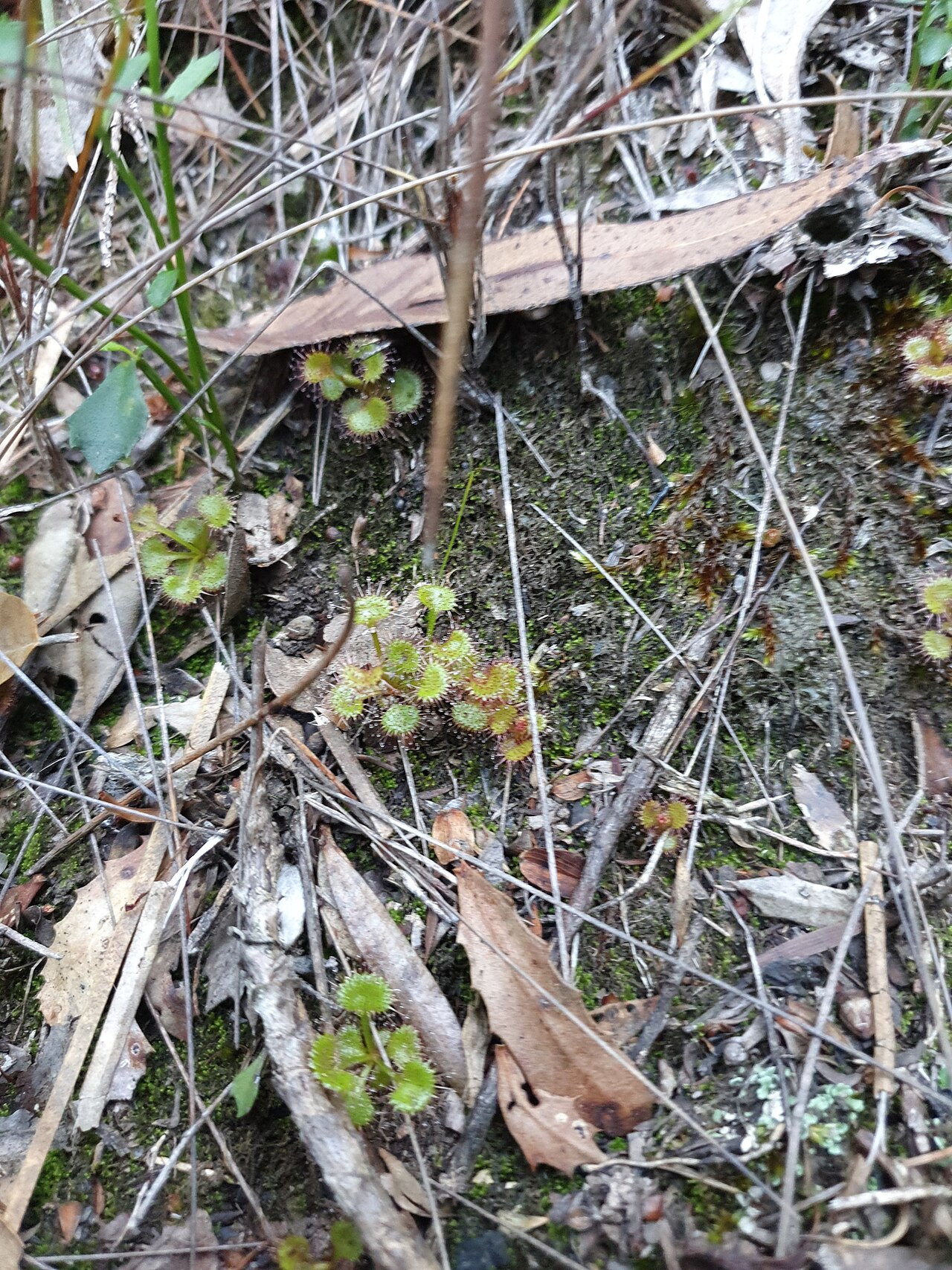
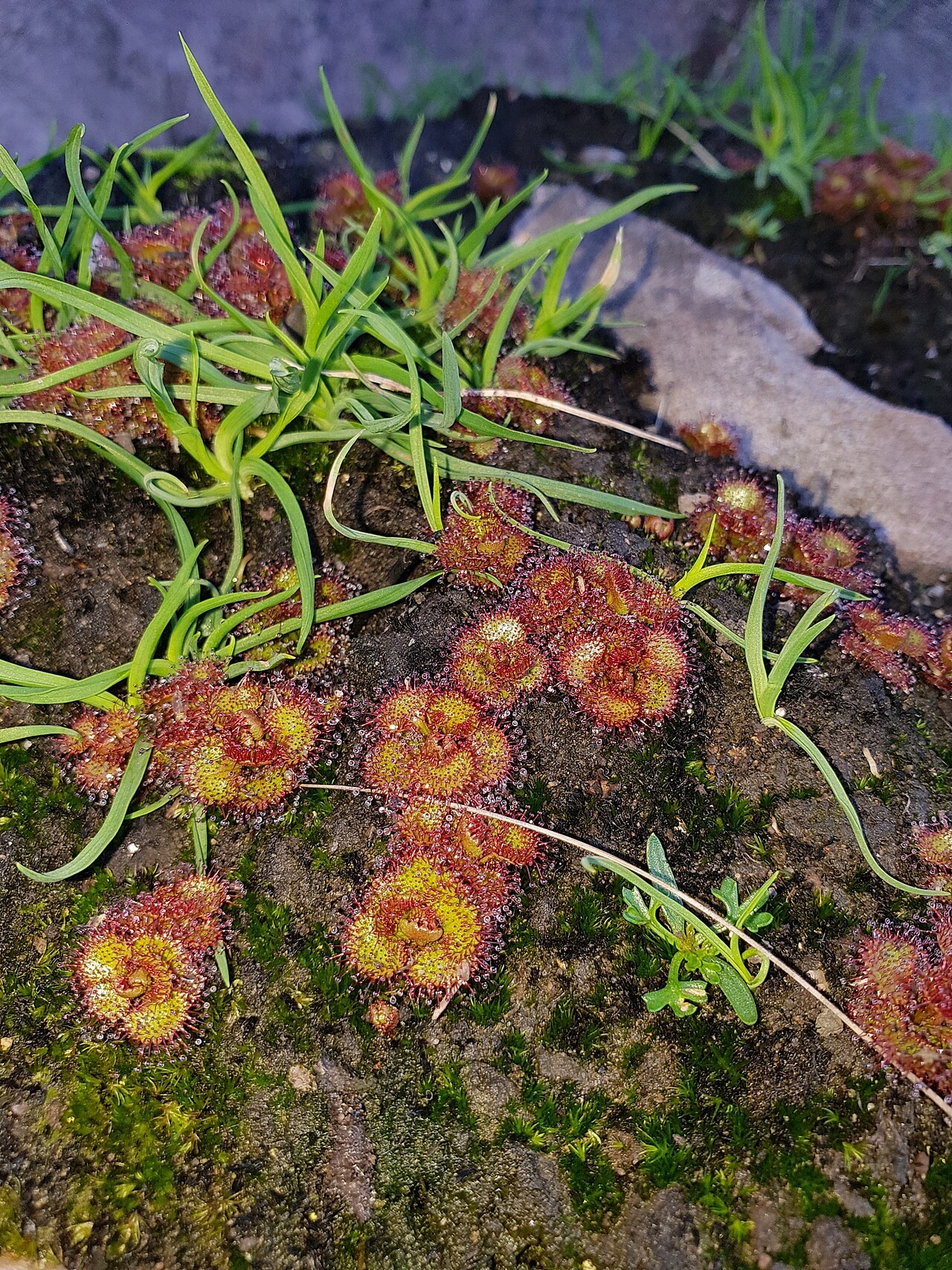
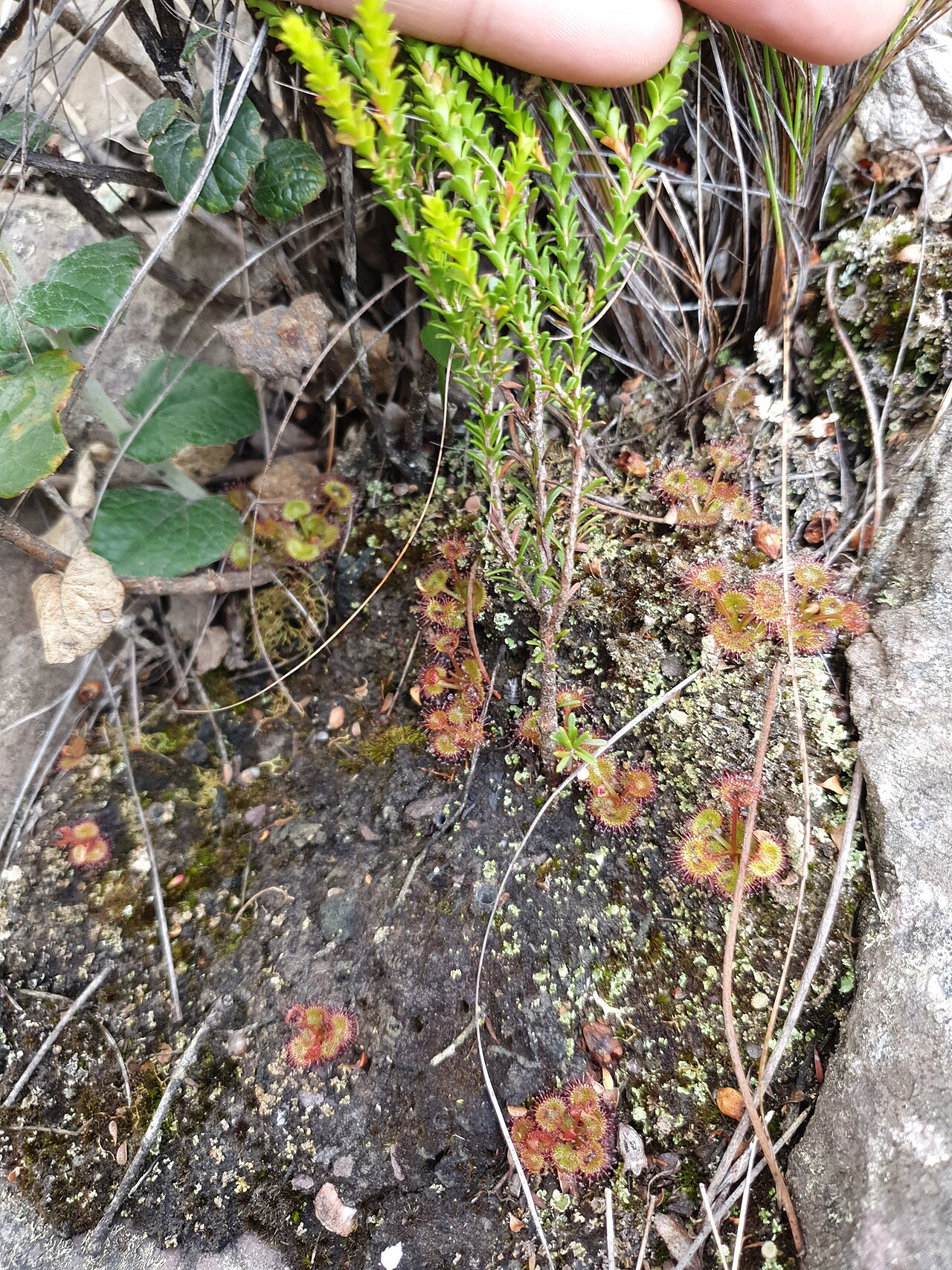
A small perennial usually 2 to 7 cm tall, rising from a bright red, globose tuber about 6 mm across. The reddish, circular trapping leaves stand in whorls around the erect stems. Unlike some relatives, the blades cannot fold around a prey item. In October and November a glabrous raceme of pink flowers appears at the top. The plant forms colonies asexually; mature seed has not yet been described.
Similar species
The closest relative is Drosera stolonifera, of which D. monticola was originally a subspecies. D. stolonifera is larger, with two to three semi-erect lateral stems 10 to 15 cm long, and grows in the lowlands and jarrah forest. Given the restriction to the summits of the Stirling Range and the small size, confusion in the field is unlikely.
The trap and how it works
An active flypaper trap. The round blades carry tentacles with a sticky droplet. An insect that lands sticks and the tentacles bend towards it, but the leaf itself does not fold around the prey, as happens in some other members of the section. The catch on the windy summits consists of small flies and other small fry.
Habitat and ecology
Loam that collects in winter on ledges and in hollows in the rock, on the summits in the cloud zone (R3, R1), among low montane heath (B5). For a south-west Australian sundew this is an exceptionally cool and moist setting, with frequent mist and in winter sometimes even snow.
Distribution and elevation
Endemic to the summits of Toolbrunup Peak and Bluff Knoll in Stirling Range National Park, in southern Western Australia. The discoverers consider it likely that the species also grows on other peaks in the range, but herbarium collections exist only from these two summits.
- Recorded (one-degree cells)
Forms and variation
Allen Lowrie and Neville Marchant described the plant in 1992 as Drosera stolonifera subsp. monticola. In 2005 Lowrie raised it to species rank, but without correct citation of the basionym, so the name was invalid. In 2011 Lowrie corrected the error and D. monticola was validly published. The species belongs to section Stolonifera.
Where and when to see it
The climb of Bluff Knoll is a popular, steep walk; the plants grow at the top and flower in October and November. Stay strictly on the track: the summits are fragile, the root rot Phytophthora cinnamomi is a serious threat in the Stirling Range, and boots carrying soil from elsewhere are its main vector. Clean your boots at the wash-down stations at the start of the track.
Conservation status
On the global IUCN Red List the species is listed as Vulnerable (VU). It is not listed in CITES. The entire known range is confined to two summits; the main risks are the root rot Phytophthora cinnamomi, which attacks the montane heath of the Stirling Range, overly frequent fires and trampling along walking tracks. A warming climate may further shrink the cool cloud zone on the summits.
Scientific name
Drosera monticola | (Lowrie & Marchant) Lowrie, 1992
The name was originally published as Drosera stolonifera subsp. monticola by Allen Lowrie and Neil G. Marchant, in Nuytsia, volume 8, p. 326 (1992). Lowrie raised the taxon to species rank in 2005 (Nuytsia 15(3): 365), but that publication was nomenclaturally invalid; the valid publication of Drosera monticola as a species followed only in 2011, in Nuytsia 21(3): 152. The holotype (PERTH 02642964) was collected from the summit of Toolbrunup Peak, in the Stirling Range, Western Australia. The collector and the exact collection date could not be established with certainty, though it is plausible that it was collected by Lowrie and/or Marchant. The name derives from Latin monticola, "mountain-dweller" (from mons, "mountain", and colere, "to inhabit") — a descriptive name matching the habitat of the type material on the summit of Toolbrunup Peak in the Stirling Range.
World Checklist of Vascular Plants (WCVP), via Plants of the World Online (POWO), Royal Botanic Gardens, Kew.